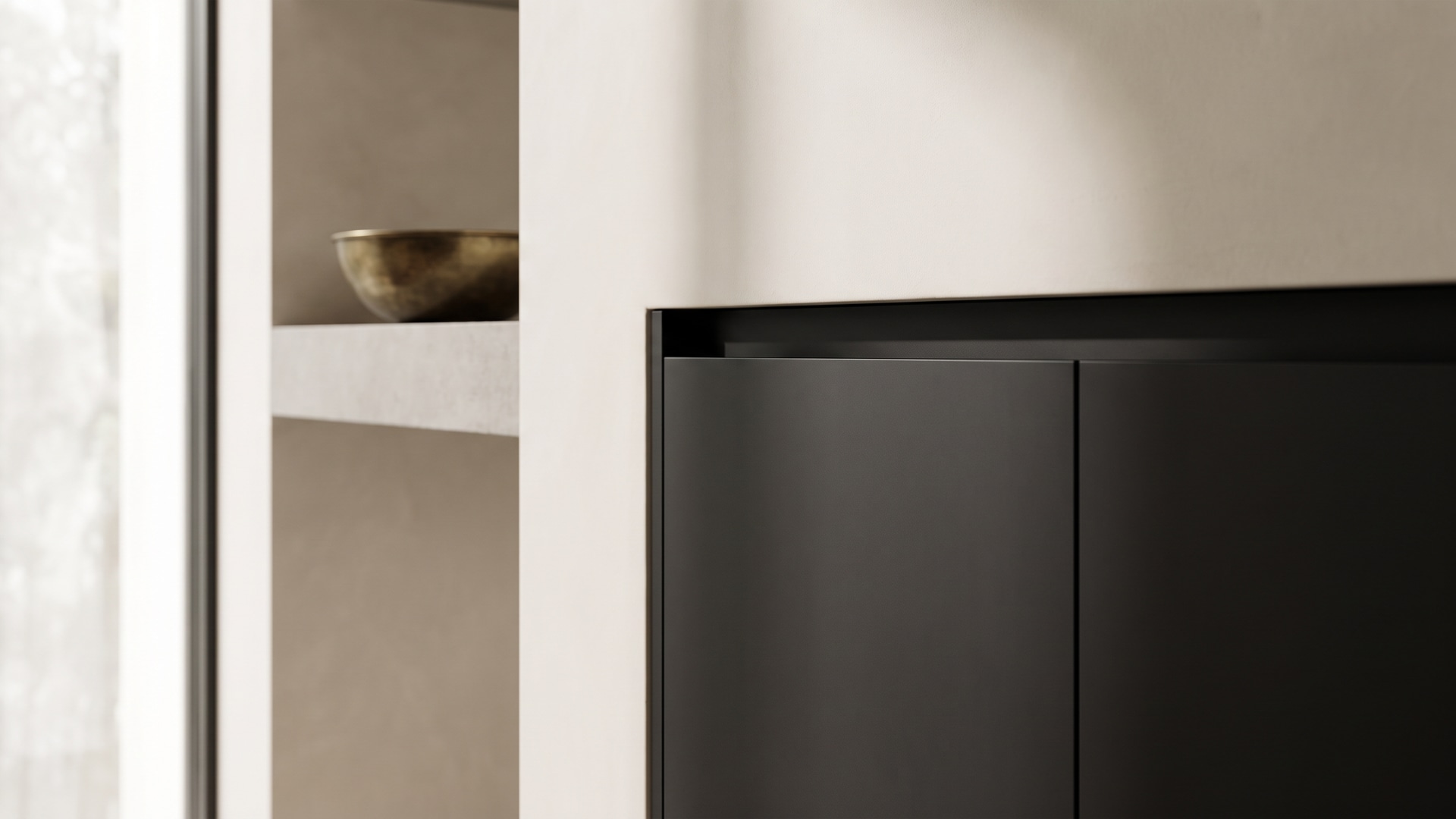
For a decade, the most requested kitchen in the country was also the hardest to live with. Clients would arrive with images of the same room: deep, moody, handle-free cabinetry in charcoal, forest green or near-black, its shutters running in unbroken planes with no hardware to interrupt them. It is a genuinely beautiful look — architectural, calm, grown-up. And in a dark matte laminate of the old kind, it was a daily disappointment, because every surface you touched kept a record of it. Fingerprints, palm smears, the faint greasy film that collects wherever hands meet a shutter — all of it showed, and it showed worst exactly where the design demanded you push: on handle-free fronts with no grip but the surface itself.
What changed is a finish, not a fashion. Super-matte and anti-fingerprint laminates took the look everyone wanted and made it survivable in a real home — cooked in, leaned on and cleaned around every day. This is a piece about that finish: what super-matte actually is, how the anti-fingerprint micro-surface does its quiet work, why designers now reach for it by default, where it belongs, and how to look after it — because matte asks for slightly different care from the gloss it replaced. None of it is complicated. But it is the whole difference between a dark, handle-free kitchen that looks immaculate in daily use and one that needs wiping every time somebody walks past.
Why the look was so hard to keep clean
To understand the fix, it helps to understand the smudge. A fingerprint is mostly oil — the natural oils and moisture your skin leaves on contact. On a smooth, glossy surface that oil sits as a thin film, and because it reflects light at a slightly different angle from the polished surface around it, your eye reads a bright, greasy print over a sharp reflection. Dark gloss is the cruellest combination of all: the darker the colour, the more a reflective surface behaves like a mirror, and the more a smudge stands out against it.
For years the only ways around this were unappealing: choose paler colours that hide marks and give up the drama, bring back visible handles so hands never touch the shutter face and give up the seamless line, or accept a lifetime of wiping. Deep, handle-free and low-maintenance behaved like a pick-two-of-three problem. India's climate did not help — through the warm, humid months skin is stickier and the hand-film heavier, so marks arrived faster and sat more stubbornly than any brochure shot in a dry studio would suggest.
What super-matte actually is
Matte is not simply the absence of gloss, and super-matte is not just “more matte” — it is an engineered surface doing a specific optical job. A glossy laminate is microscopically smooth, so it reflects light in one direction, like a mirror; that is why you see the window, the downlight and the smudge thrown back at you. A super-matte surface carries a fine, controlled micro-texture that scatters incoming light in every direction instead. Nothing bounces straight back at your eye: no bright highlight, no mirror image of the room, no sharp reflection for a fingerprint to interrupt — only a soft, velvety plane holding a deep, low-glare colour.
You can feel the difference as much as see it: where gloss is slick and cool, super-matte is faintly warm and powdery under the hand, closer to fine chalk or suede than to glass. That scattering does more than hide marks. It makes the colour read denser and more saturated than the same shade in gloss, and gives the surface the understated, expensive calm designers are really after. There is a spectrum, from a gentle matte to a true super-matte with almost no measurable sheen; the deeper the matte, the softer the light and the more forgiving the surface.
How the anti-fingerprint surface works
Super-matte solves half the problem by removing the reflection a smudge would show against. Anti-fingerprint technology solves the other half, at the microscopic scale. The same fine surface structure that scatters light also breaks up the thin film of oil a fingertip leaves behind. Rather than pooling into one glossy patch, the oil is dispersed across the micro-texture into something far too fine for the eye to register as a print. The mark is not so much repelled as rendered invisible — still, strictly, there, but with nothing for your eye to lock onto.
Many of these surfaces add a second, quietly clever property: a top layer that heals with warmth. The hairline scuffs that slowly dull a dark shutter — from a stacked plate, a ring, a dragged pan — can often be coaxed to close up with a little heat. A cloth wrung out in hot water, a palm held against the mark, or simply a warm afternoon is enough for the micro-structure to relax back towards its original state, and the scratch fades. Two honest caveats belong beside that claim. First, this recovers minor surface scratches, not deep gouges or cuts that reach the decorative layer. Second, anti-fingerprint is a resistance, not a force field: heavy grease and dried spills still need a wipe. What it removes is the constant, thankless daily upkeep, not the occasional genuine clean.
Why designers reach for it
Put those two properties together — light that scatters, oil that disappears — and a look that used to be a maintenance trap becomes an everyday default. Four reasons it now leads so many schemes:
- Dark and bold colours finally behave. Charcoal, ink blue, forest green, oxblood and true black stay looking clean in daily use, so the dramatic palettes that once punished their owners are genuinely liveable at last.
- Handle-free joinery becomes practical. Push-to-open and finger-pull shutters put hands on the surface all day. A finish that shrugs off that contact is what turns the seamless, hardware-free line from an aspiration into something you can keep.
- It reads premium and calm. The soft, non-reflective surface has a tactile, understated quality flat gloss cannot imitate: it looks considered rather than showy, and feels good under the hand — the kind of detail people notice without being able to name.
- It kills glare. In a bright, sunlit Indian kitchen, a glossy dark shutter hurls hard reflections of windows and lights straight back at you. Super-matte scatters that light into a soft, even sheen — easier on the eye, and it shows the true depth of the colour rather than a slick of reflected sky.
Where it earns its place
Super-matte is at its best precisely where hands, hard light and dark colour meet — which points it at a handful of surfaces where it does real, visible work:
- Kitchen shutters and tall units — the highest-touch, most grease-prone surfaces in the home, where an unbroken handle-free run looks best.
- Wardrobe fronts — large, uninterrupted planes where a single smudge would otherwise pull the eye across the whole room.
- Vanity units — a bathroom's most-handled joinery, often in the very moody tones super-matte flatters most.
- Any moody, minimal palette — feature panelling, a dark island, a media wall, a study — wherever the scheme leans on depth of colour rather than shine.
It is not, however, a universal answer, and specifying it well means knowing where not to. On surfaces hands rarely meet — high shelving, ceilings, the upper faces of tall cabinets — the premium buys little you will notice, and a room finished entirely in super-matte can tip into flatness. Specify it where fingers land and colour goes dark; and because we hold One India · One Price, the same sheet costs the same in Chennai or Chandigarh, so your decision stays about where the finish does real work, not about who haggles hardest at the counter.
Caring for matte is different from caring for gloss
Here is where good intentions go wrong. Most people bring habits from a gloss kitchen, and almost every one is backwards for matte. Gloss invites you to polish — buff it dry, reach for a spray that leaves a shine, attack a stubborn mark with something mildly abrasive. On super-matte all three do harm. Buffing and abrasives burnish the micro-texture smooth in patches, and a burnished patch reflects light differently from the matte around it — so you manufacture a permanent shiny mark in the act of cleaning off a temporary one. Polishes, waxes and “shine restorers” are worse: they leave a film that fills the texture and dulls it unevenly, defeating the whole finish.
The right approach is gentler and, happily, easier than fussing over gloss ever was: warm water, a drop of mild pH-neutral cleaner, and a soft or microfibre cloth — wipe, then dry with a clean soft cloth. That is genuinely all a super-matte surface asks for. A short care-and-use checklist worth taping inside a cupboard door:
- Wipe spills promptly. Turmeric, oil, tea and coffee all lift more easily before they dry — a habit worth keeping.
- Clean with mild, pH-neutral cleaner and warm water on a soft microfibre cloth. Nothing harsher is needed.
- Never use abrasive pads, scouring powders or cutting compounds. They burnish matte into uneven shine that cannot be undone.
- Skip waxes, polishes and shine-restorers. They clog the micro-texture and are the fastest way to ruin the look.
- For a stubborn mark, let a warm, damp cloth rest on it a moment, then wipe gently along the surface. Do not scrub.
- To ease a hairline scratch on a self-healing surface, apply gentle warmth — a cloth in hot water, or a warm palm — and give the micro-structure time to recover.
- Keep knives, rings and rough scourers off the face. Anti-fingerprint resists smudges, not deep cuts.
Pairing super-matte for depth
One warning follows from all of this: because super-matte is so quiet, a whole room of it can fall flat, reading as a single soft shadow with nothing to catch the eye. The instinct to fix that by adding gloss back is a mistake — it undoes the calm you chose the finish for. The remedy is not shine but texture. Set a super-matte field against a single contrasting texture and the scheme gains real depth without one reflective surface in the room.
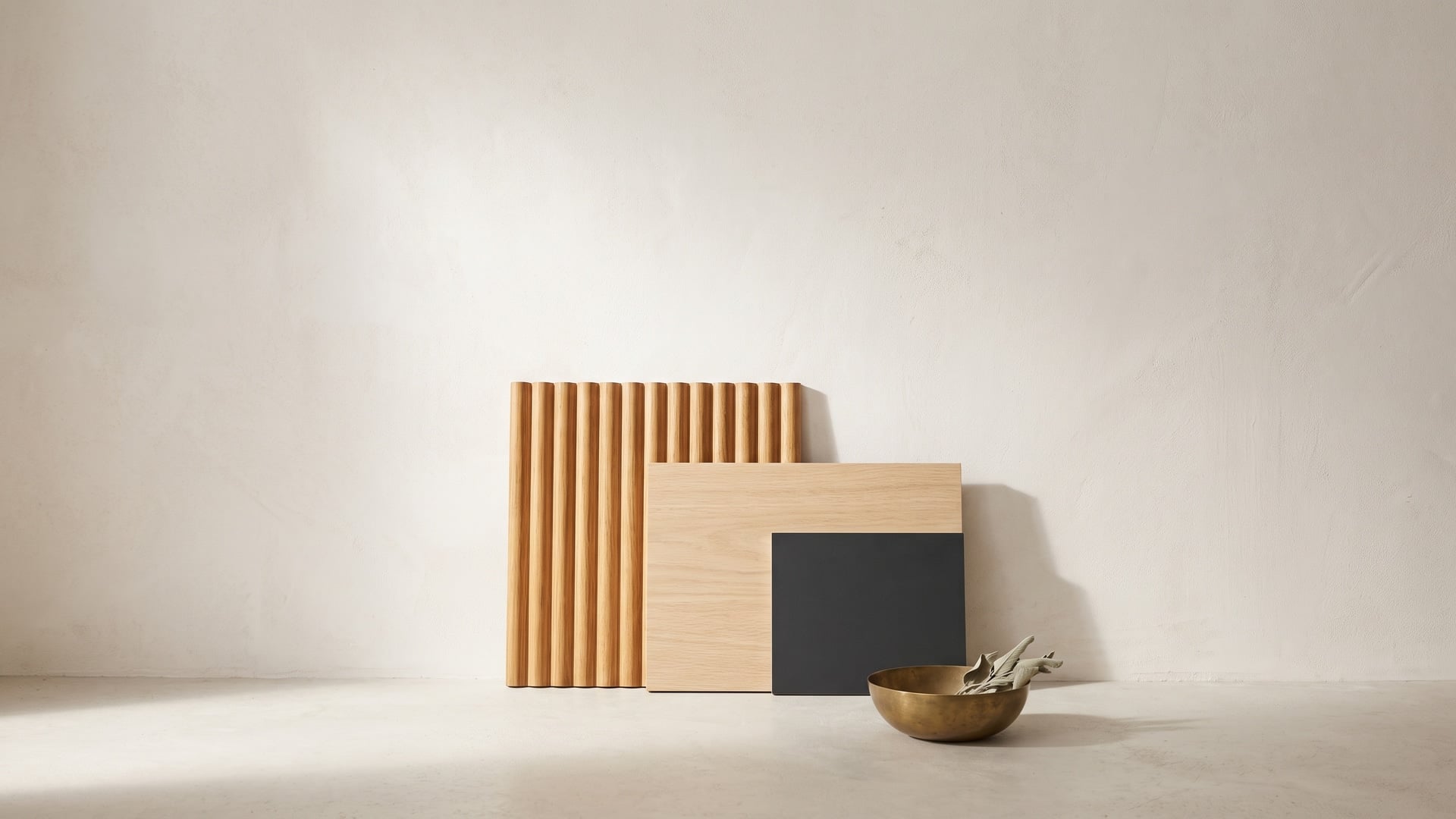
A few pairings reliably work: fluted or reeded veneer beside smooth matte shutters, so grazing light plays across the ridges while the flat planes stay serene; honed natural stone or a stone-look surface on a worktop or splashback; a stroke of brushed or matte metal on a plinth, frame or the one handle you allow yourself; or a single warm woodgrain — genuine veneer or a high-realism laminate — against the darker matte to bring grain and warmth into an otherwise solid palette. The discipline is one contrast, not three. Super-matte is the calm ground; the texture is the single note meant to read against it. Layer texture, not shine, and the depth arrives on its own.
From a high-maintenance look to an everyday one
For years, deep and handle-free was a look you admired in photographs and thought twice about at home, because you knew exactly what it would ask of you every day. The quiet achievement of super-matte and anti-fingerprint laminates is that they closed that gap. The same charcoal, handle-free kitchen that once needed wiping every time a hand reached for a cupboard now holds its composure through an ordinary Indian day of cooking, low sun and constant fingers. The finish did not make the look more dramatic — it made it liveable, which for a family that has to use the room is by far the more valuable thing.
So specify it where it counts: on the shutters, wardrobes and vanities that hands meet and colour goes dark. Care for it gently, forget everything a gloss surface taught you, and give it one honest texture for company. Do that, and the most high-maintenance look in the catalogue quietly becomes one of the easiest to keep. It is the rare trend that turns out to be plain good sense — beauty that has finally made its peace with daily life.