Walk into a plywood showroom with a room in mind and you will be shown a ladder of grades — moisture resistant at the bottom, boiling water resistant in the middle, boiling water proof and marine at the top — usually with the hint that more is always better. Resist it: the top of the ladder is not a finer version of the bottom. Each grade is built for a particular relationship with water, and specifying plywood well is simply matching that relationship to the room the panel will live in.
Grade, stripped of its jargon, answers one plain question: how much moisture will this panel meet over its life? A wardrobe in an air-conditioned bedroom and a cabinet under a kitchen sink lead completely different lives, and asking one board to serve both is how money gets wasted in the dry room and how furniture fails in the wet one. This guide walks room by room through an Indian home, matches each space to the grade it genuinely needs — no higher, no lower — and shows how to check that the board delivered is the grade on the invoice.
Grade is really a question about water
The most useful idea in the subject is that a grade describes exposure, not prestige. The letters stamped on the edge — MR, BWR, BWP — are shorthand for how much water the board can survive, from humidity in the air to hours of boiling. A higher grade is not a “nicer” board a careful buyer picks on principle; it is one engineered for wetter conditions, and in a dry room it buys performance nothing there will ever call upon.
So almost every plywood decision reduces to two questions you can ask of any panel:
- Will it ever get wet? Not “is it indoors”, but will this particular panel meet liquid water or lingering damp — splashes, spills, a leaking trap, mopped floors, monsoon humidity that never quite lifts? That honest answer sets the grade.
- Does it carry structural load? A panel holding real weight — a loft, a long loaded shelf, a bed platform — must not be allowed to delaminate, because failure there is not cosmetic. Load nudges you towards a phenolic-bonded board even when the room is dry.
Answer both honestly for each piece of joinery and the grade very nearly chooses itself.
MR, BWR and marine, in plain words
Three names cover most of what you will ever specify, and they differ mainly in one hidden ingredient — the resin that bonds the veneers together.
- MR — moisture resistant (IS:303). Bonded with urea-formaldehyde resin, MR is the economical interior workhorse: strong, stable, screw-friendly and a fine base for laminate or veneer. It handles the humidity in a room's air but not standing water or prolonged damp, when its bond slowly gives way. MR is a promise about damp air, not about liquid.
- BWR — boiling water resistant. Bonded with phenolic resin, the same family used in marine ply, BWR shrugs off humidity and the occasional splash far better than MR — the sensible middle grade for semi-wet interior work. One honest caveat: BWR has no household standard of its own the way the other two do, so treat it as marine-type bonding without the full marine certification, where the maker's integrity matters more.
- BWP and marine — boiling water proof (IS:710). Also phenolic-bonded, but certified through the demanding IS:710 regime: samples are boiled for a prolonged period without the plies letting go, the core veneers are better graded, and the board is treated against fungus, borer and termite. This is genuinely waterproof plywood, built for constant wet exposure and the outdoors.
The dry rooms, where MR belongs
Bedrooms and wardrobes. This is MR's home ground. Wardrobes, the loft above them, dressing units and storage beds live in dry or conditioned air and never meet liquid water, so a well-made MR board is entirely sufficient; marine ply here buys a defence the room will never test. The one exception is a weight-bearing loft or platform: honour the load question with a sound, thick board, though the grade can stay MR.
Living rooms and TV units. Dry again, and again MR territory: display cabinets, bookshelves, the TV console, feature panelling and interior partitions. A long shelf that sags under books is a question of thickness and support, not of grade.
Study and pooja units. Study tables, shelving and drawers sit squarely in MR's comfort zone. A pooja unit is usually dry too, but worth a thought: if it stands near an open foyer, a much-used main door or a window that lets rain in, treat it as a grey zone and step up to BWR.
Internal doors. Doors between dry rooms can sensibly use MR-grade block board or flush-door construction. Reserve the waterproof grade for the doors that face water or weather — the subject of the next two sections.
The wet zones, where waterproofing is non-negotiable
Here the calculus flips: these rooms meet water daily, and under-specifying means a rebuild, not a blemish.
Kitchen base and tall units. The base cabinets, especially anything under or beside the sink, are the most punished joinery in the house — standing damp, plumbing that eventually drips, a floor that gets mopped. This is the clearest case in the whole home for BWP marine grade (IS:710), and no place to economise. The MR-under-a-sink failure is wearily familiar: swelling, misaligned shutters, hinges losing grip, a musty core that beckons termites.
Kitchen wall and upper units. The overheads sit away from standing water but still soak up steam, heat and cooking humidity. BWR is a defensible, economical choice for upper cabinets in a well-ventilated kitchen; if the budget allows, running BWP throughout keeps the whole kitchen on one honest standard.
Bathrooms and vanities. A bathroom is a wet room by definition, and a vanity lives with splashing, condensation and near-constant humidity. Use BWP marine grade without hesitation, paired with waterproof-rated hardware. The exposure is continuous, not occasional — not a place for MR or even BWR.
Utility and laundry. Wash areas and cabinets around a washing machine or a dado sink face frequent wetting and long spells of damp. Treat them exactly like the kitchen base — BWP marine grade — and keep the carcass up off a wet floor.
Balconies, doors and the open air
Anything that faces the weather plays in a tougher league again, where sun, rain and wide swings of humidity attack together.
Balconies and semi-open areas. A covered balcony still meets wind-blown rain, morning damp and harsh sun. Built-in seating, storage or panelling there should be BWP marine grade, thoroughly sealed and finished to resist UV. Treat a balcony as outdoors that happens to have a roof.
Exteriors and outdoor furniture. Benches, planters, pergola members, gates and any panel fixed against a seepage-prone external wall demand marine grade as a baseline — IS:710, phenolic-bonded, preservative-treated. In India's climate, monsoon soaking, summer heat and ever-present termites mean nothing less will survive more than a season or two outdoors.
Main and external doors. The main door, and any door opening to a balcony, terrace or garden, must handle driven rain on one face and dry interior air on the other — a punishing gradient that warps a lesser board. These call for BWP marine-grade construction. Internal doors, as noted, can stay MR; the moment a door faces the weather, it graduates to marine.
The cost of guessing wrong in either direction
Most plywood mistakes are quiet mismatches in one direction or the other, and both cost money.
Over-specifying — buying marine ply for a dry bedroom wardrobe or a study shelf — feels like prudence but is simply waste. A BWP board's premium pays for phenolic resin, better veneers and preservative treatment that earn their keep only where water arrives; in a dry room it never does, so the extra rupees buy reassurance and nothing more.
Under-specifying is the costlier error, because it stays hidden until the board fails. An MR sheet slipped under a sink to trim a quotation looks identical on fitting day; a monsoon or two later it swells, delaminates and drags its hardware down, and the only fix is to rebuild the cabinet around it. The discipline is neither generosity nor thrift but accuracy: pay for exposure, not for peace of mind, and never save on a board that water will find. Honest pricing helps — with One India · One Price, the same sheet costs the same in Kochi or Kanpur, so the decision stays about grade and exposure, not about who haggles hardest.
Edges and cut-outs decide the outcome
One detail quietly defeats even a correct grade: a waterproof board is only as waterproof as the way it is cut, sealed and installed. Water almost never attacks the middle of a panel — it walks in through raw edges, drill holes and the sink cut-out nobody sealed. A flawless BWP sheet with an open edge in a puddle still wicks water at that edge.
Protecting those weak points is cheap and decisive. For any wet-zone joinery, work through a short checklist:
- Seal every raw edge and apply edge-banding before installation, leaving no bare core exposed.
- Silicone-seal all cut-outs — sink, hob, tap and pipe penetrations — wherever the core is opened.
- Bond wet-area joints with a waterproof adhesive, not white wood glue that surrenders once wet.
- Keep the carcass off a wet floor on leg risers, and ventilate the under-sink cavity so trapped damp can dry.
- Fix plumbing leaks promptly; a slow drip defeats any grade if left for months.
Do this and a correctly graded board delivers all it promises; skip it and even marine ply fails at the one edge water found.
Confirming the grade before you pay
A grade is only real if the board actually carries it, and the market does float loosely labelled “waterproof” sheets that meet no standard at all. Marketing words are not grades. Before you accept delivery, run through a few checks:
- Look for the ISI mark with the correct standard — IS:710 for BWP marine, IS:303 for MR — printed with a licence number, not merely the letters “ISI”.
- Read the board's own branding stamped on face and edge: a genuine sheet carries maker, grade, standard and batch details.
- Ask for the test certificate and warranty; a maker confident in the grade provides both without fuss.
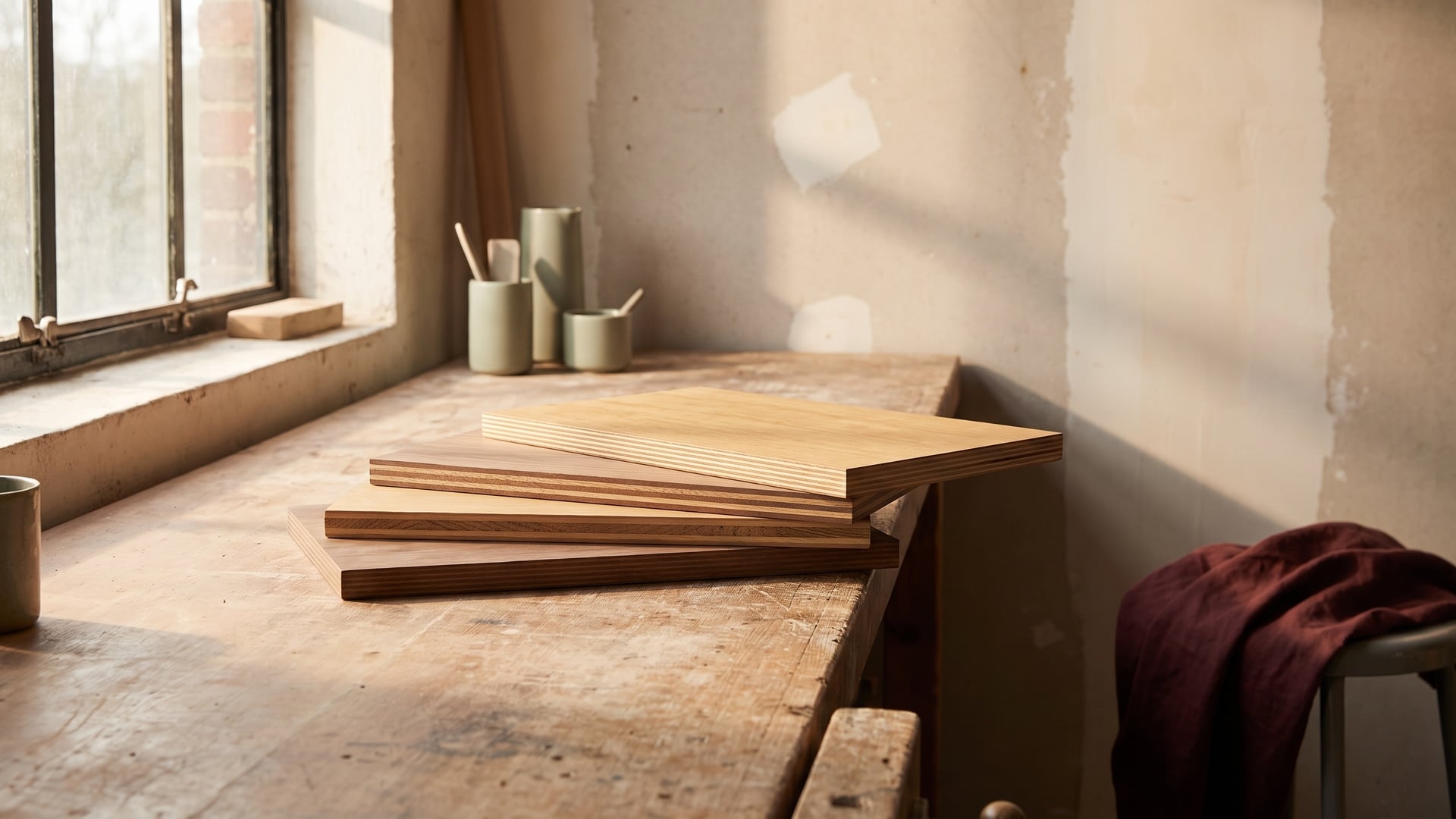
- Inspect the edge — darker, reddish-brown to near-black glue lines point to the phenolic resin of BWR and marine, while pale lines suggest MR — and look for a dense core with few internal gaps.
- Test an offcut if a claim seems too keen: boil a small piece for a few hours, and if the plies begin to part it is not genuinely boiling water proof, whatever the label says.
In a line each, the guide reads:
- MR (IS:303) — bedrooms, wardrobes, living rooms, TV units, study units and dry internal doors.
- BWR — kitchen upper units, pooja units and other grey zones near openings.
- BWP marine (IS:710) — kitchen base, bathrooms, vanities, utility, balconies, exteriors, outdoor furniture, and main and external doors.
Buy the grade the room demands
Choosing plywood well is not about buying the most protective board you can afford, nor the cheapest you can get away with. It is about reading each room honestly — will the panel ever get wet, and does it carry load — and then buying exactly the grade that answer calls for: MR where the air is dry, BWR in the semi-wet middle ground, marine where water genuinely lives, with edges sealed, joints made waterproof, and the ISI mark checked before the sheet leaves the counter.
Do that and two good things follow: your dry rooms cost no more than they should, and your wet zones last the way they were meant to, monsoon after monsoon. The board that fails is almost always the one asked to live somewhere it was never built for; the board that lasts a decade without a complaint is simply the right grade, in the right room, sealed at the edges and true to its mark. Buy the grade the room demands — no more, and no less.