Picture the first minute of a fire in a furnished room. A small flame — a shorted wire, a forgotten pan, a fallen diya — finds something to feed on. What happens next is decided far less by the spark than by the surfaces around it: the wardrobe shutters, the wall panelling, the false ceiling, the kitchen carcass. If those surfaces catch easily and carry flame quickly, a manageable incident becomes an unsurvivable room in a handful of minutes. In most Indian homes, offices and hotels, a large share of that surface area is plywood.
That is why fire-retardant plywood matters, and why we build it into our range as Firewall. It will not make a building fireproof — nothing made of wood ever is, and any honest manufacturer will say so. What it does is change how the surface behaves in those critical first minutes: it resists ignition for longer, slows flame across its face, and stops feeding the fire once the source is removed. Those differences are measured in seconds, and during an evacuation seconds are the whole currency. This article explains what actually makes a panel self-extinguishing, how to compare one fire claim against another, and — just as important — what the material cannot do on its own.
Why ordinary plywood is, in effect, fuel
Wood is cellulose, and cellulose burns. That is not a defect — it is what any organic, carbon-rich material does when hot enough. Heat an ordinary plywood panel and, well before it is visibly alight, it breaks down and releases flammable gases — a process called pyrolysis. Those gases ignite, the flame releases more heat, that heat drives more pyrolysis, and the reaction sustains itself. Once it takes hold, the panel is no longer a victim of the fire; it has become part of it.
This is why the surfaces that line a room deserve as much thought as any alarm. A standard plywood ceiling or corridor panelling can carry flame the length of an escape route, filling it with heat and smoke exactly where people need to pass. The board did nothing wrong — it behaved like the wood it is. The whole point of fire-retardant treatment is to change that default behaviour.
What fire-retardant plywood actually is
Fire-retardant plywood is ordinary plywood whose chemistry has been deliberately altered so that it resists catching, burns reluctantly, and refuses to sustain a flame on its own. The correct words are fire-retardant, flame-retardant and self-extinguishing — never fireproof. A fire-retardant panel exposed to a strong, sustained external fire will eventually char and fail; what it will not do is ignite readily, race with flame across its surface, or keep burning after the flame that lit it has gone.
That last property — self-extinguishing — is the heart of the matter. An untreated board, once alight, will smoulder and spread on its own. A well-made fire-retardant board, deprived of an external flame, quietly goes out. Everything that follows is really an explanation of how that behaviour is engineered, and of how you can tell a genuine claim from a marketed one.
Impregnated into the veneer, not painted on the surface
The single most important thing to understand about good fire-retardant plywood is where the protection lives. In a quality panel, the fire-retardant chemistry is impregnated into the veneers themselves — driven in under vacuum and pressure before the sheets are assembled and bonded — so the treatment is distributed right through the board, not sitting on its skin.
This matters enormously in practice. A surface coating or intumescent paint protects only the outer film. The first time a carpenter rips a sheet, drills a hinge cup or cuts a service hole, untreated wood is exposed — and edges and cut-outs are exactly where a fire tends to find its way in. Coatings also wear, chip, get sanded during finishing, or vanish under the next coat of paint; in a humid, monsoon climate they degrade faster still. Impregnated protection has none of those weak points. Cut it, drill it, route it — the fresh surface you expose is treated too. It is the same principle behind core-level borer and termite treatment: protection is only ever as reliable as its least protected point.
How self-extinguishing actually works
When a fire-retardant panel is exposed to heat, its treatment goes to work through three mechanisms at once, all of them aimed at breaking the self-sustaining loop that keeps wood burning:
- A protective char layer. The chemistry encourages the surface to form a thick, carbon-rich layer of char quickly. That char insulates the sound wood beneath from heat and physically blocks oxygen from reaching it, so the pyrolysis that feeds the flame slows to a crawl.
- Oxygen and fuel starvation. As the treatment decomposes it releases non-combustible gases and water vapour at the surface. These dilute both the oxygen and the flammable gases in the thin layer where combustion happens, effectively smothering the flame at its source.
- Heat absorbed, not released. The reactions that release those gases are endothermic — they draw heat out of the surface, lowering the temperature of the wood and raising the point at which it would otherwise ignite.
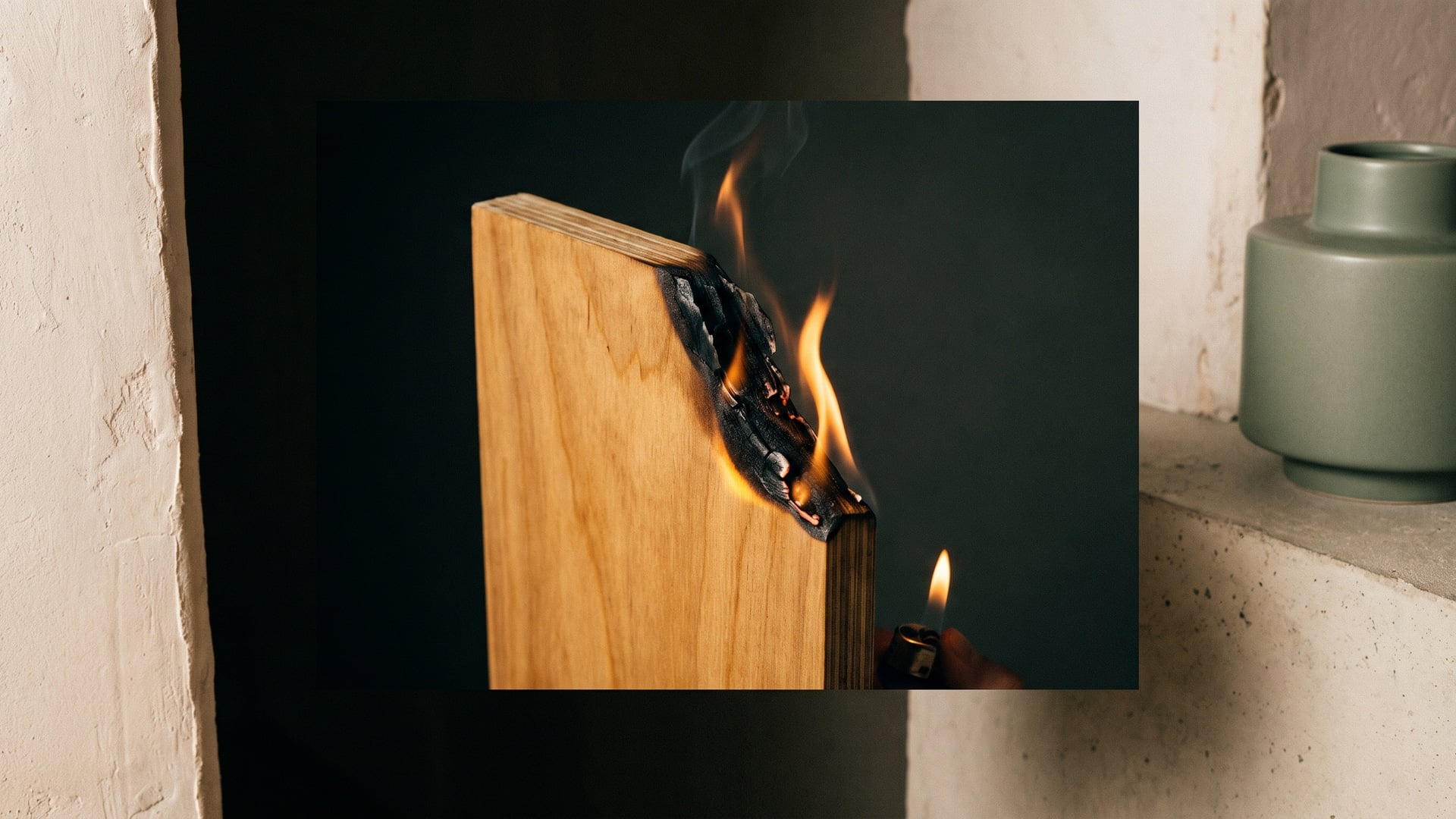
Together these effects lift the ignition temperature, slow flame spread and cut the heat the panel contributes. Remove the external flame and nothing is left to sustain combustion, so the surface stops burning instead of smouldering onward. That is self-extinguishing — a property you can test and measure, not a promise.
Flame is only half the danger: smoke and toxicity
It is tempting to judge a fire-retardant panel purely on flame, but in real building fires it is often smoke and toxic gas — not the flame front — that overcomes people first. Dense smoke blinds a corridor in seconds, so even occupants who know the building lose their way; and the gases a fire produces, carbon monoxide chief among them, can incapacitate before flame arrives. An escape route can be clear of fire and still be impassable with smoke.
This is why a serious specification looks at three things, not one: how fast flame spreads, how much smoke the material gives off, and how toxic that smoke is. A board that resists flame beautifully but pours out dense, choking smoke has solved only the smaller half of the problem. When you compare products, ask about smoke density and toxicity as deliberately as you ask about flame — during an evacuation they matter every bit as much.
The metrics and tests that let you compare
“Fire-retardant” is an adjective; a test report is evidence. The material is only ever as good as the numbers behind it, so learn the handful of measures that let you weigh boards on equal terms:
- Time to ignition — how long the surface withstands heat before it catches at all. Longer is better.
- Flame-spread index / surface spread of flame — how quickly and how far flame travels across the face. Under BS 476 Part 7, surfaces are graded Class 1 (best) to Class 4; Class 1 is what you want for linings on escape routes.
- Fire propagation index — measured under BS 476 Part 6, a gauge of how much a material adds to a growing fire.
- Rate of burning and flame penetration — the resistance measures assessed for fire-retardant plywood under the relevant Indian standard, IS:5509.
- Smoke density and toxicity — often a separate test and, as above, never to be skipped.
Two cautions. First, always read the class rating alongside its tested values — a stated class means little without the report that earned it. Second, check the report covers the actual product and thickness you are buying, not a different board from the same maker. Numbers, tied to a named standard, are the language of fire performance; adjectives are not.
Where fire-retardant plywood earns its place
Fire-retardant grades are not needed in every bedroom wardrobe, and we would not pretend otherwise. They earn their place wherever many people gather, wherever escape takes time, and wherever the occupants cannot get themselves out quickly. In Indian buildings that means, in particular:
- Kitchens and utility areas — the highest fire load in most homes and, with LPG in the room, the likeliest place for a fire to start.
- Escape routes — corridors, staircases, lift lobbies and the panelling and ceilings along them, where flame spread and smoke decide whether people get out.
- High-rise flats — where evacuation is slow by its very nature and every extra minute counts.
- Hospitality — hotels, restaurants and banquet interiors, full of unfamiliar guests and heavy fit-outs.
- Hospitals, clinics and care homes — where many occupants simply cannot evacuate on their own.
- Schools, colleges and auditoriums — assembly spaces with high occupancy and young or seated crowds.
- Offices and commercial fit-outs — especially wall panelling, partitions and false ceilings, and any public building governed by the National Building Code.
What fire-retardant plywood does not do
Honesty is part of good manufacturing, so let us be blunt about the limits. Fire-retardant plywood is one layer in a fire-safety strategy — not the strategy itself. It does not detect a fire, so it is no substitute for smoke alarms. It does not put a fire out, so it does not replace sprinklers, extinguishers or a fire brigade. And it cannot rescue a badly designed building: clear escape routes, proper compartmentation, sound electrical work, unobstructed exits and a practised evacuation plan all matter more than any board.
Think of the panel as a well-behaved participant rather than a hero. It refuses to become fuel, slows the fire down, and holds the surface together a little longer — making room for the alarms, sprinklers and exits to do their jobs. Specified in that spirit, it is genuinely valuable. Sold as a guarantee of safety, it would be a dangerous overstatement.
How to verify a fire claim: a specifier's checklist
Because “fire-retardant” is so easy to print and so hard for a buyer to see, the burden of proof sits with the manufacturer. Before you accept a claim, run through the following:
- Ask for the test report to a named standard — BS 476 Part 6 and Part 7, or IS:5509 — not merely the words on a brochure.
- Read the class and the values, not the adjective. Confirm the surface-spread-of-flame class and the actual tested figures.
- Confirm the treatment is impregnated through the veneers, not a surface coating that a cut edge or a coat of paint would defeat.
- Check the smoke and toxicity data, not only the flame results.
- Look for a genuine ISI mark against the correct IS number, with the maker's licence number.
- Match the report to your product — same board, same thickness — and keep the batch code and invoice for traceability.
- Do not sacrifice the moisture grade. A kitchen or bathroom panel still needs its boiling-waterproof (BWP, IS:710) performance; the best boards deliver fire and water resistance together rather than forcing a choice.
The real product is time
Strip fire-retardant plywood back to what it actually sells, and it is not a wall or a shutter — it is time. It cannot win a fight with a serious fire, and it does not try to. What it does is decline to join in: it resists the spark, refuses to carry the flame, keeps its smoke down, and once the source is gone quietly puts itself out. Every one of those behaviours buys seconds, and in an evacuation seconds are what people spend reaching a stair, a door, the open air.
So specify it where those seconds are worth the most — along the routes people leave by, in the rooms where fires begin, and in the buildings full of people who cannot leave quickly. Insist on the report, the class and the ISI mark, and make sure the board still meets the moisture grade its room demands. Do that, and you have added a layer that asks for nothing, shows nothing, and on the worst possible day does exactly one thing supremely well: it gives everybody a little more time.