
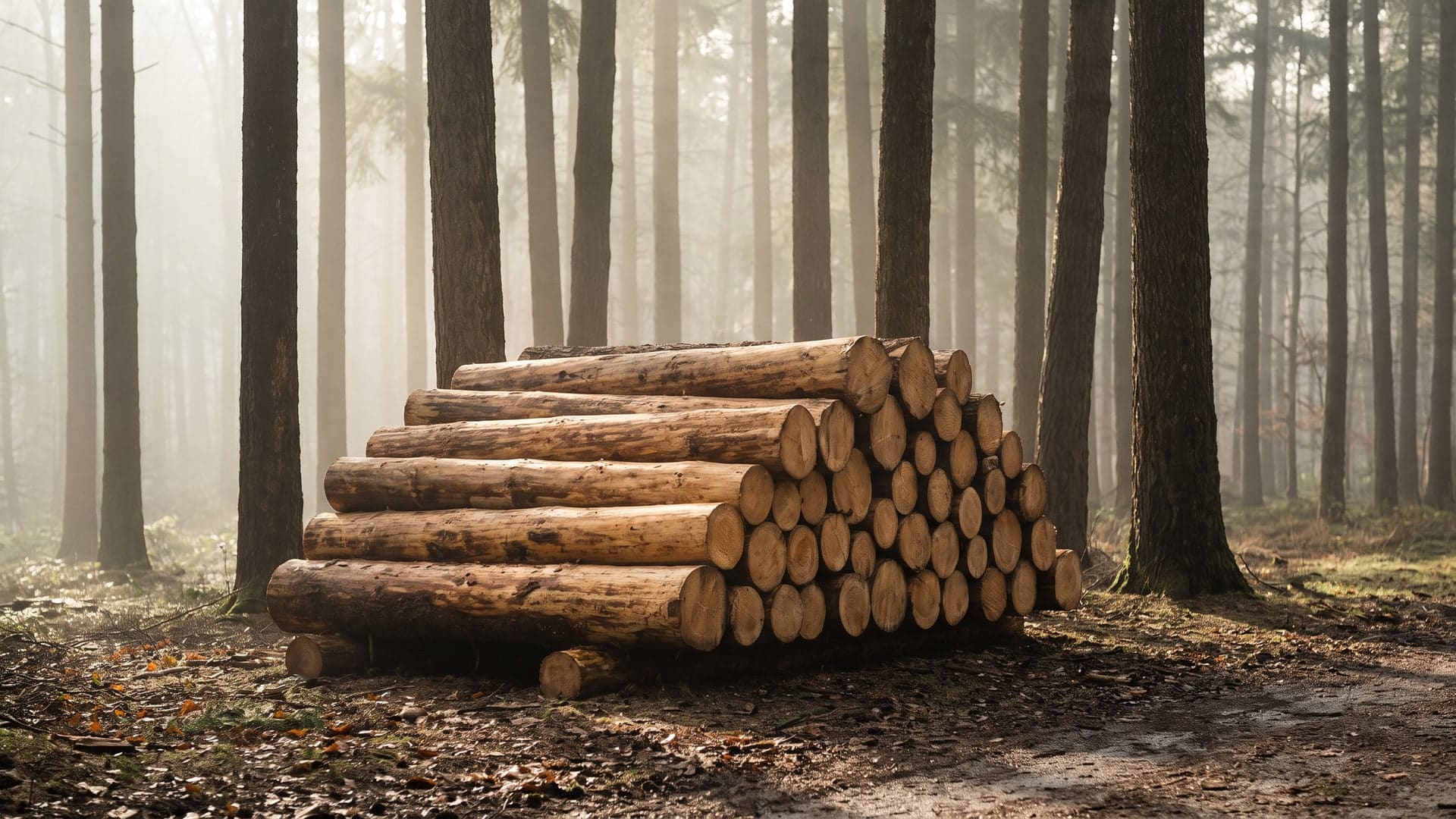
Walk any aisle of building materials and you meet the same two words on wrappers and in brochures: responsibly sourced. They appear on timber, panels, flooring and furniture, and they are meant to reassure. On their own, though, they reassure without proving anything. Two sheets of plywood can carry the identical phrase: one from a forest carefully managed to outlive the harvest, the other from a stand cleared and never replanted. The words read the same on both. Wood is unusual among building materials in that it can be genuinely renewable — but only if the forest behind it is still standing, and the phrase alone will never tell you whether it is.
This is the gap certification exists to close. A certificate does not make a board greener; it makes the claim checkable, by placing an independent third party between the seller's word and your trust. The best known of these systems is FSC, the Forest Stewardship Council, and understanding it means following a chain: from a forest managed for regeneration, through every mill and processor that touches the timber, to the finished panel in your home, each link audited along the way. This article walks that chain, explains what a well-managed forest really is, and sets responsible sourcing beside the adhesives and durability that complete the picture of a truly “green” board.
The emptiest two words in the timber trade
Few phrases in the materials world carry as much weight with as little behind them as “responsibly sourced.” Alongside “eco-friendly,” “sustainable” and “green,” it belongs to a family of adjectives that no one regulates and anyone can print. They describe an intention at best, a marketing instinct at worst.
The problem is not that the words are dishonest — often they are sincere — but that sincerity is not verification. A claim is something a seller says; a fact is something a buyer can check. Certification is the machinery that turns the first into the second, by shifting the burden of proof onto an independent body with no stake in the sale — one whose job is to inspect, audit, and withdraw its approval when the standard is not met.
What FSC certification actually is
The Forest Stewardship Council is an independent, international, not-for-profit body that sets a standard for how forests should be managed and how the timber leaving them should be tracked. It is not a government scheme and not a manufacturer's own badge, but a third party that certifies others against published rules. A comparable and credible scheme, PEFC, works on similar principles, and many boards carry one or the other.
Crucially, FSC is two certifications, not one, and the distinction is the key to the whole system:
- Forest Management certification applies to the forest itself — confirming it is harvested at a rate it can sustain, with its ecology, water, workers and neighbouring communities protected.
- Chain of Custody certification applies to everyone who handles the wood after it leaves the forest — the sawmill, veneer plant, panel manufacturer and distributor — confirming that certified material is tracked and kept separate from uncertified material at every step.
A board earns a credible claim only when both are in place: a certified forest at the start and an unbroken chain to the buyer. Manage the forest impeccably but muddle its timber with uncertified stock at the mill, and the claim collapses. Both halves are audited by accredited, independent certifiers — not by FSC marking its own homework, and not by the manufacturer.
Chain of custody, link by link
Chain of custody is the part most people have never heard of, and the part that does the real work. The idea is simple: an unbroken, documented trail, so a fibre in the finished panel can be traced back to a forest managed to the standard. Every business that takes physical possession of the timber must hold its own certificate and prove it did not quietly swap certified wood for cheaper stock along the way.
Picture a single panel's journey and the links that must each be audited:
- The forest, managed to the standard, where the harvest is planned and recorded.
- The harvesting operation, taking only what the management plan allows.
- The sawmill, keeping certified logs separate from uncertified ones.
- The veneer and processing plants, carrying that separation through peeling, drying and grading.
- The panel manufacturer, who presses the board and passes on the claim with documentation.
- The distributor and retailer, the last hands before yours.
Two features keep it honest. Every link needs its own certificate, so a single uncertified handler breaks the chain. And the system reconciles volumes: a mill cannot sell more certified board than the certified timber it can prove it bought — which stops a little certified wood laundering a lot of unknown wood under one label.
What a well-managed forest actually is
Strip away the paperwork and certification rests on one physical promise: the forest regenerates faster than it is harvested. After the cut, it is still there — still growing, still storing carbon, still home to what lived in it. That is the line between harvesting a renewable crop and mining a finite one. A forest logged faster than it recovers is not being sourced; it is being spent.
This is why a well-managed plantation is no contradiction. Natural and planted forests alike can be certified, provided each is managed to the standard. Plantations are designed from the outset as a renewable crop, planted to be harvested and replanted in cycles. India knows the model well through farm forestry and agroforestry — poplar across the northern plains, eucalyptus, and melia grown by farmers as a cash crop that feeds the plywood industry while keeping land under tree cover.
Regeneration is not the whole of “well managed,” though. A credible standard protects far more than the tree count:
- The carbon store — a standing, regenerating forest holds carbon; clearing it releases it.
- Biodiversity — high-conservation-value areas, rare species and their habitats are protected rather than flattened.
- Water and soil — catchments and soil structure are safeguarded, since forests regulate the water systems whole regions depend on.
- Workers' rights — fair pay, safe conditions and the right to organise.
- Local and indigenous communities — their legal and customary rights to the land and its resources are recognised, not overridden.
Responsible forestry, in other words, is a whole system of care, not a slogan about planting trees.
A certificate, not a logo
Here is where buyers are most easily misled. A green tree, a leaf motif and the word “eco” can be printed by anyone, on anything. A logo is decoration; a certificate is a document with a holder, a number and an auditor behind it.
A genuine FSC claim is specific in ways a decorative logo never is. It carries a licence or certificate code — the familiar FSC-C###### form — tied to a named holder whose status can be looked up in a public database. And it states an honest label type rather than a vague reassurance:
- FSC 100% — all the wood comes from certified forests.
- FSC Mix — a controlled blend of certified, recycled and rigorously checked material, declared as exactly that rather than dressed up as pure.
- FSC Recycled — made from reclaimed content.
The candour of “Mix” is the point: a real system tells you precisely what you are getting instead of hiding behind one triumphant adjective. The test at the counter is blunt — can the seller name the certificate holder and quote the code, and show a chain-of-custody certificate? If all you are offered is a logo with no number and no paperwork behind it, you are looking at a graphic, not a guarantee.
Legality and traceability
Beneath sustainability sits a floor that is easy to forget: the wood must first be legal. Illegal logging — timber taken from protected areas, over quota, or against local law — remains a real global problem, and it moves through supply chains precisely because origins are so often untraceable. A credible scheme requires legality as its baseline and then builds responsible management on top of it.
This is where chain of custody pays a second dividend: the same documented trail that proves timber is sustainable also proves it is legal and traceable to a known origin. For the buyer, traceability is quiet insurance against unknowingly paying for deforestation, and it protects a manufacturer's own supply from wood of unknown provenance. In the Indian market, where much timber is imported and certain species are additionally controlled under international agreements such as CITES, that trail is the difference between a supply chain you can stand behind and one you are merely hoping about. A traceable manufacturer, selling one consistent product across the country, is far better placed to give that assurance than an anonymous board of no fixed origin.
The fuller picture of a green board
Responsible sourcing is essential, but on its own it is one leg of a three-legged stool. A board can be perfectly certified and still be a poor choice if the rest of it is wrong; two other factors complete the picture:
- Low-emission adhesives. A panel is wood plus glue, and the glue matters to the air you breathe. Boards bonded with low-formaldehyde resins, verified to a recognised emission class such as E1 or E0 (or CARB / F-star equivalents), keep indoor air healthier. A sustainably grown board bonded with a high-emission resin has solved the forest and forgotten the room.
- Durability. The most sustainable board is the one you never have to replace. A panel that lasts decades honours the tree that made it; one that swells and delaminates in a single season wastes that tree and demands another. Choosing the right grade for the exposure, and a board built to endure, is itself an act of responsible sourcing.
Put together, a genuinely green board is grown responsibly, bonded cleanly and built to last. Miss any one of the three and the “green” label does the same over-promising work as “responsibly sourced” on its own.
A buyer's checklist
You need not be a forestry expert to buy well. A short set of questions separates a verifiable board from a hopeful one:
- Ask for the FSC or PEFC claim with its certificate or licence code, not merely a printed logo.
- Ask which label it carries — 100%, Mix or Recycled — and read “Mix” as honesty, not a red flag.
- Ask to see the chain-of-custody certificate of the manufacturer or supplier.
- Ask about the adhesive's emission class in the same breath as the sourcing.
- Match the grade to the job so the board actually lasts and need not be remade.
- Buy from a traceable manufacturer who can answer all of the above without flinching.
Met with paperwork rather than reassurance, you are buying a fact. Met with a shrug and a logo, you are buying a phrase.
Renewable, but only if the forest is still standing
Wood is one of the very few genuinely renewable materials we build with. Steel, cement, aluminium and plastic are all drawn from finite stock at a heavy carbon cost; a tree, by contrast, is grown by sunlight and can be grown again. That is an extraordinary advantage, and the reason timber belongs at the heart of a lower-impact way of building.
But the advantage carries a condition, and the condition is the whole point. Wood is renewable only if the forest it came from regenerates faster than it is cut — only if that forest is still standing, and still growing, after the harvest. Certification is simply how we keep that condition honest: a documented, audited promise that the tree in your panel was part of a cycle, not the end of one. The certificate is never the thing that matters. The standing forest is — the paper exists only to prove it is still there.