There is a particular quality to a room lined in real wood that most people notice before they can name it. They relax a little. They run a hand along the surface without meaning to. Something about the warmth of the grain — the way it catches light differently from a painted wall, the way no two boards are quite alike — settles a person in a way that a colour swatch never manages. That response is not nostalgia or sentiment. It is the subject of a fast-growing field known as biophilic design, and it rests on a simple, well-documented truth: human beings feel calmer and think more clearly when they are surrounded by natural materials and natural patterns.
As a manufacturer of plywood, veneers, laminates and doors, we find this the most encouraging shift in interiors for a generation, because it moves the natural surface from mere decoration towards genuine wellbeing. But encouragement is not a specification. The useful question for an architect, a builder or a homeowner is not whether biophilia works — the research is fairly settled — but how to bring real woodgrain indoors in a way that survives an Indian kitchen, a long monsoon and twenty years of a family living around it. What follows is our attempt to answer that honestly, surface by surface.
What biophilic design actually is
The word biophilia describes an idea older than the trend: that human beings carry an innate affinity for the living world, shaped over the long stretch of evolution we spent outdoors rather than inside boxes of concrete and glass. Biophilic design simply takes that idea seriously in a building. It is not only about adding plants, though plants help. It is about deliberately reintroducing the qualities of nature that our senses are tuned to — daylight and its passage across a day, natural materials, organic form, and the irregular patterns found in wood, stone, water and leaf.
A substantial body of research now links these qualities with measurable calm: lower stress, steadier mood, better concentration and a greater sense of ease in a space. None of this would have surprised the builders of older Indian homes, with their shaded courtyards, timber columns, stone floors and carved jaali screens that filtered light and air. Biophilic design is, in many ways, a rediscovery of what traditional architecture knew instinctively — and a chance to build it back into the flats and houses we live in now.
Why visible wood grain delivers it so directly
Of all the natural materials available to an interior, wood is the one that does the most with the least, and the reason is the grain. A length of veneer is a record of a living thing: the growth rings of slow and fast seasons, the gentle drift of the figure, the occasional knot where a branch once left. The eye reads all of this, instantly and without effort, as unmistakably natural — because it is.
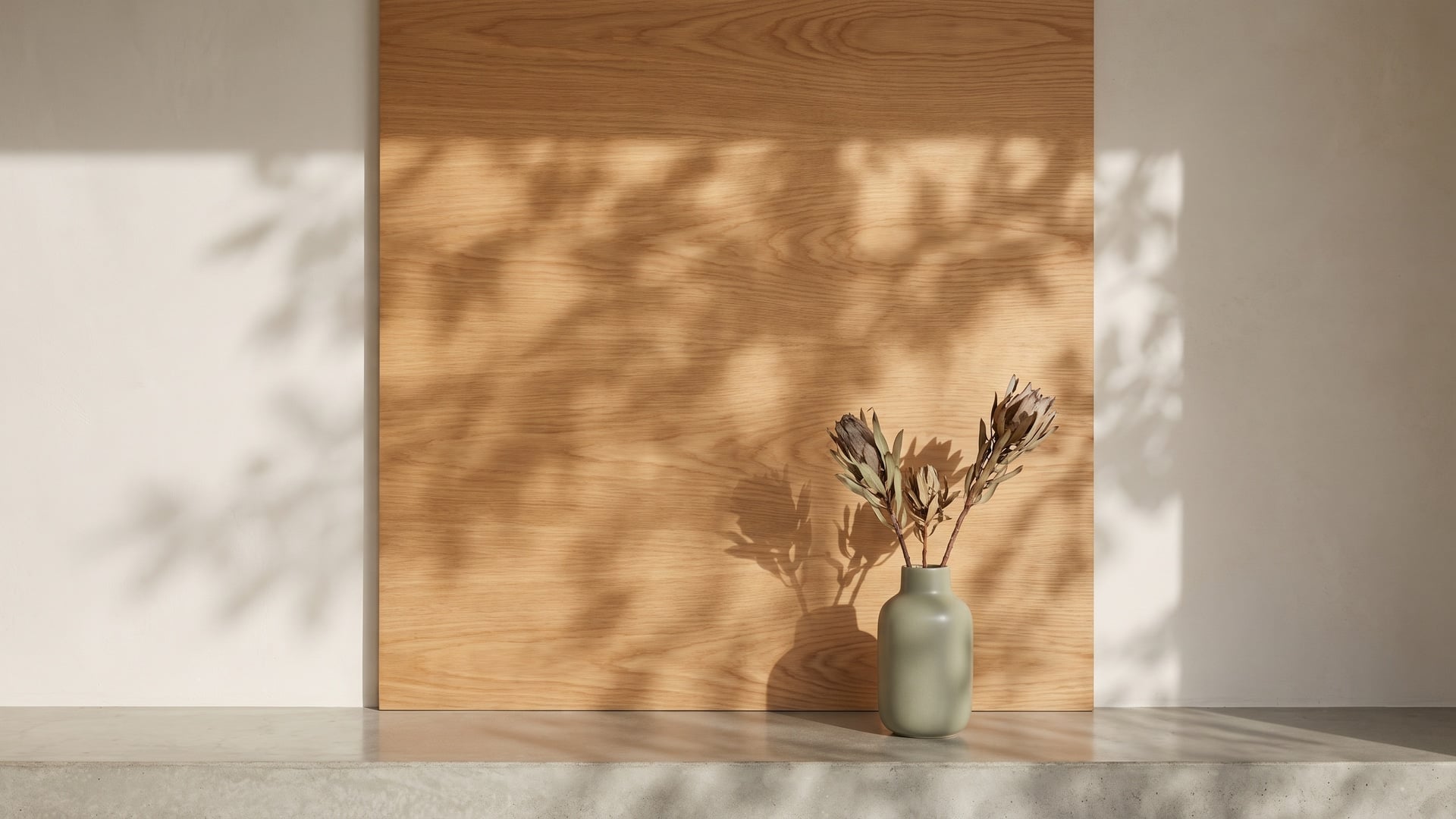
Set that against a flat, manufactured surface. A plain painted panel or a uniform solid laminate offers the eye nothing to rest on; it is even, closed and, in a subtle way, lifeless. Real grain is the opposite. Its lines are irregular and never quite repeat, carrying the same kind of soft, self-similar complexity the eye meets in bark, in stone and in the branching of a tree. That is precisely the quality biophilic design reaches for, and wood grain hands it over more directly than almost anything else we make — before you have added a single plant or opened a single window.
The two decisions that make biophilia practical
The romance of real wood runs straight into the reality of daily use, and this is where a clear head helps. We find the whole subject resolves into two honest decisions: where to spend on genuine wood, and where to let a high-performance surface carry the same look.
The first decision is to reserve real-wood veneer for the surfaces you touch and see most, and can look after — the places where character earns its keep and wear is gentle. The second is to specify high-realism woodgrain laminate on the workhorse surfaces, where heat, water, knocks and cleaning rule the day and durability has to come first. Both carry real grain into the room; they simply divide the labour honestly.
- Real-wood veneer belongs on: feature and television walls, bed headboards, dining tables, wardrobe shutters in bedrooms, study fronts and the panelling of living and formal rooms — surfaces that reward a closer look and lead a calm life.
- High-realism woodgrain laminate belongs on: kitchen shutters and tall units, the base of wardrobes, children's-room joinery, shoe racks and utility storage, and any high-traffic run that is opened, wiped and knocked a hundred times a week.
Get this division right and you spend where it shows, protect where it matters, and never ask a delicate surface to do a rough job — or pay veneer prices for a cabinet that would be happier in laminate.
The quiet power of continuity
One move does more for a biophilic interior than any other, and it costs nothing extra to plan: carry a single grain across the space. When the same warm oak or walnut flows from the kitchen shutters to the dining sideboard to the living-room joinery, the eye reads the whole home as one grounded, generous, unhurried place rather than a series of competing rooms. In a compact Indian flat, that continuity is often the difference between a space that feels calm and one that feels busy.
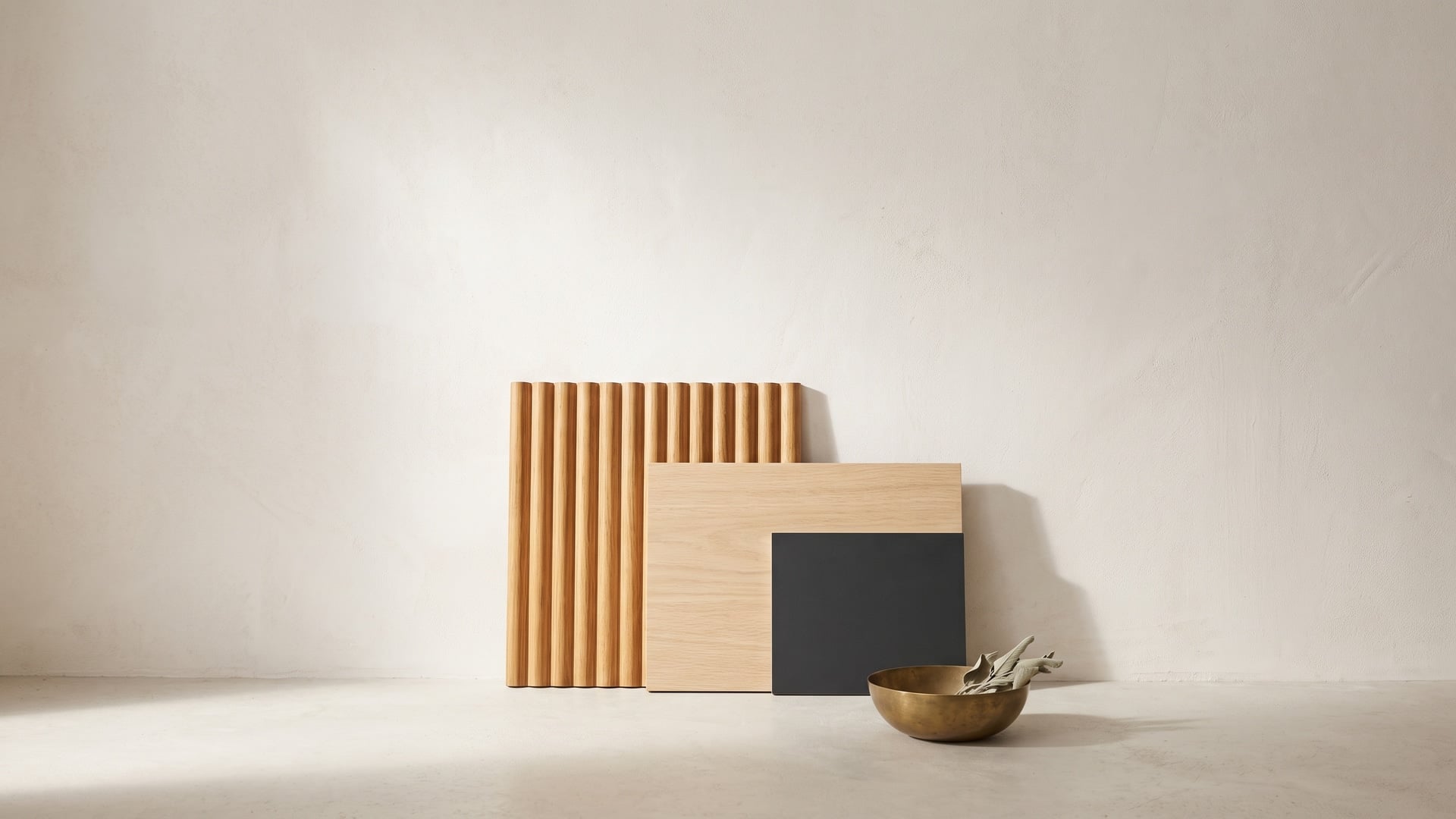
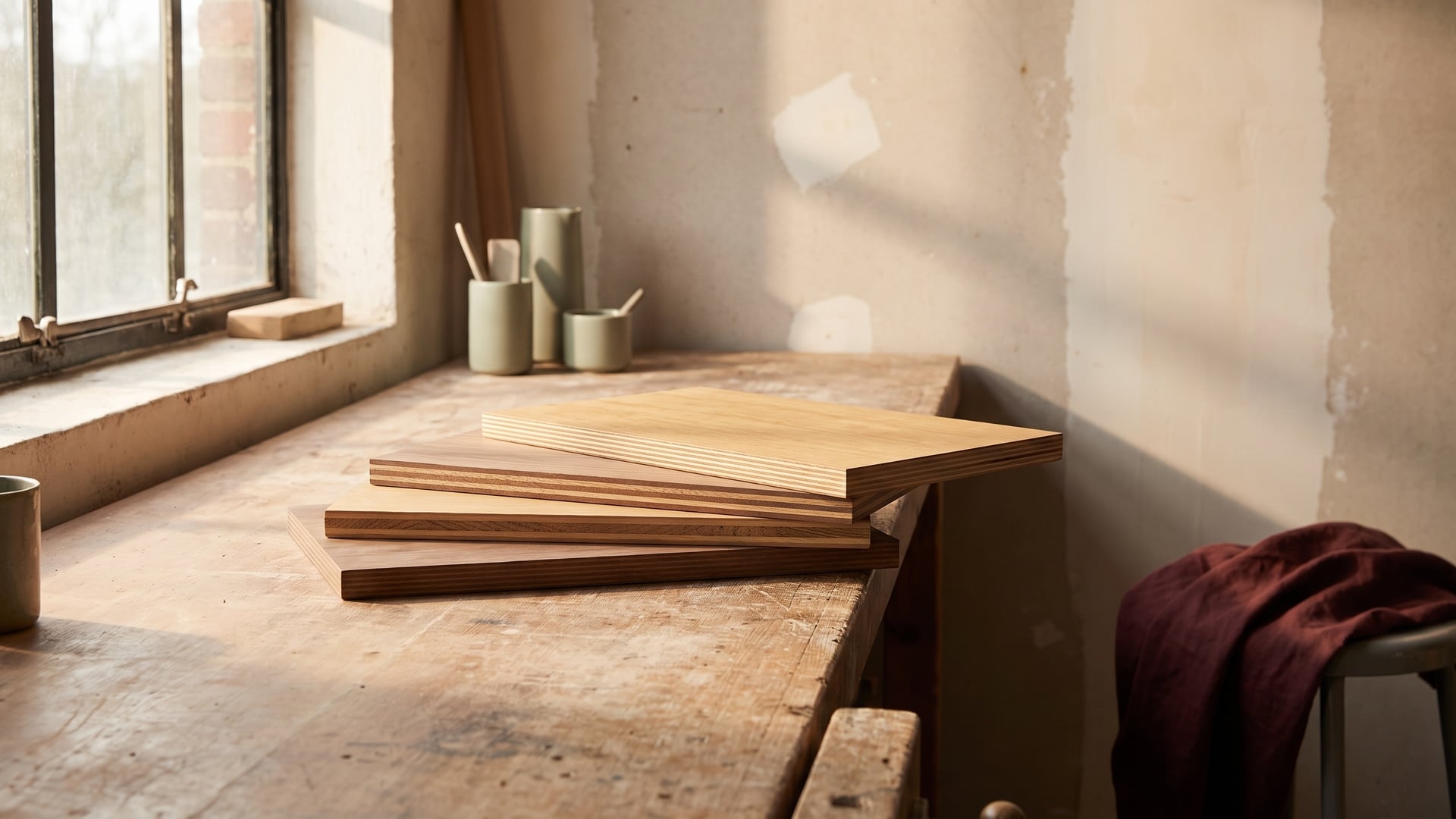
Continuity is also where veneer and laminate become partners rather than rivals. Choose a genuine veneer and a companion woodgrain laminate in the same species and tone, and the two blend into a single visual language — the veneer leading on the feature surfaces, the laminate quietly matching it on the working ones. On large veneer runs, ask for panels to be book-matched and sequenced from one batch so the grain flows across a wall rather than jumping at every join. The material does the storytelling; your job is simply to keep it speaking in one voice.
Authenticity is the whole point
Because the biophilic effect depends entirely on a surface reading as genuinely natural, authenticity here is not a luxury — it is the mechanism. This is the one place we would urge no compromise: choose real veneers and high-realism woodgrain laminates, and steer well clear of the flat, glossy printed imitations that give the whole category a bad name. The eye is not easily fooled, and the hand still less so.
What separates a convincing woodgrain laminate from a cheap one is worth knowing when you specify. Look for a decor that does not obviously repeat, so the pattern reads as a real board rather than as wallpaper. Favour a matte or textured finish over high gloss, since real wood is rarely shiny and gloss is the quickest tell of a fake. Best of all is an embossed-in-register, or synchronised, surface, where the tactile grooves you feel line up exactly with the printed grain you see, so touch and sight agree. When they agree, the brain accepts the surface as natural; when they contradict each other, the illusion collapses and the biophilic benefit goes with it.
The company good wood likes to keep
Wood grain is the strongest single move in a biophilic scheme, but it works best in company. The natural materials and conditions reinforce one another, and layering a few together turns a nice surface into a room that genuinely feels alive.
- Daylight first. Nothing flatters real grain like natural light moving across it through the day. Plan for it, and keep window treatments light and sheer so the room breathes rather than shutting the sun out.
- Living green. A few well-placed plants — even hardy, low-effort ones — restore the actual living element that the materials only suggest.
- Natural stone and clay. A stone countertop, a terracotta pot or a lime-washed wall pairs with wood the way it does in nature, each making the other feel more real.
- Honest textiles. Linen, cotton, wool, jute and cane add the soft, irregular texture that hard surfaces cannot, and round out the sensory picture.
- Warm, matte finishes. Across all of it, favour soft matte over cold gloss; scattered light reads as calm, where a mirror shine reads as manufactured.
Balancing the real with the durable
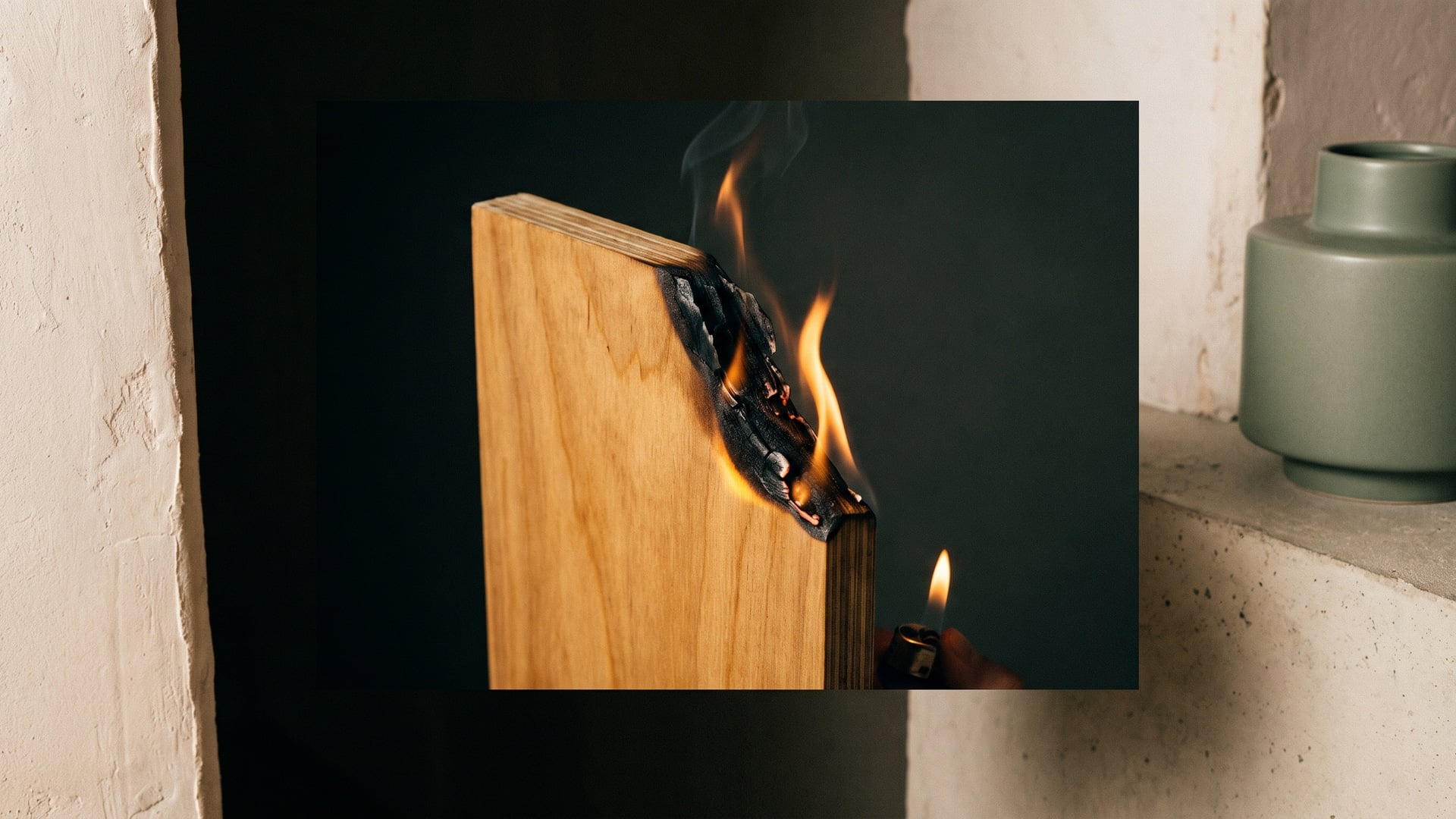
Honesty obliges us to say that real wood is a living surface, and living surfaces ask something in return. Veneer moves a little with the seasons, marks if it is treated carelessly and slowly earns a patina — which is part of its charm, but also a maintenance reality worth naming before the decision, not after. The answer is not to avoid real wood; it is to place it where it can be cared for, and to let a good woodgrain laminate shoulder the rough duty without any guilt.
Two practical habits keep beauty and durability on the same side. First, remember that what you see is only half the panel: even the finest veneer or laminate fails fast over the wrong core, so specify a boiling-waterproof (BWP, IS:710) core beneath any woodgrain in a kitchen, bathroom or other wet zone, and seal every cut edge and cut-out. Second, protect the veneer you do use with a suitable lacquer or a good wax-oil finish, and clean all these surfaces the gentle way — a soft, barely damp cloth, never a harsh scrubber or a strong solvent. Look after real wood sensibly and it will repay you for decades; a well-made laminate, meanwhile, simply keeps working.
A checklist for specifying biophilic surfaces
When you are ready to turn the idea into a specification, this short list keeps the essentials in view:
- Lead with real grain — genuine veneer on the touch-and-see surfaces, high-realism woodgrain laminate on the workhorses.
- Insist on authenticity — a non-repeating decor, a matte or textured finish, and embossed-in-register grain wherever you can get it.
- Carry one grain through — match veneer and laminate by species and tone, and book-match large runs from a single batch.
- Right core, right zone — BWP (IS:710) under any woodgrain in a wet area, with every edge and cut-out sealed.
- Layer the naturals — daylight, a few plants, stone or clay, and honest textiles alongside the wood.
- Plan the care — reserve veneer for surfaces that will be looked after, and finish it properly from day one.
Somewhere you can breathe
For all the research behind it, biophilic design is finally less a style than a feeling — the quiet sense, on walking into a room, that you can let your shoulders drop and breathe out. That feeling is not manufactured by any single product; it is assembled from daylight, greenery, natural texture and, at the centre of it, the honest warmth of real wood grain carried thoughtfully through a home. It is also not a fashion that will date, because it is really a return to something old: the way people built when the only materials to hand were the ones the living world provided. Bring real woodgrain indoors with a little care about where the veneer goes, where the laminate works harder, and how it all holds together, and you are not chasing a trend at all. You are making a place that feels, in the truest sense, like somewhere to live.