Ask anyone who has lived through an Indian summer and the monsoon that follows what they most fear for their woodwork, and the honest answer is rarely fire or even water — it is the quiet, invisible damage of borers and termites. These pests do their work out of sight, inside the board and behind the polish, and the first sign is usually the last thing you want to see: a shutter that sounds hollow when you tap it, a drift of fine powder beneath a wardrobe, or the thin mud tunnels of a termite column climbing a skirting. By the time the damage shows, the timber inside is already compromised, and the repair is seldom a simple one.
What makes the problem so costly is that modern interiors are built in. A loose chair can be carried out and replaced; a full-height wardrobe, a modular kitchen carcass or a panelled feature wall is fixed to the structure, and removing it means dismantling the room around it. That is why protection against borer and termite attack cannot be an afterthought sprayed on at the end — it has to be engineered into the panel from the very start. This article explains how a genuine two-tier preservative process works, why the surface treatments that pass for protection so often fail, and what to look for so that you are buying real security rather than a reassuring word printed on a label.
Why Indian conditions are so hard on built-in timber
Warmth and humidity are precisely what wood-destroying organisms need, and much of India offers both for most of the year. Subterranean termites live in the soil and need only moisture and cellulose to thrive; the long warm season and the damp that follows the monsoon keep them active far longer than in temperate climates. Powder-post borers, meanwhile, are beetles whose larvae feed on the starch in the sapwood of certain hardwoods, tunnelling outward and reducing the inside of a board to flour while the surface still looks sound. Coastal belts and high-humidity regions suffer worst, but few parts of the country are genuinely safe, and air-conditioned interiors — sealed, still and comfortable — can be as inviting to pests as they are to people.
It helps to understand that these are two different enemies with one shared weakness. Termites arrive from the ground, build tell-tale mud shelter tubes and hollow timber from within, often leaving a paper-thin skin over an empty core. Borers travel in the wood itself and betray themselves through small round exit holes and fine, flour-like frass. Both attack from the inside, which is why an infestation is usually well advanced before it becomes visible — and why, in built-in joinery, the loss is structural and disruptive rather than merely cosmetic. Their shared weakness is simple: neither can establish a foothold in timber that has been made genuinely inhospitable all the way through.
Why surface sprays and dip treatments fail
A great many boards sold as protected are treated only on the outside — a spray applied to the finished panel, or a quick dip that wets the two faces. Such a board looks identical to a properly treated one and costs less to make, which is exactly why the practice persists. The flaw is simple and fatal: the protection lives only on the skin. The moment a carpenter cuts the panel to size, drills a hinge cup, routs a groove or drives a screw, fresh, untreated wood is exposed at the very points pests exploit — cut edges, boreholes and the concealed backs of shutters. Every joint becomes an open door.
A dip or a spray simply cannot reach the core, so if a beetle or a run of moisture ever gets past the face, there is nothing inside to stop it. Put plainly, surface treatment protects the board while it sits on the shelf; it does very little for that board once it has been cut and assembled into furniture. Protection that only exists where you can see it is protection that disappears the instant a saw touches it.
Inside our two-tier treatment
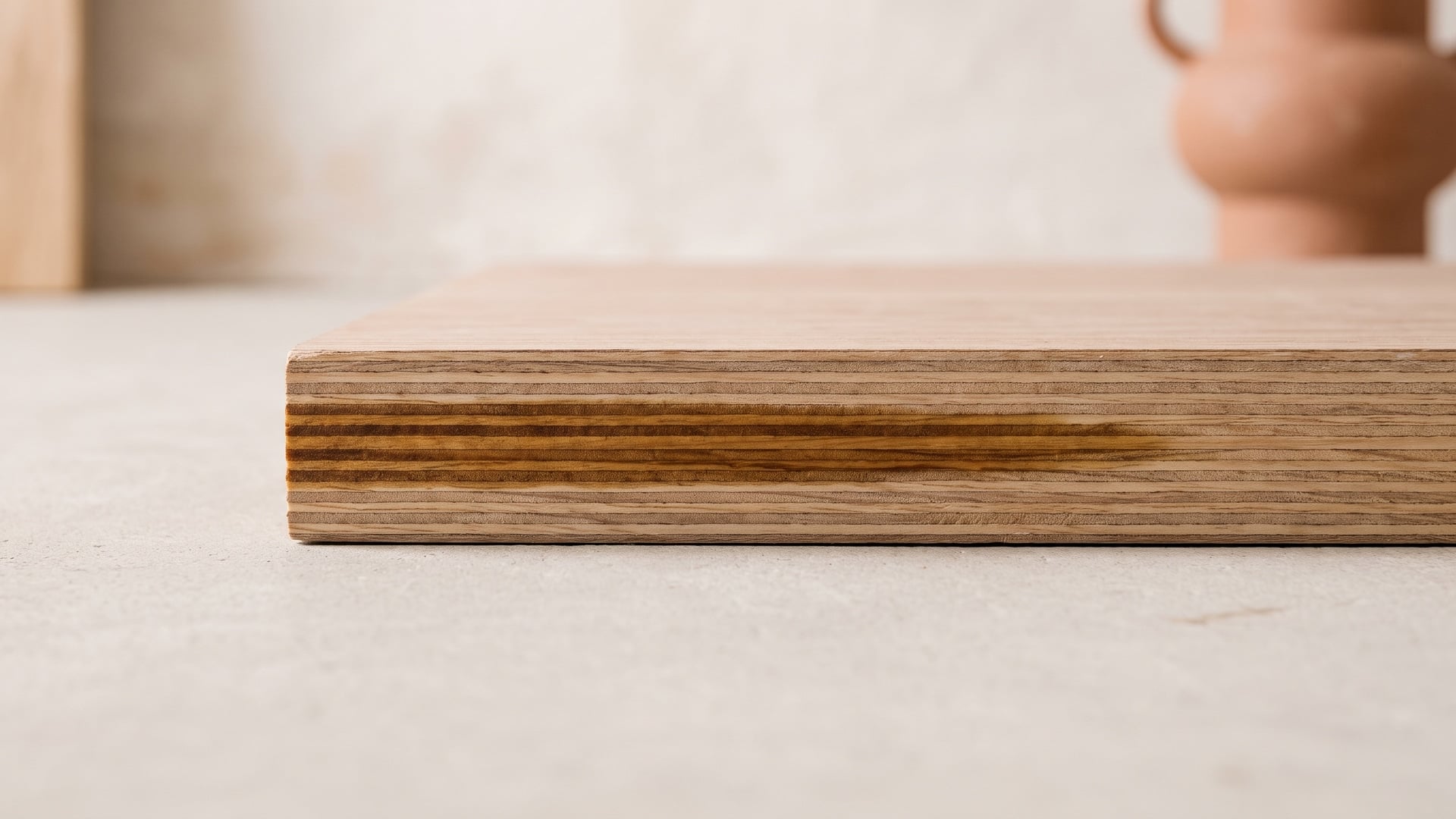
The alternative is to distribute the protection throughout the board rather than leave it sitting on the surface, and that is what a genuine two-tier process does. The first tier treats the individual veneers before assembly. Because a plywood panel is built from many thin plies, each veneer is passed through preservative so that the chemistry is carried into every layer before it is ever glued into a board. Protection is therefore present at every depth of the finished panel, not merely on the outer faces. This is the step that surface treatment can never replicate, because it happens before the board exists.
The second tier treats the finished panel after it has been pressed. Once the treated veneers have been bonded and consolidated under heat and pressure, the assembled board is treated again and cured, so that the outer surfaces and the glue lines carry protection as well. The two tiers together mean there is no clean, unprotected core waiting inside. Whichever way the board is later cut, drilled or rebated on site, the freshly exposed wood is already treated wood — the edge of a shutter, the wall of a hinge borehole, the back of a carcass panel. The pest that finds its way to any of those surfaces finds timber it cannot use.
The chemistry, in plain terms — and why it is safe at home
Described in general terms, the preservatives belong to the same broad families relied upon the world over to protect structural and furniture-grade timber. They work in two complementary ways: by making the wood indigestible to insects that feed on its starch and cellulose, and by making it a hostile place in which to lay eggs or establish a colony. The same treatment also discourages the fungi and mould that so often accompany decay in humid conditions, which matters as much in a Mumbai monsoon as termite resistance does.
The reassuring part is what happens after treatment. Once the veneers are pressed, cured and locked within their glue lines and final finish, the chemistry is fixed inside the wood — held in place, not loose on the surface and not off-gassing into the room. A well-made, fully cured treated panel is safe to live with; the intent is timber that pests will not touch inside a home that people can use freely. Paired with low-emission adhesives, the finished board contributes to healthy indoor air rather than working against it. Good preservation is not about loading a board with something harsh — it is about quietly closing the door that borers and termites need to be left open.
Reading the label and the warranty
Because a surface-treated board and a core-treated board can look identical, the proof has to be in what the maker is willing to state and stand behind. When you compare options, look past the generic “termite proof” stamp and check for the specifics that actually distinguish real protection:
- Treatment at the veneer or core level, stated explicitly — not a vague claim that could mean nothing more than a surface dip.
- A written guarantee specifically against borer and termite attack, with a stated duration and clear terms. A promise you can hold in writing is worth far more than a reassuring word from a salesperson.
- Genuine IS certification and the ISI mark against the correct standard for the grade — IS:710 for boiling-waterproof (BWP or marine) plywood and IS:303 for moisture-resistant (MR) grades. Preservative performance forms part of what these standards address.
- A traceable, consistently branded product — the kind of One India, One Price consistency that tells you the board is what it claims to be and not a look-alike carrying a borrowed name.
Remember that a warranty is only ever as good as the manufacturer behind it. A written guarantee from a maker with a genuine, traceable presence means something you can act on; an unbranded “lifetime” claim on an anonymous board usually means nothing at all.
Myths worth retiring
A few comfortable beliefs cause more borer and termite damage than any single pest, because they lead people to spend on the wrong thing. It is worth naming them plainly:
- “Treated is treated.” A surface-dipped board and a core-treated board both carry the word, yet they behave completely differently the moment a carpenter cuts into them. The claim is equal; the protection is not.
- Solid wood is automatically safer. Untreated solid timber — especially the starch-rich sapwood of many species — is a borer's favourite meal. A properly treated engineered panel frequently resists attack far better than raw hardwood does.
- Expensive or well-seasoned wood is immune. Termites do not read price tags. Warmth, moisture and cellulose are the only invitation they need, and costly timber offers all three.
- A polished surface seals pests out. Polish protects the face you see, but attack arrives through the unsealed edges, backs and joints you do not.
What still matters at site
Even the best board rewards good site practice, and a manufacturer who is honest with you will say so. Treatment engineered into the panel does the heavy lifting, but the way joinery is detailed and kept dry decides how long it stays trouble-free. The two work as a system, and neither fully substitutes for the other.
Seal every cut edge with edge-banding or a sealer so that moisture and pests find no bare timber where the panel was trimmed. Keep joinery dry as a matter of routine — fix plumbing leaks promptly, ventilate the cabinet beneath a sink, and never trap damp against a carcass. Maintain a barrier between soil and woodwork, and treat anti-termite soil treatment during construction as a complement to board-level protection rather than a replacement for it. Above all, use treated boards throughout the assembly, including the hidden backs and bottoms, because a single untreated ply tucked out of sight is the weak link that undoes everything else.
A buyer's checklist before you sign off
Before you approve a quotation or accept delivery, a short set of checks will tell you whether you are buying real protection or a hopeful label:
- Confirm the board is treated at the veneer or core level, not only on the surface.
- Ask for the written borer-and-termite guarantee in your name, and keep the document safely.
- Check the ISI mark and the correct IS number for the grade — IS:710 for BWP, IS:303 for MR.
- Specify the right grade for the exposure — boiling-waterproof for kitchens, bathrooms and any humid or coastal location.
- Insist that edges are sealed and that even concealed panels are made from treated stock.
- Buy from a traceable manufacturer, so that the guarantee is backed by someone you can actually reach.
Protection you cannot see
The irony of good preservative work is that you will never watch it doing its job. There is no finish to admire and no texture to run a hand across — only years passing without a hollow-sounding shutter or a line of powder on the floor. That invisibility is the entire point. Protection painted onto the surface announces itself and then quietly wears through at the first cut; protection driven into the core says nothing and simply holds, joint after joint, season after season. Choose the board that is treated all the way through, get the guarantee in writing, detail it well at site — and the borers and termites that shape so many Indian woodwork stories will never find the foothold they need. The best defence is the one you cannot see, because it is the one that actually lasts.