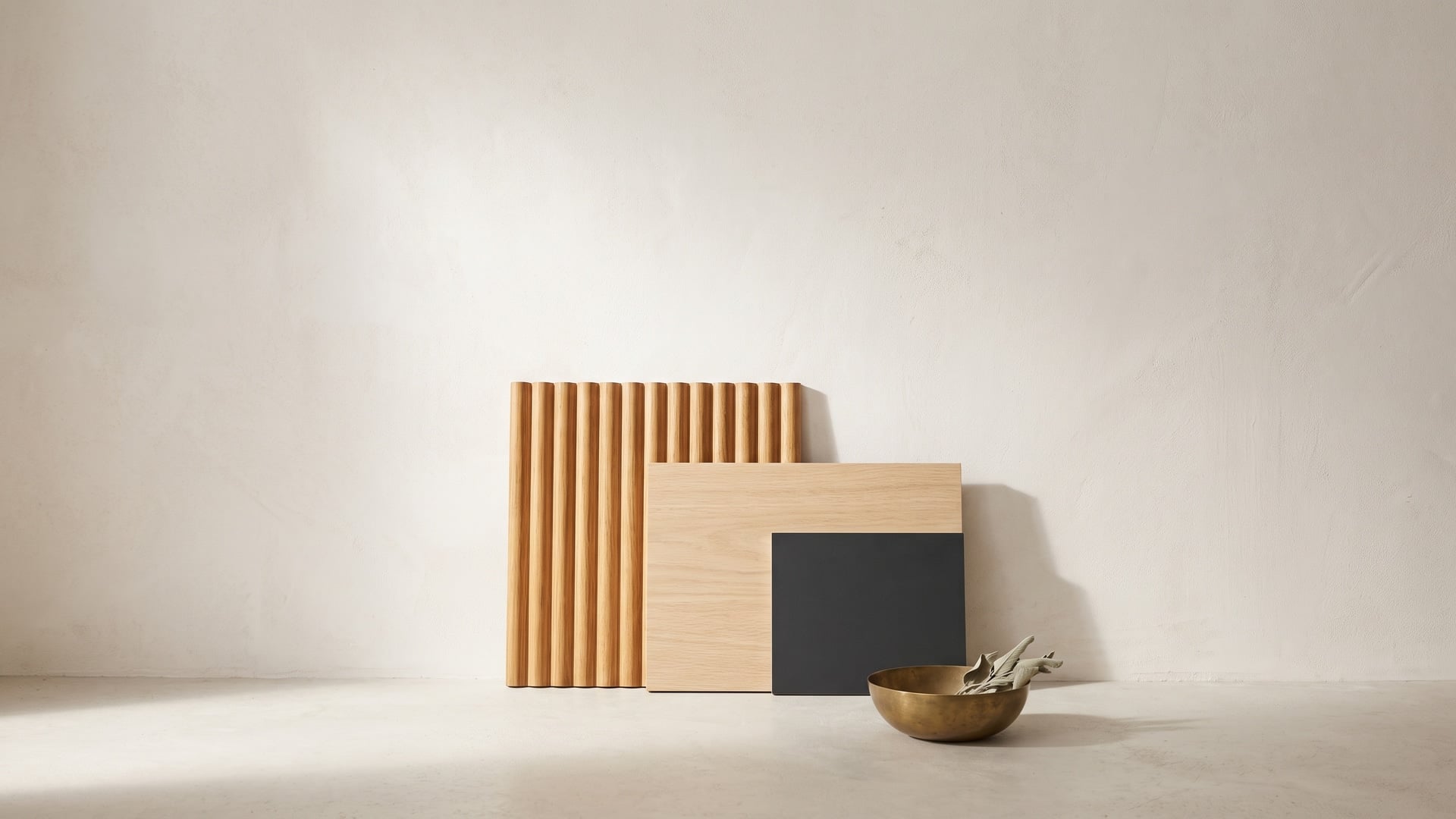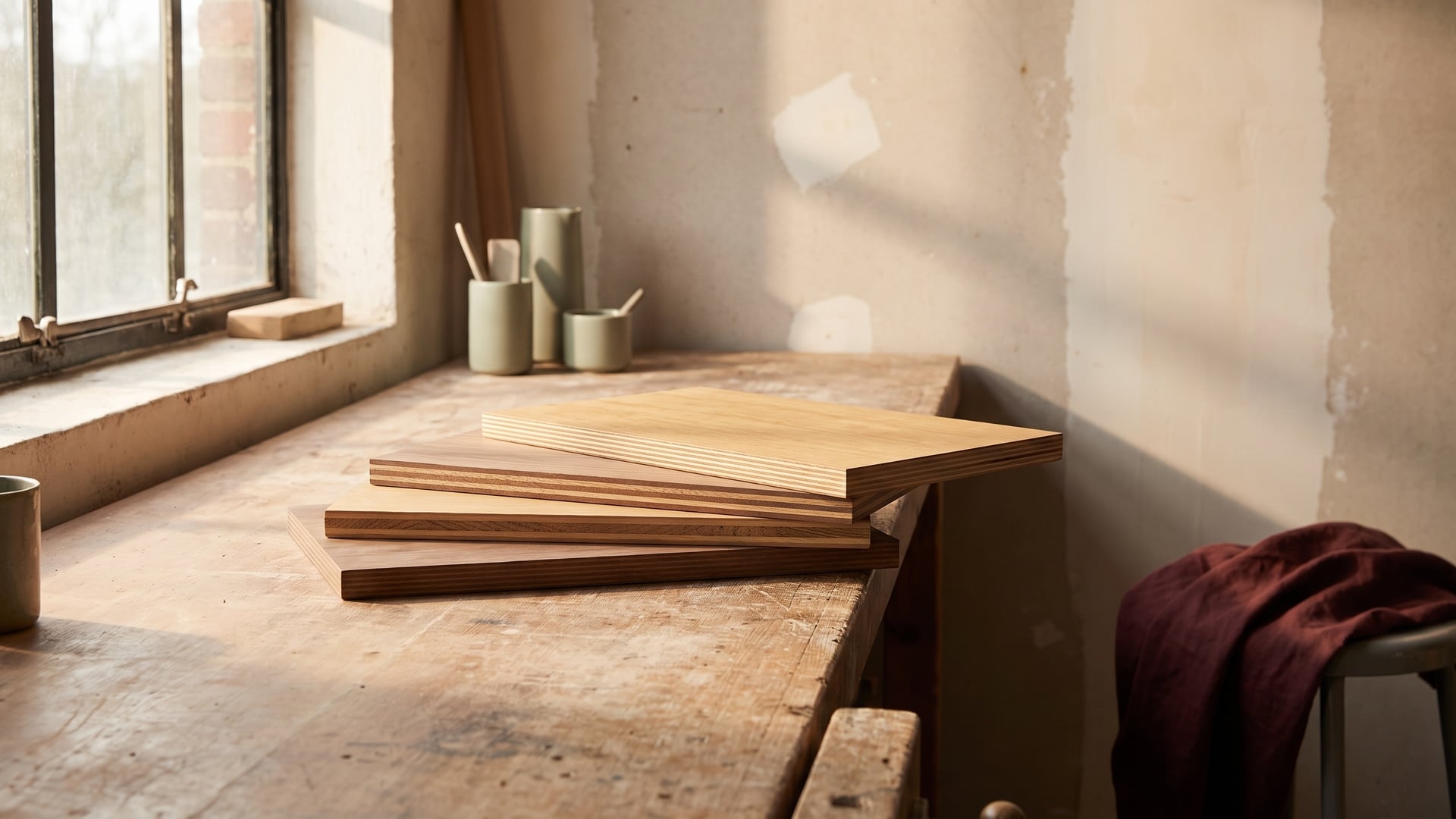
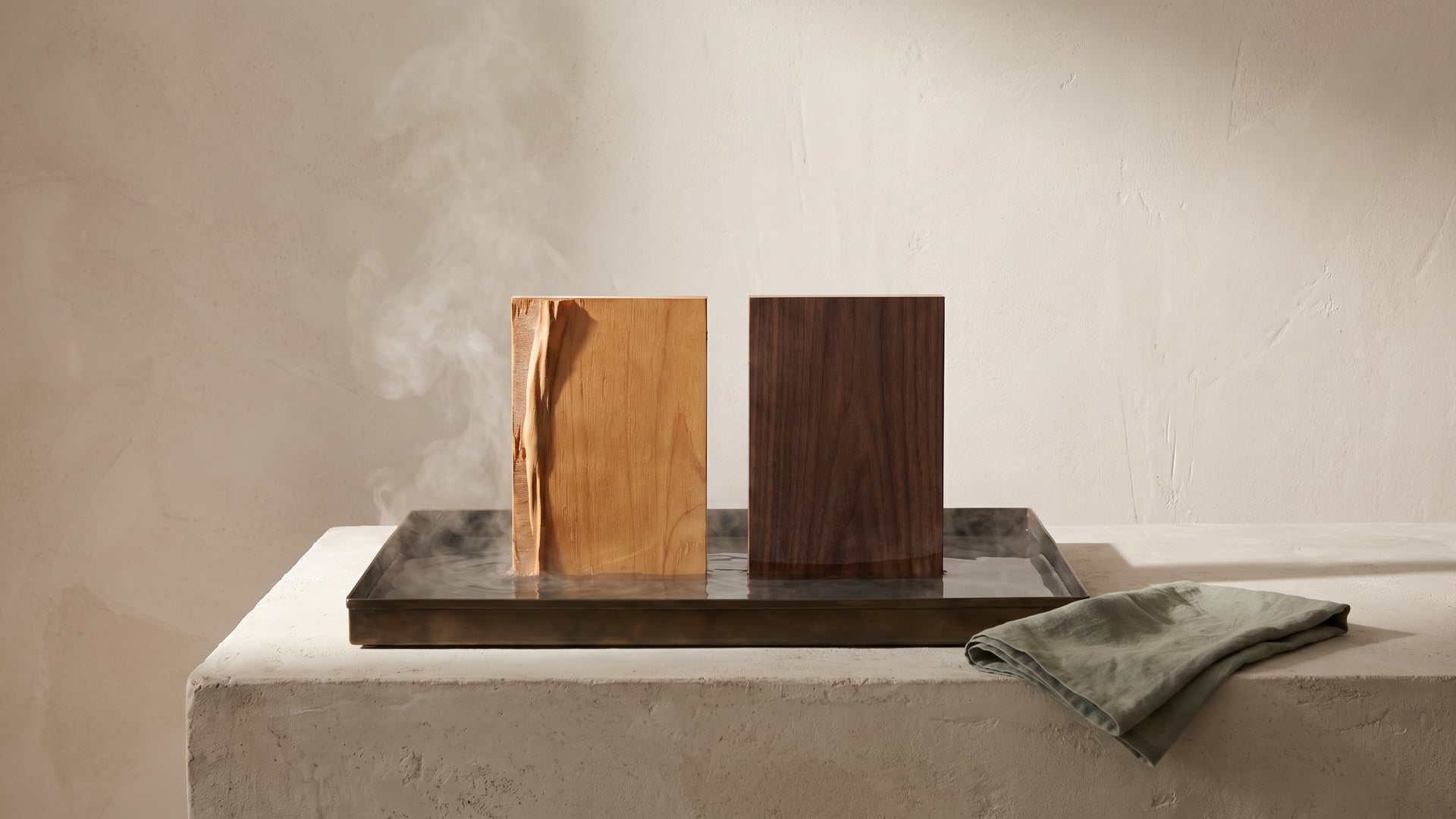
On the rack at the timber merchant, two sheets of plywood can look almost the same: similar thickness, a similar face veneer, the same smooth finish under your palm. One might cost noticeably more than the other, and it is tempting to read that gap as a brand premium or a salesman's margin. It is neither. The difference sits where you cannot see it from the outside, in the resin holding the veneers together. That single choice of adhesive is what separates a board that shrugs off a leaking sink for years from one that swells, lifts and comes apart in a single monsoon.
This is the real story behind the two terms you will hear most at the counter: MR and BWP. MR stands for moisture resistant; BWP for boiling water proof. They are not two rungs of one ladder so much as two different tools for two different jobs, defined by Indian Standards (IS:303 for MR, IS:710 for BWP marine grade) and, more fundamentally, by chemistry. Understand that chemistry and the boiling-water test that certifies it, and you will never again over-pay for a dry bedroom wardrobe or, far worse, under-build a kitchen that must live with water every single day.
The real difference is the glue, not the grain
Plywood is thin veneers of wood stacked with their grain alternating, bonded under heat and pressure. The wood in an MR board and a BWP board can be broadly comparable; what changes is the glue between the layers.
MR plywood is bonded with urea-formaldehyde (UF) resin, an economical, effective adhesive that cures to a strong, rigid bond in dry conditions. Its weakness is water: prolonged exposure to moisture slowly hydrolyses the bond, so the very chemistry that holds the plies together breaks down over time. UF resists the humidity in the air, which is exactly why the grade is called moisture resistant and not waterproof.
BWP plywood is bonded with phenol-formaldehyde (PF) resin, a thermosetting resin that cross-links into a dense, stable network as it cures. That network does not hydrolyse the way UF does; it stays intact through soaking, boiling and repeated wet-dry cycles, and it resists heat and fungal attack too. This is why marine and exterior plywood is built on PF, and why a BWP board carries a premium: PF resin and the tighter manufacturing it demands cost more. You can often read the difference at the edge, where PF glue lines tend to be darker, a reddish-brown to near-black, while UF lines are paler.
Inside the boiling-water test
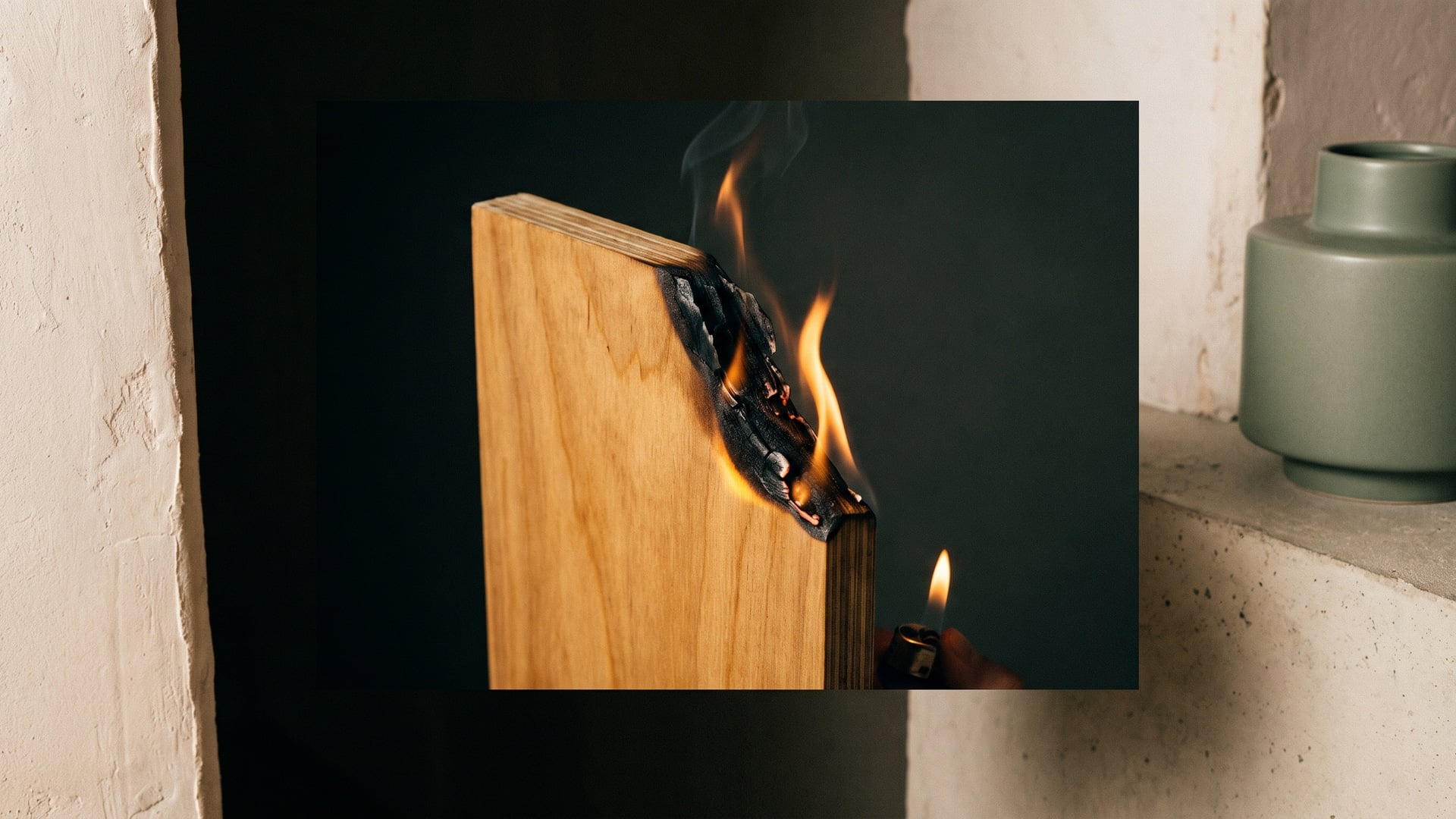
"Boiling water proof" is not a marketing flourish; it names an actual test. To be certified as marine grade under IS:710, sample pieces cut from the board are immersed in continuously boiling water for an extended, standard-specified period, commonly cited as around 72 hours. They are then dried and examined. The plies must not delaminate, and the glue line must retain its shear strength, meaning the bond between veneers has to survive being cooked in water for roughly three days without letting go.
IS:710 asks more than the glue alone can answer. Marine-grade boards also face a mycological test for resistance to fungal and microbial attack, and the standard demands better-quality core veneers with fewer gaps and overlaps, plus preservative treatment against borer and termite. The boiling-water test is really a proxy for the whole package: if the bond can take days of boiling, the everyday reality of a damp kitchen or a monsoon-soaked exterior holds no fear for it.
MR grade under IS:303 is tested too, but far more gently: usually resistance to cold water and humidity rather than prolonged boiling. That is the honest measure of the gap between them. MR is verified to cope with damp air; BWP is verified to cope with water itself.
What MR grade is genuinely good for, and where it stops
None of this makes MR a poor product. Used where it belongs, MR plywood is an excellent, sensible choice, and reaching for marine grade everywhere is money spent where no water will ever test it. In a dry interior, a well-made MR board is strong, stable, holds screws well and takes laminate or veneer beautifully.
MR is at home in bedroom wardrobes, living-room TV units and display cabinets, study tables, bookshelves, headboards, dry wall panelling and interior partitions: furniture that lives in conditioned or naturally dry rooms and only ever meets the humidity in the air. Its limit is equally clear. MR is not built for standing water, repeated splashing or prolonged damp. Put it where water collects or lingers and the UF bond begins its slow surrender. The grade name is a promise about air, not about liquid, and the trouble starts the moment that distinction is ignored.
How MR fails when it meets water
When MR plywood is pressed into wet-zone duty, the classic case being a kitchen base unit under the sink, the failure is rarely sudden. It creeps, and it usually arrives as a sequence:
- Swelling. The veneers drink up moisture and the board thickens, especially at the bottom edge sitting on a damp floor. Shutters stop aligning, drawers bind, and doors no longer close flush.
- Delamination. As the UF bond hydrolyses, the plies separate. The board loses its rigidity and starts to feel spongy or hollow when tapped.
- Edge lift and blistering. Raw or poorly sealed edges wick water first, so the laminate or veneer lifts and bubbles along the edges and around cut-outs long before the middle of the panel shows anything.
- Screw and hardware failure. A swollen, softened core cannot grip. Hinges loosen, handles pull out, and heavy shutters sag under their own weight.
- Warping and odour. Uneven moisture bows the panel, and a persistently damp, degrading core invites fungal growth, a musty smell and, with the board softened, easier access for termites and borers.
By the time these show, the fix is usually replacement rather than repair, and the saving made at purchase is spent several times over in ripping out and rebuilding.
The cost difference, and when it earns its keep
BWP does cost more than MR, and the reasons are legitimate rather than arbitrary: costlier PF resin, better and more tightly graded core veneers, preservative treatment and stricter quality control all add up. The mistake is to treat that premium as either always worth it or always a rip-off. Neither is true.
The right frame is simple: pay for exposure, not for reassurance. Marine grade for a bedroom wardrobe that will never see a drop of water buys nothing you will ever use. MR for a bathroom vanity or an under-sink cabinet is a false economy you will repay with interest when it fails. Match the grade to the genuine water exposure of each location and the premium lands exactly where it does real work. A transparent manufacturer helps here: with One India · One Price, the sheet costs the same in Kochi or Kanpur, so your decision stays about grade and exposure, not about who is haggling hardest at the counter.
A room-by-room guide to choosing
Rather than decide board by board, decide by zone. The question is never "which is better" but "how much water will this piece actually meet?"
- Use BWP (IS:710): kitchen base and tall units, and anything under or beside the sink; bathroom vanities and shutters; utility, wash and dado areas; exterior doors, shutters and gates; pergolas, planters and outdoor furniture; any panel fixed against an external wall prone to seepage; and structural or load-bearing work where failure is not an option.
- Use MR (IS:303): bedroom wardrobes and lofts; living-room TV units, display and storage cabinets; study tables and bookshelves; bed frames and headboards; dry wall panelling and interior partitions; and false ceilings in dry areas.
- Think twice in the grey zones: pooja units and foyer consoles near an open entrance, and almost everything in a coastal or high-humidity home (Mumbai, Goa, coastal Kerala and the like), where ambient moisture is relentless. When in doubt in a humid climate, step up to BWP.
The joints and cut-outs everyone forgets
Here is the part that undoes even good decisions: a BWP board is only as waterproof as the way it is fabricated and installed. The face may be sealed by laminate, but every drill hole, sink cut-out, plumbing penetration and raw edge is an open door to the core. Water rarely attacks the middle of a panel; it walks in through the edges and the holes.
Two things protect those weak points: sealing, and the right adhesive. Cut edges should be sealed and edge-banded rather than left raw; sink and hob cut-outs should be sealed with silicone around the opening; and joints in wet areas must be made with a waterproof adhesive, a phenolic, polyurethane or comparable synthetic resin rated for wet conditions, never an ordinary white wood glue that gives up the moment it stays wet. A short checklist for any wet-zone joinery:
- Seal every raw edge and band exposed edges before installation.
- Silicone-seal all cut-outs: sink, hob, tap and pipe penetrations.
- Bond wet-area joints with a waterproof adhesive, not standard PVA wood glue.
- Keep the board off a wet floor on leg risers, and leave the under-sink cavity ventilated so trapped damp can dry.
Checking the grade at the counter
A grade is only real if the board actually carries it, and the market does see loosely labelled "waterproof" sheets that meet no standard at all. Marketing words are not grades. Before you buy, run through a few checks:
- Look for the ISI mark with the correct standard (IS:710 for BWP marine grade, IS:303 for MR), printed with a licence number, not merely the letters "ISI".
- Check the board's own branding stamped on the face and edge: a genuine sheet carries the maker, grade, standard and batch details.
- Ask for the test certificate and warranty. A manufacturer confident in the grade will provide both without fuss.
- Read the edge. Darker, reddish-brown to black glue lines point to PF resin; look too for a dense core with few internal gaps or overlaps.
- Test an offcut. Boil a small piece for a few hours; if the plies begin to separate, it is not genuine boiling water proof, whatever the label says.
Set side by side, the two grades line up like this:
- Adhesive. BWP uses phenol-formaldehyde, stable in water; MR uses urea-formaldehyde, which breaks down with prolonged moisture.
- Standard. BWP is IS:710; MR is IS:303.
- Water test. BWP faces continuous boiling immersion; MR faces cold-water and humidity resistance.
- Right for. BWP suits kitchens, baths, exteriors and structural work; MR suits dry interior furniture.
- Termite and fungus. BWP is treated and more resistant; MR is more vulnerable once damp.
- Cost. BWP is a genuine premium; MR is economical.
Water always finds the weakest board
If there is one principle to carry out of all this, it is that water is patient and thorough. It never tests the strong part of an installation; it finds the weakest board, the unsealed edge, the cut-out someone forgot to silicone, the cheaper sheet slipped in under the sink to shave a little off the estimate. In India's climate of long monsoons, heat that drives moisture in and out of everything, and termites waiting for a softened core, that weakest point decides whether a piece of furniture lasts a decade or swells out of shape in a single season.
The reassuring part is that none of the defences are complicated. Choose the grade by honest exposure, not by habit or by price alone. Spend on BWP where water genuinely lives, and use MR freely and confidently where it does not. Seal the edges, waterproof the joints, and verify the mark before the board ever leaves the counter. Do that, and you will never be the one explaining why the wet-zone board was the weak one.