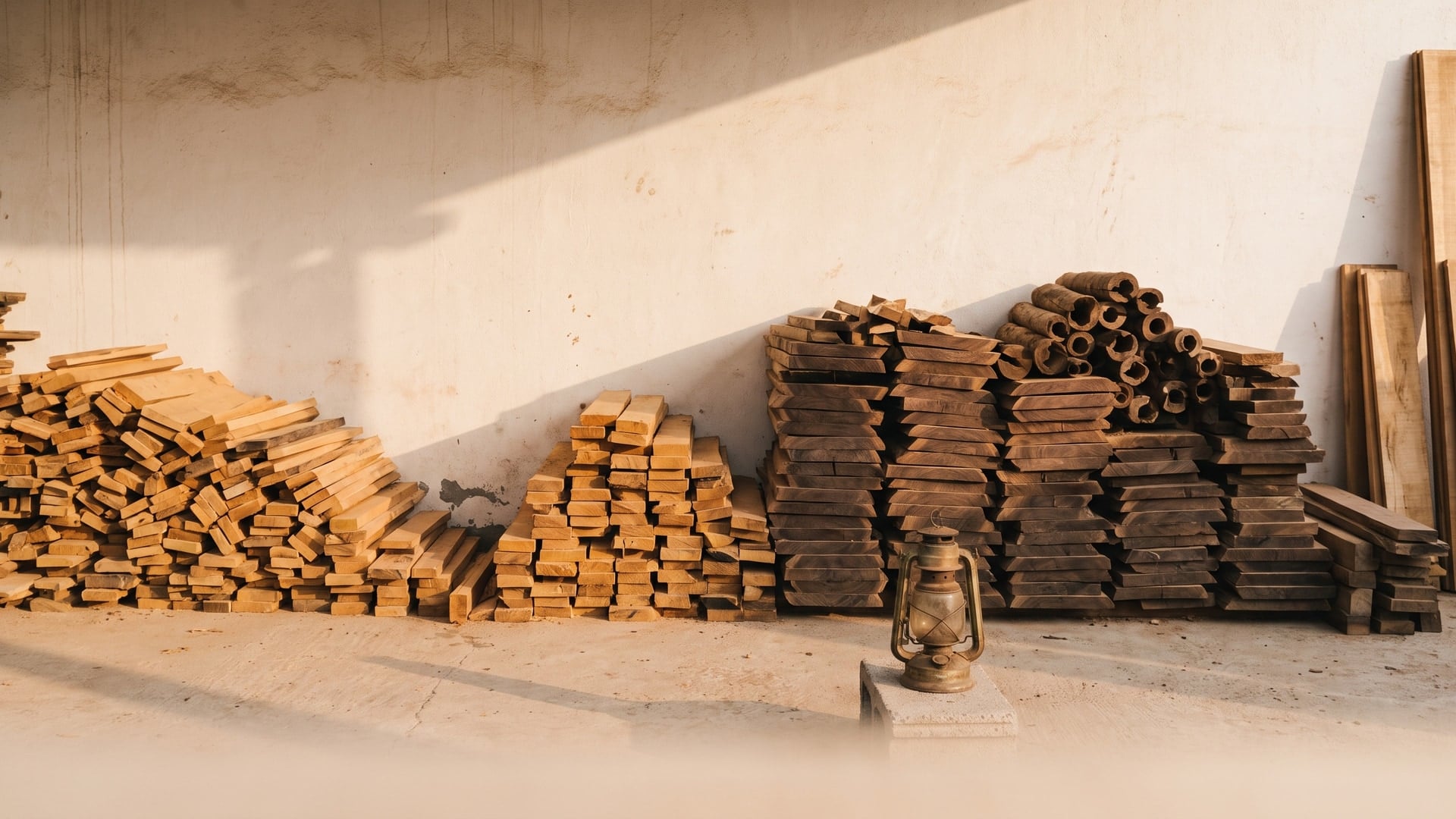
A hardwood log rolling into a plywood plant is a finite, patiently grown thing — years of sun and rain resolved into a few hundred kilograms of usable timber. The log is steamed soft, mounted on a lathe and peeled: a knife bites in and the log unwinds into one continuous ribbon of veneer, spinning down until only a slender spindle is left in the chuck. That ribbon becomes the faces and cores of plywood. But a great deal of the log never reaches a finished sheet — the leftover spindle, the ends clipped off the veneer, the trim sawn from a pressed panel, the dust under the sander. The question that separates a thoughtful manufacturer from a careless one is simple: what happens to all of that?
For a long time the answer was to throw it away — burn it in the open, tip it in a heap, forget it. That is linear manufacturing: take, make, discard. It is wasteful twice over, because you paid for the raw material once and then pay again to be rid of it. Circularity is the opposite instinct. It treats what is left over not as rubbish but as raw material in the wrong shape yet, and designs the plant so that residue loops back in — as another product, as fuel, as heat, as water used a second and a third time. It is not a flourish added at the end of the line but a way of building and running a factory — good for the forest and good for the ledger at once. This article is about how that loop works, and why it quietly shows up in the board you buy.
Circularity, plainly put
Strip away the jargon and circularity is a single change of question. The linear factory asks, at the end of the line, how do we get rid of the waste? The circular factory asks, at the design stage, how do we make less waste to begin with, and how does whatever remains become an input somewhere else? It is the difference between a bin and a loop.
What makes the idea durable is that environment and economics pull the same way. Every kilogram of offcut turned into a blockboard core is a kilogram you did not pay to cart away, and a slice of a tree you did not have to fell to replace it. Every tonne of sawdust burned for heat is a tonne of bought fuel you did not purchase. The plant that wastes less spends less and takes less from the forest, all at once. So circularity does not depend on goodwill or a marketing season to survive the next tight quarter; it rests on arithmetic.
Getting more product from every log
The single biggest lever is yield: how much of each log leaves as product rather than loss. Peeling for veneer cannot use everything. The lathe can only peel a log down to a certain diameter before the spindle — the peeler core — must be released. Clipping the veneer ribbon to size leaves trimmings; pressed panels are sawn square, leaving edge trim; sanding throws dust. In a linear plant, those are streams of waste. In a circular one, each has a home:
- Peeler cores — the leftover spindles — sawn into battens for blockboard and batten-board cores, or chipped as furnish for composite panels.
- Veneer trimmings and clippings — jointed and reused where the wood is sound, or chipped into particle board and MDF furnish.
- Edge trim and reject panels — broken down and fed back into composite lines rather than skipped to a heap.
- Sawdust and sander dust — compressed into briquettes for fuel, or blended into board furnish.
- Bark and unusable fines — sent to the boiler as fuel, the lowest-value but still-useful destination.
The point of all this routing is one number: a larger share of every tree leaving the gate as something useful — plywood, blockboard, a composite panel, a door — and a smaller share leaving as nothing at all.
Energy that loops back into the plant
Making plywood is hot work. Veneer must be dried in heated dryers before it can be glued, and the resin that bonds the plies cures under presses held at high temperature. That heat is one of the plant's largest running costs.
Here the residue that could not become product earns its second life. Bark, fines, off-spec chips and dust — often compressed into dense briquettes that burn hot and clean — are fed into a biomass boiler, and the steam and heat they raise dry the next batch of veneer and warm the next pressing. Better-run plants go further and recover the heat that would otherwise be lost: hot flue gases and hot water captured and cycled back to pre-heat dryers and incoming air, so the same energy does more than one job. The effect is a plant that leans far less on bought-in furnace oil, diesel or purchased power, running instead on a fuel it was already going to produce. The disposal problem and the energy bill cancel much of each other out.
Water used in a loop, not once
Water runs quietly through a plywood plant too: in the steaming and conditioning of logs before peeling, the mixing of glue, the cooling of presses and machinery, and routine washing down. The wasteful pattern is draw-and-discharge — pull fresh water from the ground, use it once, send it out as effluent. It is costly, and across much of India's industrial heartland, where factories sit in water-stressed districts and lean hard on groundwater, it is not a responsible way to run.
The circular pattern keeps the water moving. Cooling water is cycled and re-cycled rather than run to waste. Process water is passed through an effluent treatment plant, cleaned, and returned for non-critical duties such as washing and dust control. The governing aim is simple: draw as little fresh water in as possible, and let as little as possible back out. In a dry region, that discipline is the difference between a plant that shares the water table fairly and one that quietly draws it down.
Why this ends up in the board you buy
It is easy to file all of this under internal housekeeping. That is a mistake: every panel you carry home has an embodied cost in trees, energy and water, and circularity is what shrinks it.
The logic is direct. A plant that gets more finished product from each log needs fewer logs to make the same quantity of board, and fewer logs per panel means less pressure on forests per panel. So the yield discipline practised inside the factory turns up, invisibly, as a smaller footprint in the finished sheet on the rack. For an architect specifying against a green-building rating, or a homeowner who simply wants to buy well, this is the substance beneath the word sustainable. Circularity is not a separate virtue kept in a report; it is part of the board's footprint, built in before the sheet leaves the line.
Efficient and wasteful manufacturing, side by side
The gap between an efficient plant and a wasteful one is rarely visible on the finished product, which is why it is worth naming. Set the two ways of working next to each other:
- A wasteful plant buys or fells more timber than its output justifies, treats residue as a disposal headache to be dumped or open-burned, fires its boilers on bought fossil fuel while its own offcuts rot in a yard, draws and discharges water freely, and measures success by finished output alone.
- An efficient plant measures yield per log as closely as output per shift, keeps a destination for every stream, runs substantially on its own residue, loops and treats its water, and counts what it throws away as carefully as what it sells.
The same-looking sheet can come from either; the difference is the tree-and-energy story behind it — how many logs, how much bought fuel, how much fresh water it took to make. Wastefulness is not only an environmental failing; it is a symptom of a plant that is not paying attention, and inattention rarely stops at the woodpile.
Sourcing, circularity and durability are one system
Circularity does not stand alone. It sits in the middle of a longer chain, with responsible sourcing upstream and durability downstream, and it is strongest when the three are treated as one system.
Upstream is where the wood comes from. India's plywood industry has moved a long way from natural-forest hardwoods towards plantation and farm-grown timber — poplar, eucalyptus, melia dubia, gmelina, subabul and similar fast-renewing species raised by farmers on field bunds and marginal land, especially across the belts of Punjab, Haryana and Uttar Pradesh that feed hubs like Yamunanagar. This is agroforestry: a renewable, traceable, farmer-supporting resource rather than a raided forest. Getting more product from each of those logs multiplies the value of an already-responsible input.
Downstream is how long the board lasts — the part most people miss. The most complete form of circularity is a panel that never needs remaking. A board that survives decades — properly bonded, full-cored, treated against borer and termite, and matched to the right grade for its exposure — spares all the timber, energy and water a premature replacement would have consumed. Every board that fails early is a second helping of all three. Durability is circularity stretched across time: use less to make it, then make it last so you need not make it again.
What circular practice looks like
Circularity is easy to claim and harder to run. Here is a short checklist you can put to any manufacturer, ours included:
- A destination for every residue stream — peeler cores, trimmings, offcuts and dust going to product or fuel, never to a dump or an open fire.
- Offcuts put back to work — blockboard cores and composite panels engineered from what other lines leave behind.
- On-site biomass energy — wood residue, often briquetted, firing the boilers that dry veneer and heat the presses.
- Recovered process heat — waste heat captured and reused rather than vented to the sky.
- Water in a loop — recirculated and treated through an ETP, with fresh draw and effluent discharge both kept low.
- Yield measured per log — not just output measured per shift.
- Responsibly sourced timber — plantation and farm-grown wood feeding the whole loop.
- Durable, correctly graded boards — built to postpone their own replacement.
No single item is dramatic; together they are very nearly the whole of it.
The quiet discipline of wasting little
Circularity rarely announces itself. There is no one feature on a sheet of plywood you can point to and call the sustainable part. It is the sum of a hundred small refusals — to burn what could be a blockboard core, to dump what could be fuel, to draw fresh water for a job treated water could do, to fell a second tree when better yield from the first would have served. The most responsible manufacturing is quiet about all this almost by definition, because the whole point is that the waste is no longer there to be seen.
Come back to the log we started with, unwinding on the lathe. In a careless plant, much of it leaves as smoke and spoil. In a circular one, most of it walks out of the gate as plywood, blockboard, a door or a composite panel, and the little that remains has already gone to work heating the presses or is on its way into the next board. That is the real measure of a good plant — not what it makes, which anyone can show you, but how little it wastes, which you have to think to ask about. It is worth asking, because a manufacturer careful enough to waste almost none of a tree is usually careful about everything else as well.