The whole promise of a decorative laminate is that it refuses to be precious. It is built to be handled, wiped, leaned on and lived with — kraft paper and a printed decor fused under heat and pressure beneath a tough, cured overlay that shrugs off the spills, scuffs and steam that would mark a natural surface in a single season. A good laminate does not ask to be tiptoed around, which is why it earns its place on the worktops, shutters and desktops that take the hardest daily punishment in an Indian home.
And yet walk through enough kitchens and you will find two versions of the same laminate: one still looking freshly fitted at year ten, and one of the same age gone tired, hazed and dull along its edges. The board is rarely the difference. The difference is a handful of small habits — how spills are dealt with, what cloth reaches for the surface, whether a trivet is used, whether water is ever left to sit at a seam. None of it is difficult and none of it takes real time, yet together it decides everything. Look after a laminate properly and its low-maintenance reputation becomes a decade of looking new; neglect the few things that matter and even the best board ages before its time.
Why laminate forgives so much — and the few things it will not
Knowing why the surface is tough tells you what to stop worrying about and where the real risks lie. The face you touch is a cured, wear-resistant overlay — a hard, sealed skin that water cannot penetrate, that most spills cannot stain, and that resists the daily abrasion of plates, mugs and sliding objects. On that face, laminate is genuinely forgiving: a wiped spill leaves no trace, a splash of curry does not stain if it is cleared, and ordinary use barely registers.
The vulnerabilities are specific, and naming them is most of laminate care. Heat can scorch or blister the surface. Abrasives scratch and permanently dull it. Harsh chemicals can bleach or etch the decor. And water at an unsealed edge or joint can creep past the laminate to the substrate beneath, which is not waterproof even when the surface is. Keep those four in mind and the rest is simply the easy business of wiping a surface built to be wiped.
Everyday cleaning: warm water and a soft cloth
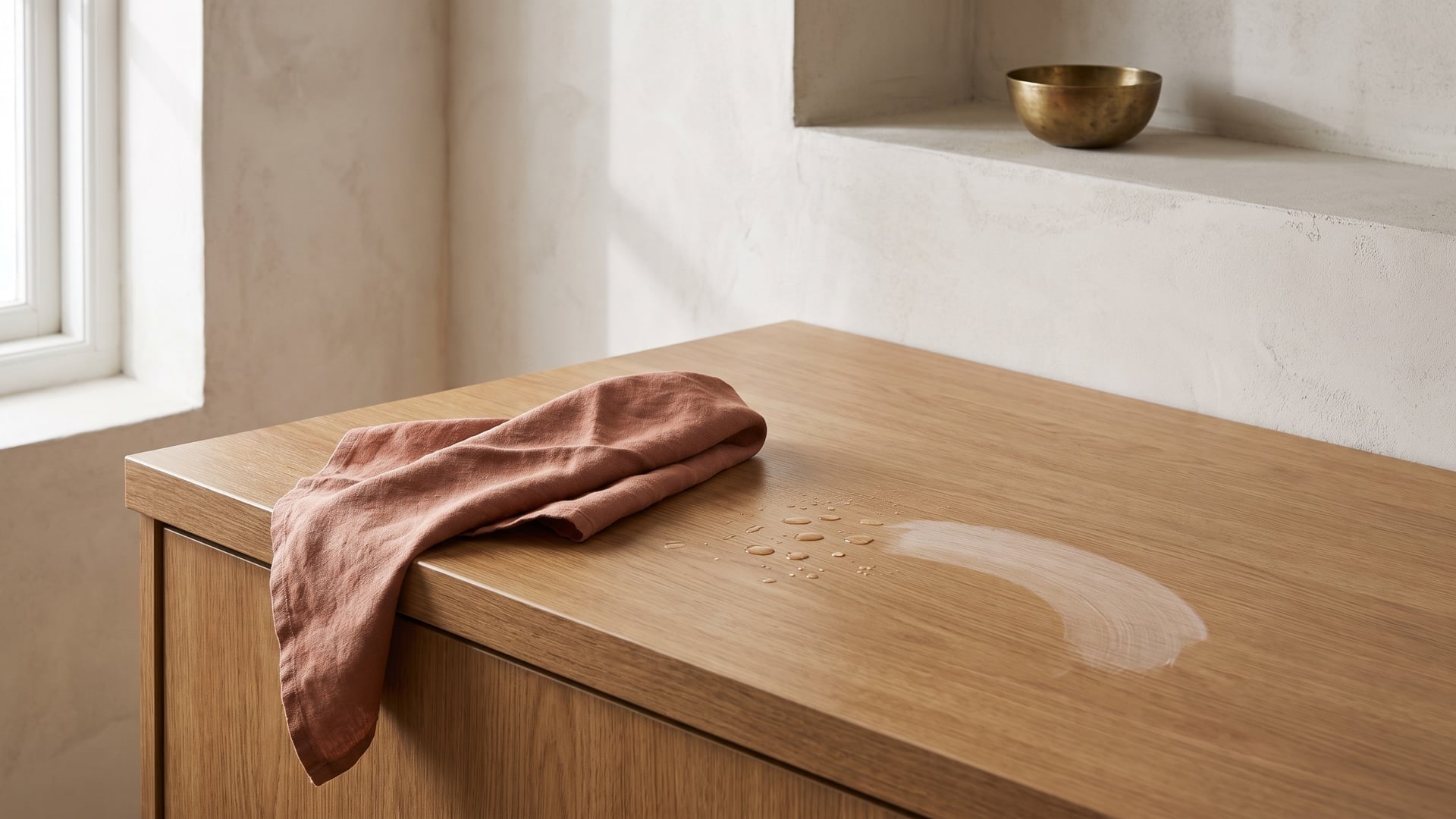
The most important thing about cleaning laminate is how little it needs. For the vast majority of marks — food, grease, dust, fingerprints, the film that settles on any kitchen surface — the right tool is a soft cloth, warm water and a few drops of mild detergent. That is genuinely all: no special sprays, no branded laminate polish, no arsenal of chemicals. Reaching for anything stronger usually does more harm than good. A reliable routine:
- Wipe with a soft, damp cloth — microfibre or soft cotton — using warm water with a little mild dishwashing liquid for grease. Wring it damp, not dripping.
- Clean along the grain or texture, not in tight circles, so that on woodgrain finishes you follow the surface rather than working dirt across it.
- Deal with spills as they happen. Nothing on a sealed laminate stains if cleared promptly; trouble begins only when a spill dries, bakes in the sun or sits against a seam.
- Dry the surface afterwards with a clean cloth. Most people skip this, and it matters more here than almost anywhere: our hard water leaves chalky white spots as it evaporates, and a quick dry-off prevents them.
Do this and the surface largely looks after itself. A ten-second wipe-and-dry as you cook and clear is worth more than any monthly deep clean.
What to keep away from the surface
If everyday cleaning is about what to use, good care is just as much about what to keep away. The surface is tough, but a few common habits attack exactly its limits:
- Abrasive pads, scouring powders and steel wool. Green pads, gritty powders and wire wool are made to grind, and they will grind the fine cured finish into a permanently dull, scratched patch — a swirl on gloss, a shiny spot on matte. Neither can be undone.
- Bleach, and strong acids or alkalis. Chlorine bleach, acidic descalers and toilet cleaners, caustic drain cleaners and the like can discolour, whiten or etch the decor. If any splashes on, clear it at once with plenty of water rather than letting it dwell.
- Standing water at joints and edges. Harmless on the face; at a seam, edge or sink cut-out, water left to sit finds its way to the substrate beneath. Never leave puddles, wet cloths or dripping vessels over a join.
- Knives and direct chopping. A laminate worktop is not a chopping board — cutting on it scores the surface and blunts your knives. Always use a board, and lift heavy or rough-based items rather than dragging them across.
- Waxes, furniture polishes and oils. Laminate never needs feeding the way timber does. Polishes only build a hazy, streaky film that traps dust and dulls the very shine they promise to restore.
Heat and moisture: the two quiet threats
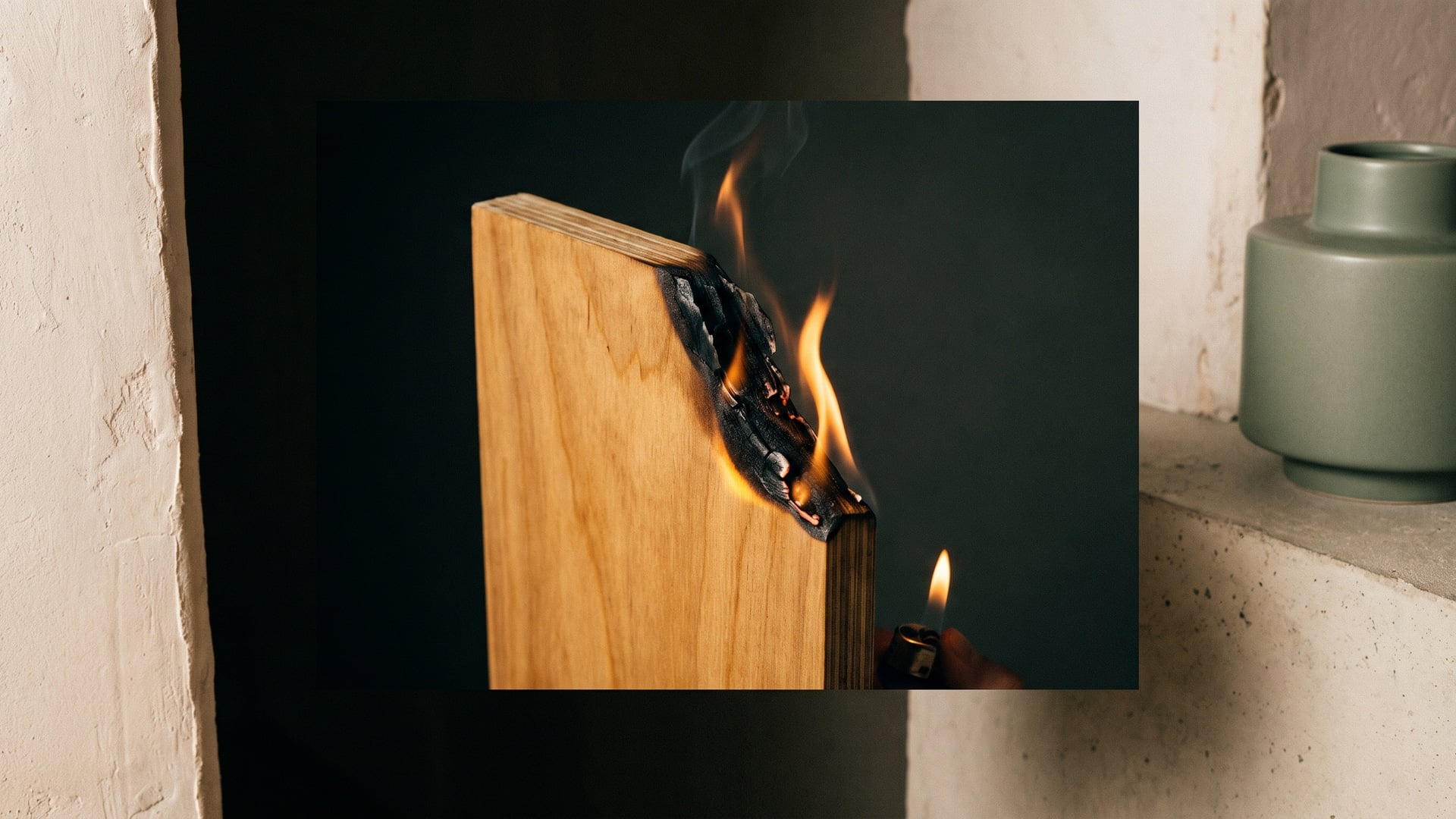
Most laminate that fails early fails for one of two reasons, both preventable. The first is heat. A laminate is heat-resistant, not heatproof: it takes a warm plate happily, but a pan straight off the flame or a pot fresh from the hob can scorch, blister or leave a permanent pale scald mark, and repeated heat in one spot can craze the surface. The rule is absolute — never set a hot vessel directly on the worktop. Keep trivets, wooden pot-stands or heat mats within reach and use them without fail, and leave a gap or a mat beneath heat-throwing appliances such as kettles, toasters and air-fryers.
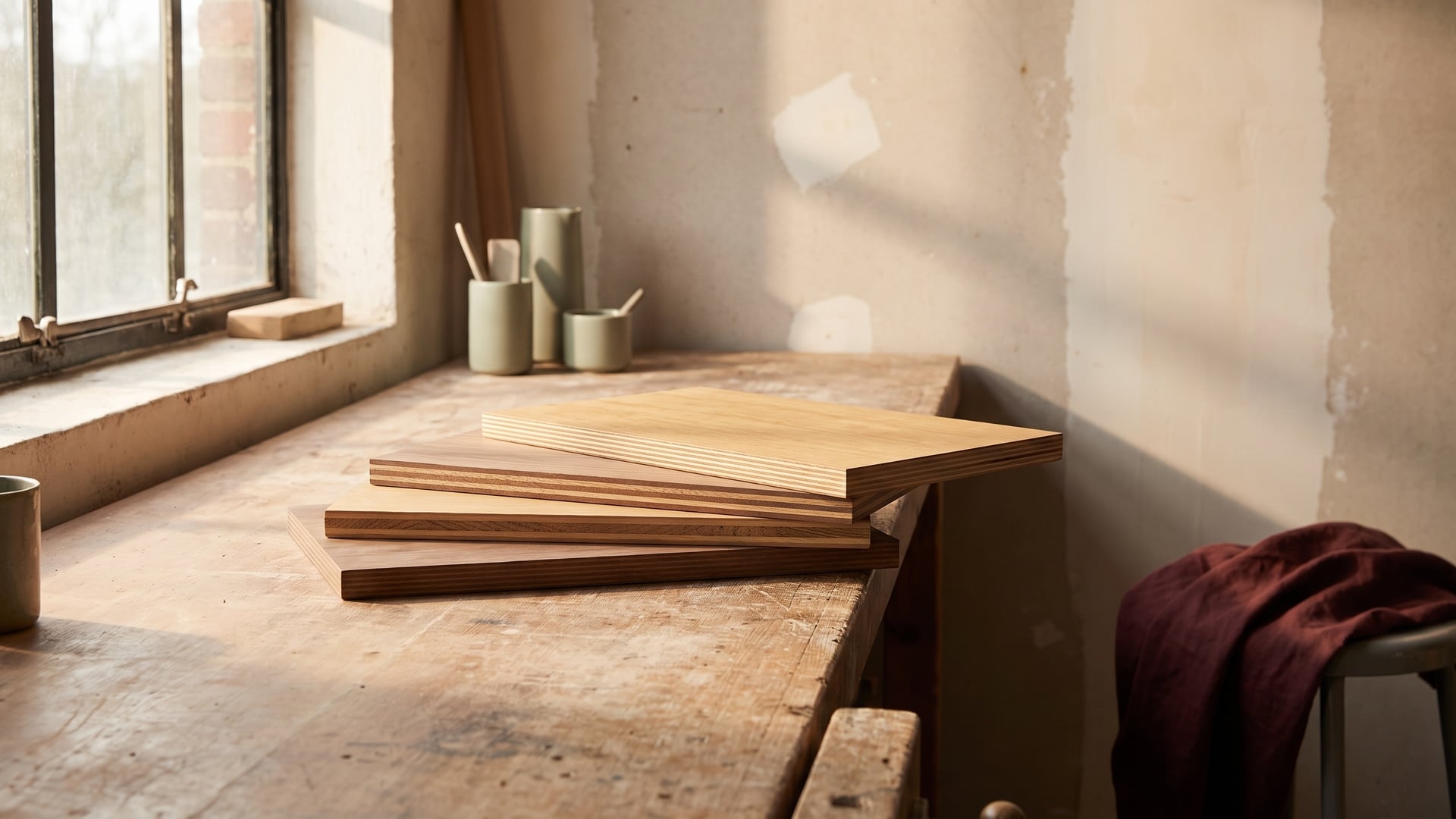
The second is moisture, and the danger is widely misunderstood. The surface is waterproof; the board beneath — MDF, particleboard or ply — and the glue line holding it together are not. While water stays on the sealed face it does no harm. The trouble starts when it reaches somewhere the seal does not cover: an edge, a seam, a sink cut-out, a chip. There it soaks into the substrate, which swells and lifts the laminate from within. Our climate doubles the risk — the monsoon keeps everything damp, and hard water crusts every tap. So wipe water away from around sinks and taps rather than letting it pool, keep the sealant bead around a cut-out intact, and never leave a soaking cloth or mat against a join.
Matte, super-matte and gloss need slightly different hands
All laminates share the same basic care, but the finish changes what shows — and how you should wipe.
Gloss and high-gloss are mirror-like and hide nothing: every fingerprint, smear and water spot is visible, and every fine scratch shows as a swirl under light. Clean with plenty of clean water and a very soft, grit-free cloth, then buff dry gently. Never drag a dry or dirty cloth across it — trapped grit is what leaves those swirls. Keep abrasives and solvent cleaners well away.
Matte and super-matte have the opposite temperament, concealing scratches and dust but showing greasy fingerprints and dried droplets more plainly, especially in darker colours. The critical thing is to resist scrubbing: hard rubbing, or any abrasive, polishes a small area smooth and leaves a shiny burnished patch that stands out starkly against the matte and cannot be reversed. Wipe gently and evenly, letting mild detergent do the work rather than pressure — many super-matte surfaces, made with anti-fingerprint properties, need nothing more than a damp cloth.
The lesson is the same from opposite directions: gentle, clean, even wiping suits every finish; abrasion ruins every finish — showing as a swirl on gloss and a shiny smear on matte.
Tackling stubborn marks safely
Now and then something more determined turns up — dried-on food, a sticky grease film, a ring of hard-water scale, ink or a turmeric stain. The instinct is to reach for the strongest cleaner and scrub. Resist it: start gentle, escalate slowly, and spot-test anything stronger first.
- Spot-test in a hidden place. Before using any cleaner beyond mild detergent, try it on an out-of-sight corner — inside a cabinet, under an overhang — and check it does no harm.
- Soften, do not scrape. Lay a warm, damp cloth over dried food for a few minutes to loosen it, then wipe. Never use a knife, blade or metal scraper; to lift something proud, use the edge of a plastic spatula or your fingernail.
- Grease and sticky films yield to warm water with a little extra detergent, or a soft cloth with a dab of isopropyl (rubbing) alcohol — spot-tested — then rinsed and dried.
- Ink, marker and dye often lift with a little isopropyl alcohol. Avoid acetone and nail-polish remover, which can attack some finishes.
- Hard-water scale around taps responds to diluted white vinegar: wipe it on, wait a moment, then rinse thoroughly and dry. Keep it off seams and gloss.
- Turmeric, tea and coffee — the classic Indian kitchen stains — are best caught early, as turmeric sets and then bleaches slowly in sunlight. Blot promptly, wash with detergent, and treat any residue with a cautious dab of alcohol.
Whatever you use beyond soap and water, the last two steps never change: rinse with clean water, then dry. Leaving a cleaning chemical on the surface is its own kind of neglect.
Protect the edges and seams — that is where failure starts
If a laminate ever lets you down, it will almost always begin at an edge or joint, not in the middle of a panel. The face is a sealed, continuous skin; the edges and seams are where the vulnerable substrate sits closest to the surface, and where water, given the chance, gets in. A little attention here does more for the surface's life than anything you do to the open face.
- Keep joints and edges dry. Wipe water from seams, from the join behind a worktop and from any cut-out; never leave standing water or a wet cloth against them.
- Watch the edge-banding. The lipping or edge-band that seals a cut edge is doing an important job. If a corner starts to lift or peel, re-secure it early, before moisture works underneath and the problem spreads.
- Respect sink and hob cut-outs — the wettest, hottest points on the surface. Make sure the exposed core was sealed at fitting, keep the silicone bead around a sink intact, and renew it the moment it looks tired.
- Do not lever or overload an edge. Sitting on a worktop, hanging off a leaf or dragging heavy loads across a square edge stresses the bond exactly where it is most exposed.
A postformed edge, where the laminate rolls over the front in one seamless piece, is well protected by design; a square edge with a glued lip needs more watching. Either way the rule is the same — keep the edges dry and intact, and the surface behind them stays sound.
A quick do-and-don't checklist
Everything above distils into a short list worth pinning up in a new kitchen:
- Do wipe spills as they happen and dry the surface after cleaning.
- Do use a soft cloth with warm water and mild detergent for almost everything.
- Do use a chopping board for cutting and a trivet for anything hot.
- Do keep edges, seams and sink cut-outs dry, with their sealant intact.
- Do spot-test any stronger cleaner in a hidden corner first.
- Don't use abrasive pads, scouring powders, steel wool or gritty cleaners.
- Don't use bleach, strong acids, caustic cleaners or solvents such as acetone.
- Don't set hot pans, pots or heat-throwing appliances directly on the surface.
- Don't let water stand at a joint, edge or cut-out.
- Don't waste money on waxes and laminate polishes — the surface never needs them.
The habits that add up to a decade
Stand back from the detail and the whole of laminate care comes down to a few unglamorous habits, repeated without fuss. Wipe as you go and dry as you finish. Reach for a board and a trivet by reflex. Keep water off the seams. Be gentle with the surface and gentle with its edges. Meet a stubborn mark with patience rather than force. None of it is hard, none of it is time-consuming, and together it is the entire difference between a surface that ages and one that does not.
That difference is real, and it is visible. A quality laminate — properly made, correctly bonded, carrying its ISI mark — is built to take a decade of ordinary Indian life in its stride: the heat, the humidity, the hard water and the bright sun that yellow, blister and peel lesser surfaces long before their time. Give it the handful of simple habits in this guide and it holds up its side of the bargain, looking much as it did the day it was fitted while cheaper surfaces nearby have gone dull and begun to lift. We build the board to last; these small routines are how you let it. That is the quiet economy of a good laminate — look after it a little, and it looks after you for years.