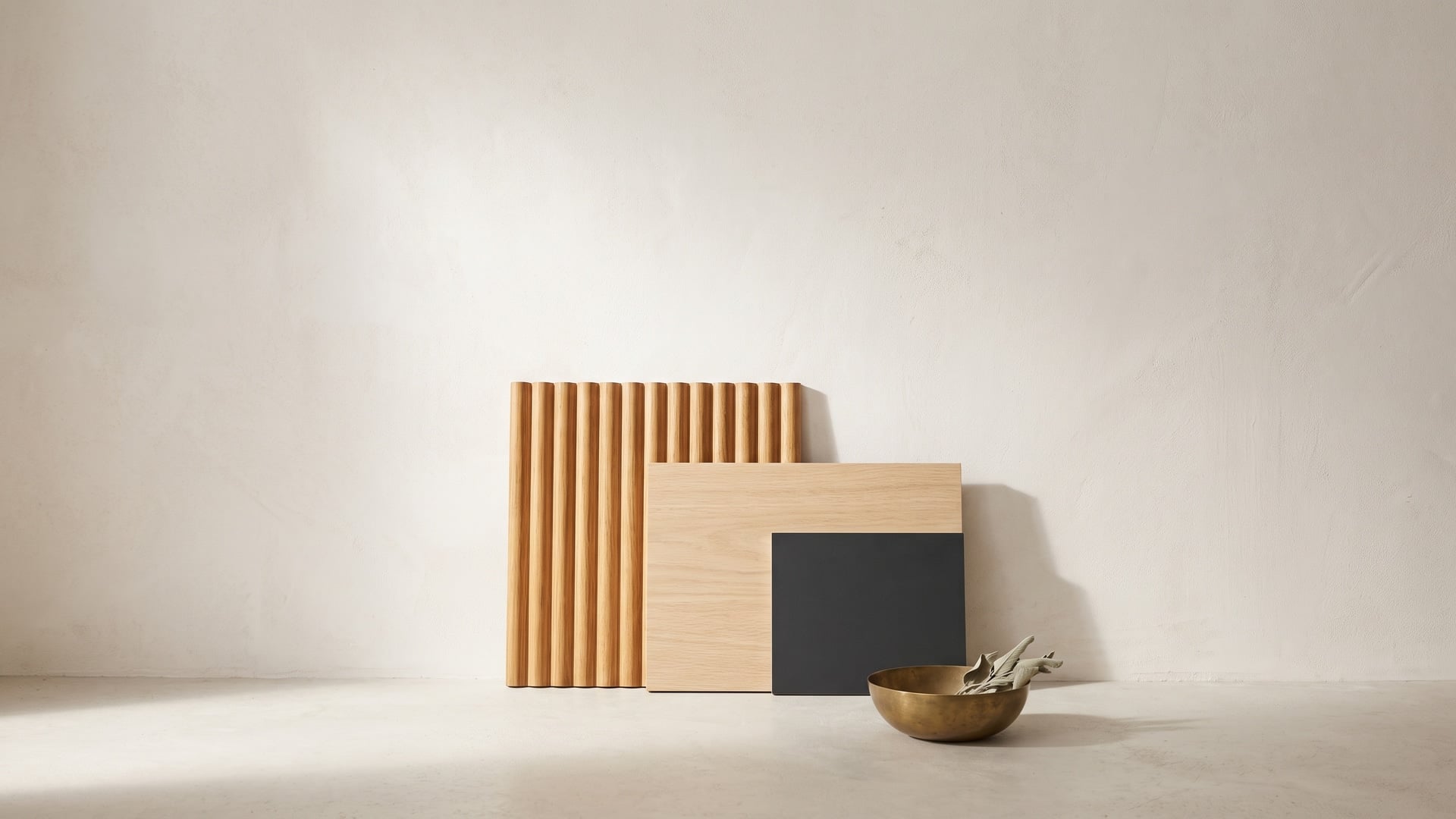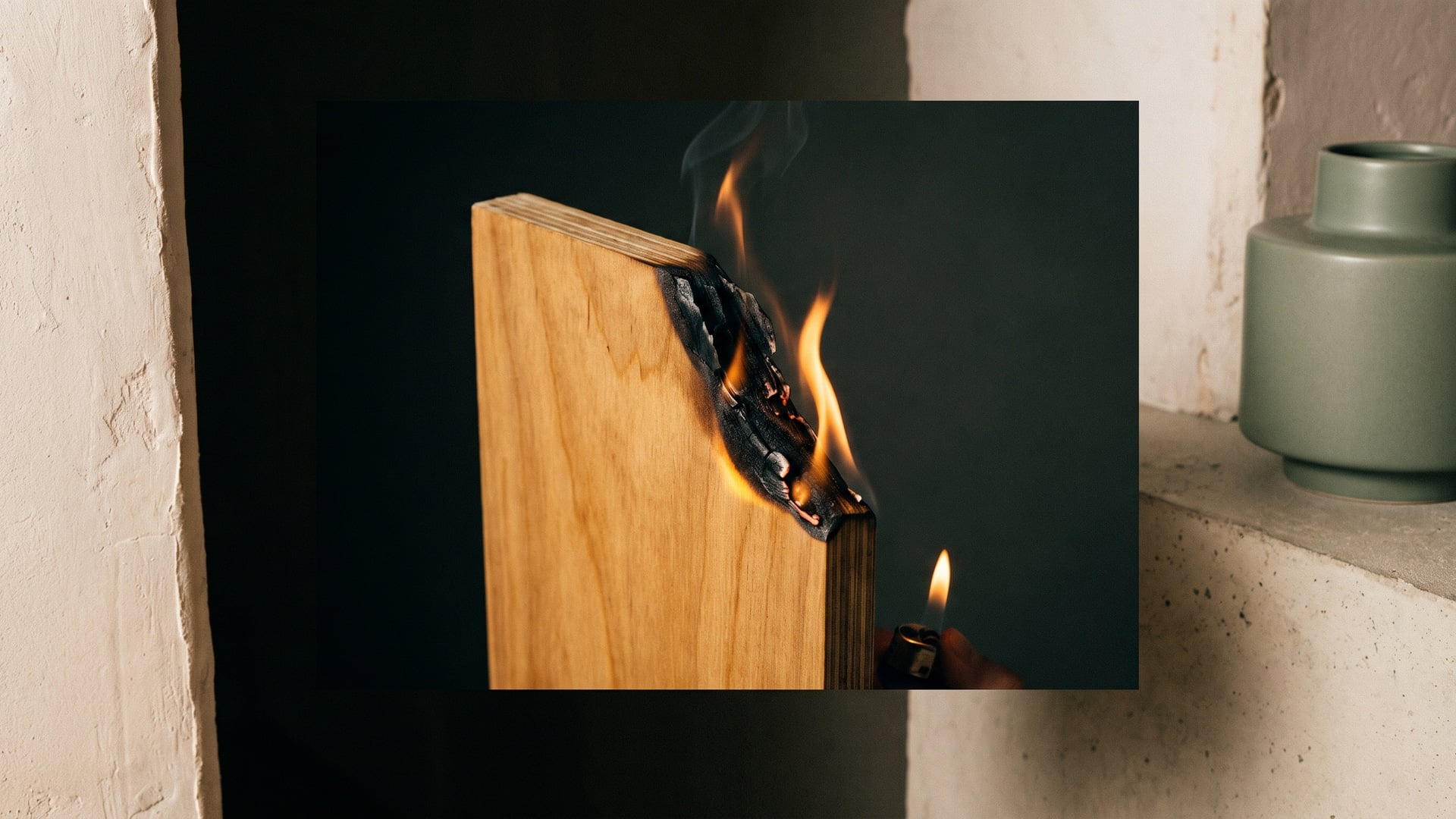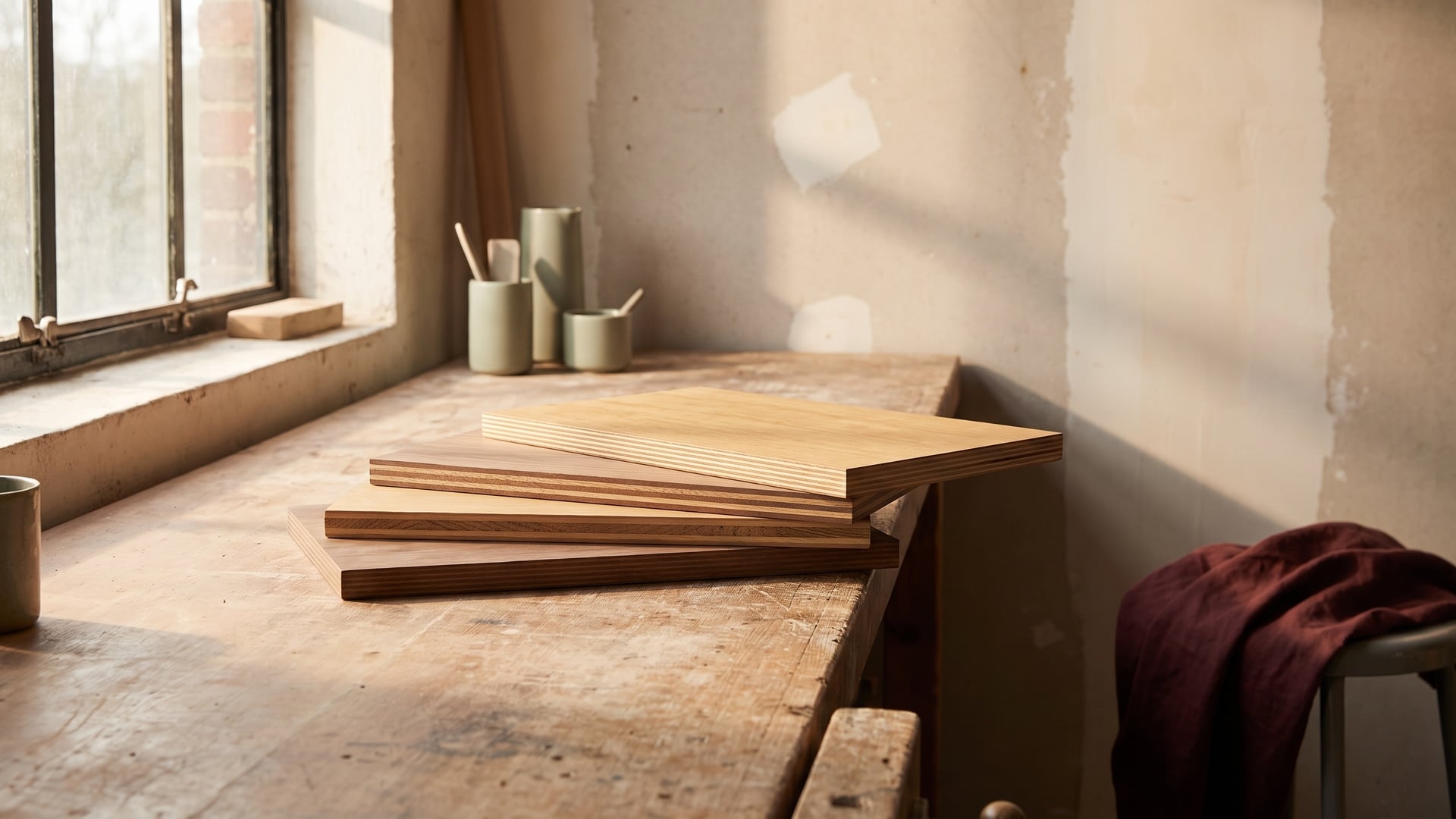
Pick two sheets of plywood off the same stack, in the same thickness, faced with the same calm woodgrain, and they can look like twins. Fit them in the same kitchen and come back in six or seven years: one is still flat, tight and holding every screw, while the other has swollen at a joint, dropped a shutter and begun to peel at an edge. Nothing on the surface predicted that difference, because the difference was never on the surface. The face veneer is what you see; the core is what you rely on.
A plywood board is not a solid slab of wood. It is a stack of thin veneers, cross-bonded at right angles and pressed together with adhesive, and the face everyone judges is only the outermost slice. Everything beneath it — the great majority of the board's thickness — is core. That core carries the load, grips the fasteners, keeps the panel flat and decides whether water finds a way in. The two things a good manufacturer controls most carefully, core construction and calibration, are precisely the two a buyer cannot see once the laminate goes on. This article is about how to read them anyway.
What the core actually is
Understand how a board is built and its behaviour stops being mysterious. Veneers are peeled from a log, dried, coated with resin and laid up in odd numbers — three, five, seven, nine plies or more — with the grain of each layer turned across the one below. That cross-graining is the whole idea of plywood: it balances wood's natural urge to move along its grain, so the panel stays far more stable than solid timber of the same size. The outer veneers are the faces; everything between them is the core — in most boards, the large majority of what you are paying for.
Because the core is the bulk, it is also the board. When we talk about strength, screw-holding, flatness through a monsoon's worth of humidity and resistance to water, we are really talking about the core and the glue that binds it, not the pretty face pressed on top.
Gaps, overlaps and voids: the defects that decide everything
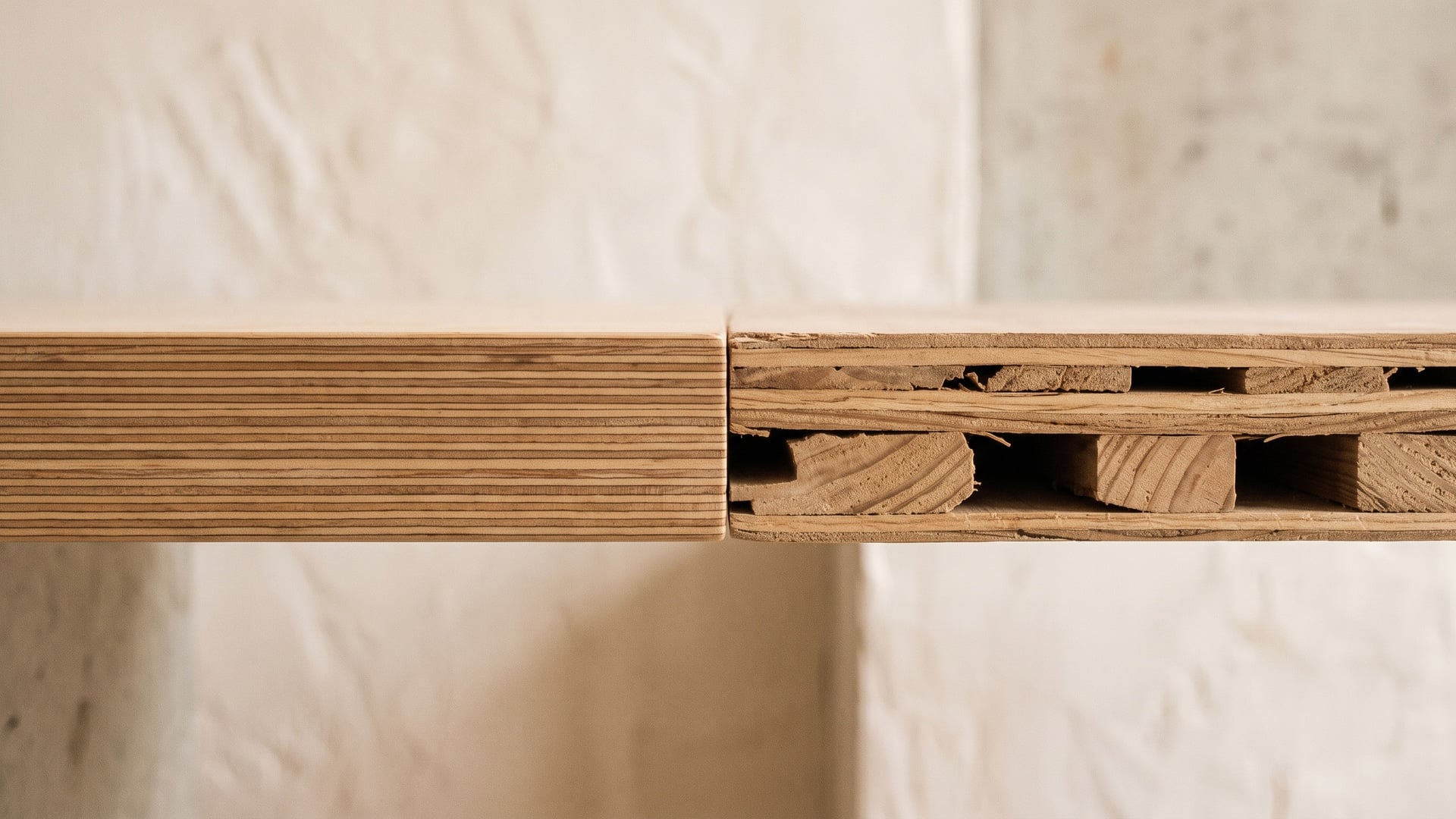
Core veneers are not tidy rectangles. They are peeled sheets with natural splits and ragged edges, and laying them up neatly — edge to edge, no gap and no doubled-up overlap — takes good material and patient work. Cut that corner and three defects appear inside the board, all of them invisible from outside:
- Gaps — spaces where two core veneers should have met but didn't, leaving a line with no wood in it at all.
- Overlaps — the opposite error, where veneers double up into a ridge that stops the plies pressing flat and telegraphs through the surface.
- Voids — enclosed hollow pockets in the core, often where one gap sits above another. These are the worst, because they are sealed air inside a board sold as solid wood.
None of it shows on the face, but all of it shows up in use. Core voids attack a board in four ways:
- Fastener grip — a screw, hinge or bracket needs solid wood to bite into. Drive one into a void and there is nothing to hold; it spins, strips its thread or pulls straight out, taking the hardware with it.
- Load-bearing strength — a shelf or worktop carries its load through continuous wood. A void is a break in that path — a soft span where the board sags, flexes and, under real weight, cracks.
- Flatness and stability — uneven internal density and hidden overlaps mean uneven internal stress, so the panel bows, cups and twists as the humidity swings between seasons.
- Water resistance — the one most people miss. A void is a channel. Once moisture reaches an unsealed edge or a screw hole — routine in an Indian kitchen or bathroom — those hollow pockets let it run deep inside and pool, swelling the core from within long before the surface shows a mark. A waterproof adhesive cannot protect wood that water can simply flow past.
What a full hardwood core looks and behaves like
A full hardwood core is the honest answer to all of this. Full means the core veneers are laid solid, edge to edge, with no gaps, overlaps or voids — a continuous body of wood from one face to the other. Hardwood means those veneers are dense species chosen for strength and grip, not soft, cheap, fast-peeled filler. Put the two together and the board behaves the way plywood is meant to.
You can feel it before you test it. A full hardwood-core board is reassuringly heavy for its size, because it is wood rather than wood-and-air. It takes a screw and holds it without splitting or spinning, carries a load across its span with no soft spot, stays flat when the weather turns, and offers moisture no hollow highway to travel down. This is what the Indian standards really certify: an IS:710 boiling-waterproof (BWP) or IS:303 moisture-resistant (MR) board is tested for glue integrity and, in the waterproof grades, for surviving prolonged immersion — tests a gappy, voided core cannot pass honestly.
Calibration: the step that makes joinery fit
If construction decides how a board performs, calibration decides how it fits. Calibration is a finishing step: after pressing, the panel is run through a wide-belt sander that skims both faces to a uniform, precise thickness across its whole area — corner to corner, edge to edge. A calibrated 19 mm board is genuinely 19 mm everywhere, not 19 at one corner and 18.4 at the other.
That sounds like a small thing until you watch a carpenter build with it. Cabinets are assembled from many panels meeting at right angles, and every joint assumes the parts are the thickness they claim to be. When they are, the carpenter builds flush, square, gap-free carcasses; grooves and rebates line up; hinges sit true; and a laminate or shutter lands dead flat with no step at the seams. When a board is uncalibrated and its thickness wanders, every one of those joints fights back — doors sit proud or sunk, laminates ripple over the high spots, mitres open at the corners, and the fitter loses hours packing and planing to hide a fault milled into the board. Calibrated stock is the difference between joinery that clicks together and joinery that has to be argued into place.
Glue lines: the bond you can see at the edge
Between every pair of veneers is a glue line, and its quality is as decisive as the wood's. A good glue line is even, continuous and fully bonded — a thin, unbroken film that turns a stack of loose veneers into a single structural panel. A poor one is starved, patchy or contaminated, with dry zones where the plies were never truly joined. Those are the boards that delaminate: the layers separate, blister and peel, usually starting at an edge and usually in the first monsoon after fitting.
The adhesive itself sets the grade. Moisture-resistant (IS:303) boards use adhesives that shrug off humidity and the odd splash; boiling-waterproof (IS:710) boards use phenolic resins that stay bonded through heat, steam and prolonged wetting, which is why they belong in kitchens, bathrooms and anywhere exposed. But even the finest resin fails if spread unevenly or the press is rushed. Continuous, well-bonded glue lines are what let a board behave as one piece for decades instead of quietly coming apart in layers.
How to read a board at the counter
You do not need a laboratory to judge core quality — only the cut edge and a couple of field tests. The edge is where a board tells the truth: it is the one place the core is on open display. Look at a freshly cut edge in good light and read the plies:
- Tight, even veneers — the layers should be uniform in thickness and neatly stacked, with no wavering or wedge-shaped plies.
- No gaps or hollows — solid wood the whole way across, with no dark slots, hollow pockets or overlaps between the layers.
- Clean glue lines — thin, dark, unbroken lines between the plies, with no dry or starved patches.
- Consistent thickness — sight, and if you can, measure the board at several corners; a calibrated sheet reads the same everywhere.
Two quick physical checks confirm what the edge suggests. Tap across the face with a knuckle and listen: a full core answers with a solid, even, dead sound, while voids ring back hollow or rattle as you move over them. Lift the sheet and feel its weight: a genuine hardwood core is dense and heavy for its size, so a board that feels suspiciously light for its thickness is usually light on wood and long on air. Neither test is fussy, and together the tap-and-lift catches most bad boards in under a minute.
The false economy of a beautiful face
The most expensive board is often the cheap one. A gorgeous laminate over a gappy, uncalibrated, poorly bonded core is a short-lived object dressed as a lasting one, and the failure always costs more than the saving — the more so in Indian conditions, where heat, monsoon humidity and termites all hunt for exactly the weaknesses a poor core provides.
When that board fails — a shutter drops because the screws let go, a worktop swells because water ran down a void, a run of cabinets bows through a damp season — you do not simply replace a sheet of plywood. You lose the laminate bonded to it, the hardware, the carpenter's labour and the use of the room while it is redone. Set against that, the gap between a full hardwood-core BWP board and a hollow lookalike is small — and it is the same honest difference wherever you buy, a genuine board carrying its grade and its price consistently under One India, One Price rather than tempting you with a discount on hidden air. Buying on the sticker price alone is how people end up paying twice.
A buyer's checklist for core quality
Take this to the counter and do not skip a line:
- Read the edge — tight, even veneers with no gaps, overlaps or hollow pockets.
- Confirm a full hardwood core — solid, dense wood right through, not soft filler plies.
- Check calibration — consistent thickness measured at all four corners.
- Inspect the glue lines — thin, continuous and unbroken, with no starved patches.
- Tap and lift — a solid, dead sound and a reassuring weight for the size.
- Match the grade to the room — IS:303 (MR) for dry interiors, IS:710 (BWP) for kitchens, bathrooms, exteriors and anything structural.
- Verify the certification — a genuine ISI mark carrying the correct IS number and a licence number.
- Ask for the warranty in writing — cover against delamination, borer and termite, kept safe with the invoice.
Buy the core, and the face takes care of itself
It is worth ending where the whole subject begins. Everything a buyer actually wants from plywood — strength, a firm grip on every screw, flatness that survives the seasons, joinery that fits, resistance to the water and the termites that define an Indian year — is decided in the core and the calibration, not in the face. The face is a finish. It can be chosen last, changed with fashion, and on a sound board it will still look right a decade on, because the panel beneath it never moved.
So judge a board the way it will one day judge you: from the inside out. Get the core right — full, dense, void-free, evenly bonded and precisely calibrated — and a good face becomes the easy part, the reward for a decision you made where no one was looking. Buy the core, and the face takes care of itself.