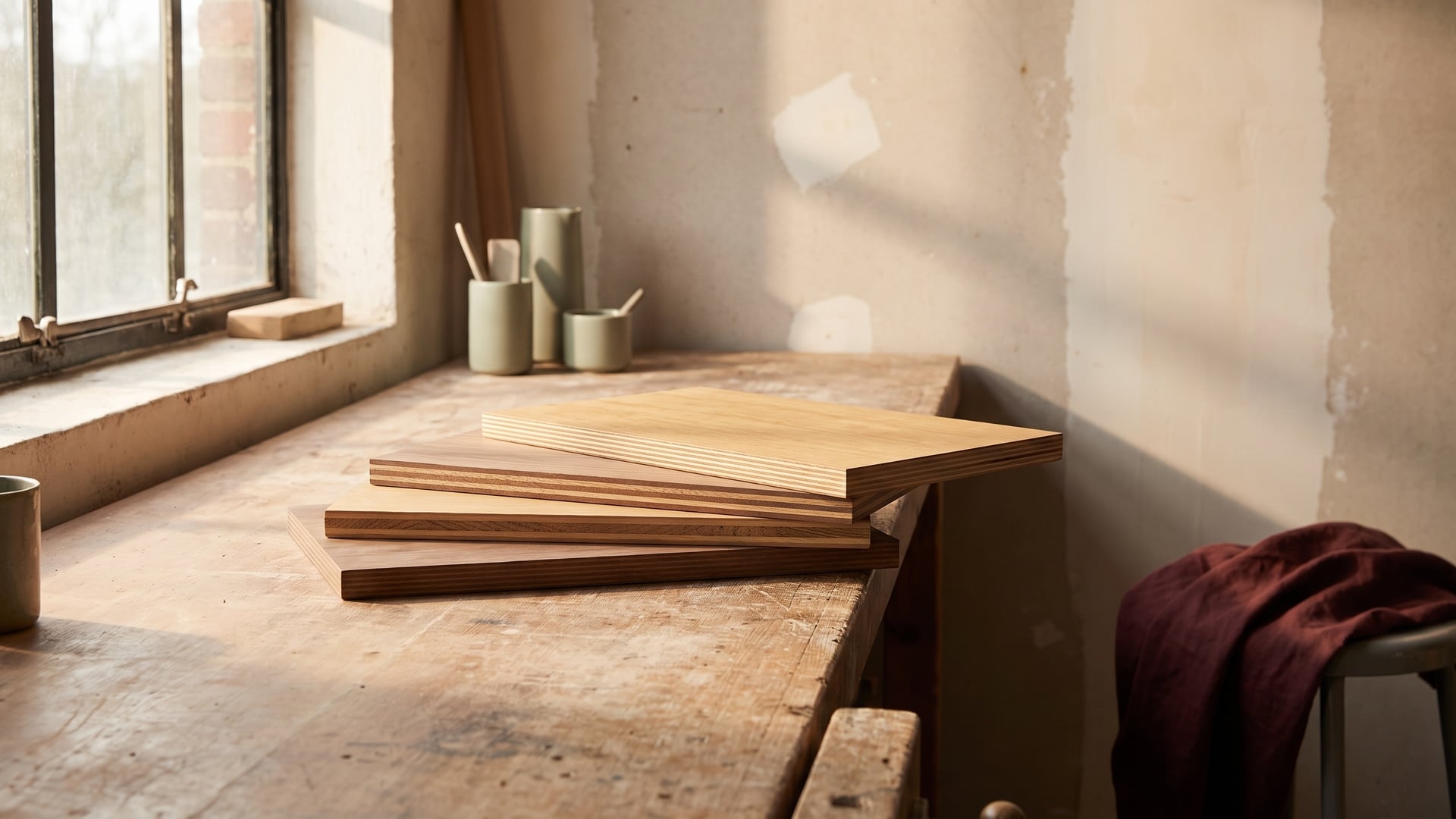
Hold a sheet of plywood up to the light and you see wood: a calm face veneer, a neat stack of plies at the edge, the honest grain of a natural material. What you do not see is the other half of the board. Between every layer of wood sits a layer of adhesive, and by the time you have counted the glue lines in a seven- or nine-ply sheet, the resin is no longer a minor ingredient holding the wood together — it is close to an equal partner in what the panel is. Wood and glue, in roughly equal importance. It is worth pausing on, because the wood is inert and familiar, while the glue is a chemistry that goes on living quietly inside your home long after the carpenter has gone.
For most of plywood's history, buyers judged a board on what they could see or test — the face, the core, the grade, how it stood up to water. The adhesive's other job, the one nobody mentioned at the counter, was the air. Certain resins slowly release formaldehyde, a gas you breathe without noticing, and in a sealed, air-conditioned home that slow release matters more than it once did. As a manufacturer, we think the glue inside a panel deserves the same scrutiny as the wood around it. This article explains, in plain terms, what formaldehyde is, what the E1 and E0 emission classes mean, why the question has grown sharper in Indian homes, and how to specify boards that keep the air as clean as the wood is beautiful.
Half the panel is the glue
It is tempting to treat adhesive as a detail — the stuff that makes plywood plywood, but not something you choose. In truth the resin runs right through the board, cured under heat and pressure between every pair of veneers, so a panel is part wood and part cured resin all the way across; and the invisibility that hides a gappy core from a buyer hides the glue too. This holds across the whole family of engineered panels, not plywood alone. Blockboard, medium-density fibreboard (MDF) and particleboard are all wood held together by a binder, and some carry far more of it — MDF and particleboard are built from countless fibres or chips, each coated in resin, so the internal glued surface area, and the potential for off-gassing, is far greater than in a plywood board with its handful of thicker glue lines. Whichever panel is chosen for a room, the binder is part of the specification, whether anyone names it or not.
Formaldehyde and off-gassing, plainly
Formaldehyde is a colourless gas with a sharp, slightly pungent smell, and one of the most common indoor air pollutants in the world. It is not exotic — it occurs naturally in tiny amounts, and even solid timber gives off a faint trace. The concern is never its existence, only its concentration. In panel products the source is the adhesive: the workhorse wood resins — urea-formaldehyde, melamine-fortified variants and phenol-formaldehyde — are built from it, and a board bonded with them can release a little unreacted formaldehyde over time.
That slow release is what we mean by off-gassing. A board emits most in its early life, then tapers over months and years as the free formaldehyde works its way out. Two things speed it up, and both are everyday facts of Indian life: heat and humidity. Warmth drives the gas out faster; moisture can slowly break weaker resin bonds, releasing a little more. At ordinary indoor levels formaldehyde is chiefly an irritant — stinging the eyes, catching in the nose and throat, troubling sensitive airways — and health authorities classify it as a human carcinogen at sufficient exposure. This is no cause for alarm; trace formaldehyde is part of normal living. It is simply a reason to keep what a new interior adds as low as it sensibly can be.
What E1 and E0 actually mean
Emission classes turn all of this into something you can ask for by name. A class ranks a board by how much formaldehyde it releases into the air, measured not by a salesman's assurance but in a controlled chamber test. The familiar E-classes originate in European panel standards and are now referenced by green-building frameworks worldwide. From worst to best for indoor use:
- E2 — higher emission. Not suitable for interiors. A board that is unrated or openly E2 has no business inside a home.
- E1 — low emission. The accepted benchmark for interior use across most of the world, and a genuine E1 board is safe for everyday furniture by mainstream standards.
- E0 — very low emission, a stricter class that releases far less again, approaching the natural background level of the wood itself.
- No-added-formaldehyde (NAF) systems — boards bonded with resins that contain no added formaldehyde at all, such as isocyanate (pMDI) or certain bio-based binders. Their emissions come down close to the wood's own background.
The rule of thumb is simple: the lower the class, the less off-gassing and the more forgiving the board is in a closed room. E1 is the floor you should never go below indoors; E0 and no-added-formaldehyde systems are the upgrade worth specifying where air stands still. And a class is a declared, tested property — not a mood word like eco or green on a brochure.
Why it matters more than ever in a sealed Indian home
A generation ago, most Indian homes breathed. Ceiling fans turned, windows stayed open for much of the year, and cross-ventilation carried whatever a new wardrobe gave off away almost as fast as it was released. The modern home is built the other way round. We seal rooms to hold in air-conditioning, fit tighter windows and doors, and keep compact flats closed for hours at a stretch. The same board that was harmless in an airy old house now releases into air that barely exchanges — and concentration, not the board alone, is what you breathe.
India then adds the two accelerants we already met. The heat that makes air-conditioning necessary drives off-gassing faster, and the humidity that makes waterproofing necessary can coax more formaldehyde out of a weak resin. There is a third factor people rarely weigh: how much panel is in the room. A fitted bedroom can hold a full wall of wardrobe, a bed with storage, a dresser and a study unit — a large area of engineered board packed into a small, sealed volume. More panel surface in less ventilated air means a higher concentration from the very same class of board. Fresh air was always the oldest remedy; design it out for the sake of cool, quiet rooms, and the board has to be cleaner to begin with.
Where it matters most
Low emission is worth paying for unevenly — concentrate it where people spend still, closed, breathing hours. The order of priority is fairly clear:
- Bedrooms — where you spend seven or eight continuous hours with the door shut and the air-conditioner on, often beside a wall of wardrobe.
- Children's and nursery rooms — children breathe more air relative to body weight and their airways are more sensitive, so cots, study units and toy storage deserve the strictest class you can get.
- Built-in wardrobes and storage — the single largest area of panel in most homes, frequently in the bedroom and often shut for long spells.
- Closed, air-conditioned rooms generally — home offices, media rooms and small flats with little cross-ventilation.
By contrast, a naturally ventilated living room or a covered balcony is far more forgiving, because moving air does the diluting for you. The point is not to fear plywood everywhere; it is to spend the low-emission budget where the air is stillest and the hours longest.
Emissions and waterproofing are different questions — and they agree more than they fight
It is easy to muddle two separate properties of the glue. One is waterproofing: a boiling-waterproof (BWP) marine board earns its grade from a strong, stable phenol-formaldehyde resin that cross-links into a dense network and survives prolonged water and heat. The other is emission: how much free formaldehyde escapes into the air. They are not the same question, and a buyer should not assume one answers the other.
The encouraging news is that they tend to pull in the same direction. The phenolic chemistry that makes a BWP board boil-proof is also thermally and hydrolytically stable, so a well-cured phenolic bond releases very little formaldehyde — performance and low emission can genuinely go together. The bigger emitters have historically been the cheaper urea-formaldehyde bonds, precisely the ones that also surrender to water. And no-added-formaldehyde systems now let a board be structurally sound and essentially emission-free at once. So you rarely trade health for durability. What you should not do is assume: cure and formulation vary between makers, so ask for the declared class whatever the grade.
What to ask for — in writing
The single most useful habit is to make the emission class part of the paperwork, not the sales talk. A manufacturer confident in its glue will state the class plainly; vague reassurance is not a specification. Before you commit, ask for the following, and ask for it on paper:
- The declared emission class — E1 or E0 — for the specific product, written onto the quotation or specification, not merely implied by an adjective in a catalogue.
- Documentation to back it — a test report or a manufacturer's declaration of the class, and a clear statement of whether the board uses a no-added-formaldehyde system.
- The class matched to the room — E0 or no-added-formaldehyde for bedrooms and children's rooms, with E1 as the honest baseline for the rest of the interior.
Keep that declaration with the invoice, alongside the grade and batch code, as you would the warranty against delamination. A class you cannot later point to is a class you cannot rely on. Words such as safe and eco describe a board; the emission class certifies one.
A checklist for specifying healthier boards
Take this to the table when you plan an interior, and do not let it slide off the list under budget pressure:
- Ask for the emission class by name — E1 or E0, per product, in writing.
- Step up to E0 or no-added-formaldehyde for bedrooms, children's rooms and closed, air-conditioned spaces.
- Treat E1 as the minimum for any indoor board, and keep anything unrated or E2 out of the home.
- Specify MDF and particleboard classes too — they carry more internal glue than plywood, so their emission matters as much or more, especially in shutters and wardrobes.
- Let new joinery breathe — air the room and the freshly fitted furniture through the first weeks, when off-gassing is highest, before you seal it up for the air-conditioning.
- Match grade and emission together — a phenolic BWP board for a wet zone is usually low-emitting as well, so the two decisions reinforce each other.
- File the emission declaration with the invoice, grade and batch code, so the claim stays traceable.
Healthy interiors start with what you cannot see
The argument folds back to the truth that governs core and grade: what decides how a panel treats you is hidden the moment the laminate goes on. You will never see the resin between the plies, and if it is a good one you will never smell it either. But it is there all the same — either adding quietly to the air your family breathes in a closed room, or sitting as inert as the wood around it. Which of those it does was settled long before the board reached your home, in the choice of adhesive and the care of the cure.
This is not a case for fear. Trace formaldehyde is part of ordinary life, and a genuine E1 board is safe by every mainstream standard; an E0 or no-added-formaldehyde board is better still, and worth the small premium where it counts. It is a case for respect — for the sealed bedroom, the child's study and the cooled flat with its windows shut against the heat, the rooms where air stands still and people sleep. Good wood deserves good glue. Ask for the class, match it to the room, and seal the edges on the emissions question the way you would on water. Do that, and you will have looked after the half of the panel that quietly looks after you: the half you cannot see.