Every carpenter and site engineer has seen it: a sheet of plywood that lay perfectly flat on the merchant’s rack arrives on site, waits a week in a corner, and by the time it is lifted it has taken on a gentle bow or a twist across one corner. The instinct is to blame the board — a bad batch, a soft core, a maker who cut a corner. Occasionally that is true; far more often it is not. The same sheet, from the same bundle, would have stayed flat if it had been set down differently and left alone for a couple of days. Warping is rarely a verdict on the plywood; it is usually a record of what happened to the board between the factory and the frame.
We say this as a manufacturer, not to dodge responsibility but because the remedy is almost always in your hands rather than ours. A good board leaves the press balanced — thin veneers laid with their grain crossing, bonded under heat and pressure so the tensions inside pull evenly and the panel sits flat. Keep that balance and it stays flat, even in large sizes. Upset it — by letting one face drink moisture the other cannot reach, by standing a sheet on its edge for a fortnight, by fixing it before it has come to terms with the room — and the board moves, because that is what wood does. This article is about protecting the balance: how to store, acclimatise, seal, fix and handle plywood so a flat sheet stays flat.
The physics of a bow, in one idea
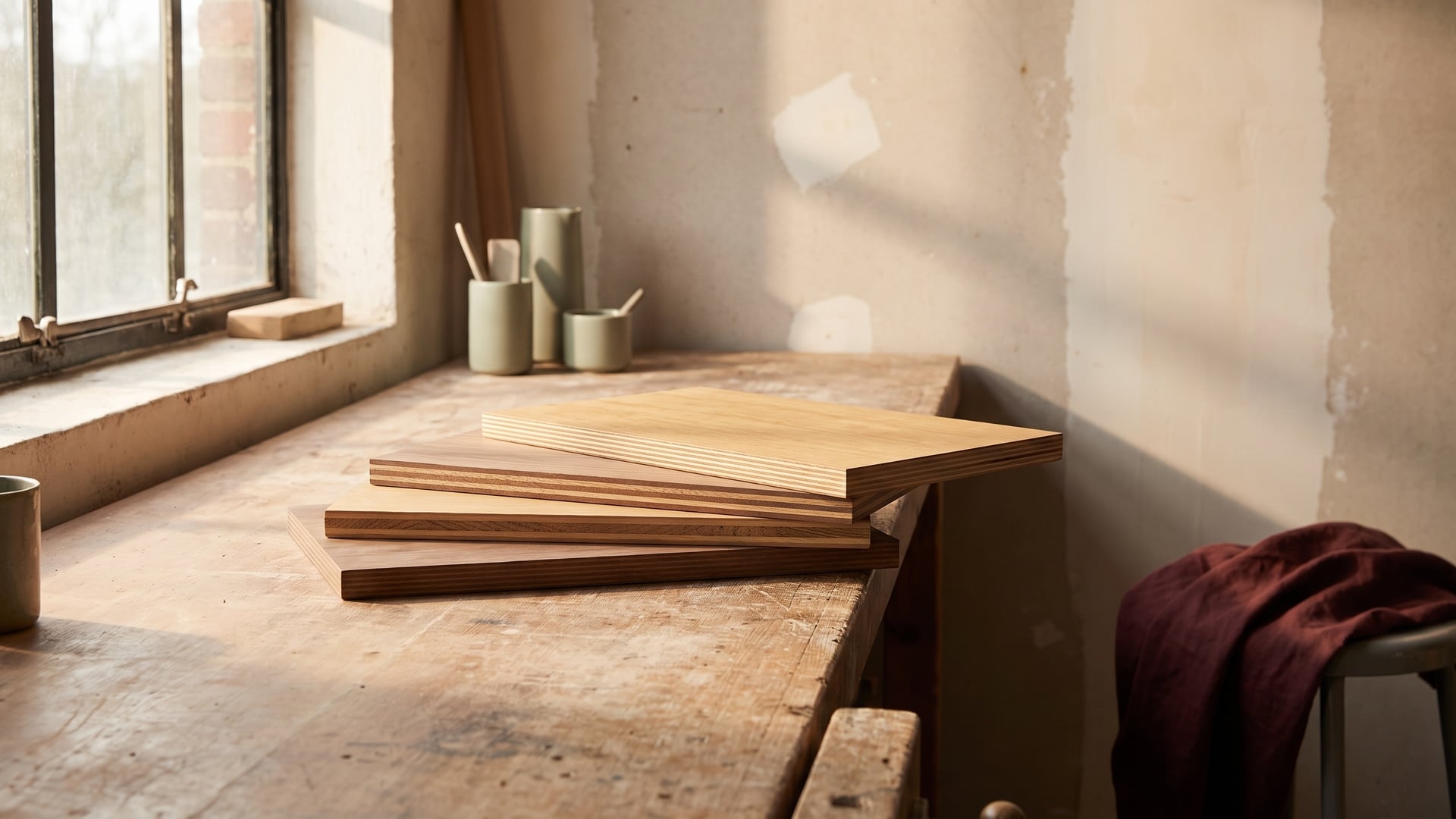
Plywood is wood, and wood is hygroscopic — it takes up and gives off moisture until it balances with the air around it. Gain moisture and the fibres swell a little; lose it and they shrink. Cross-bonded plywood holds this in check: because each ply pulls against the grain of its neighbours, and the construction is symmetrical about the centre line, the movements of the layers cancel out and the sheet keeps its shape. That symmetry is the whole trick, and warping is what you see when it breaks.
There are only two ways to break it, and nearly every warped panel is one or the other. The first is unequal moisture: one face gains or loses water faster than the other, so it swells or shrinks while its opposite stays put, and the panel curls towards the drier, tighter face. A sheet drying in the sun bows because the sun-struck face loses moisture first; a sheet against a damp wall bows because the wall-side face gains it first. The second is unbalanced construction: a laminate, polish or sealer on one face and nothing on the other, so the two sides pull with different force even in steady air. Grasp those two and every rule that follows becomes obvious.
Store it flat, store it dry
The single most common cause of a bowed panel is the way it waited to be used. Plywood wants to be stored lying flat, fully supported, in a dry and shaded place — and most site storage fails at least one of those three.
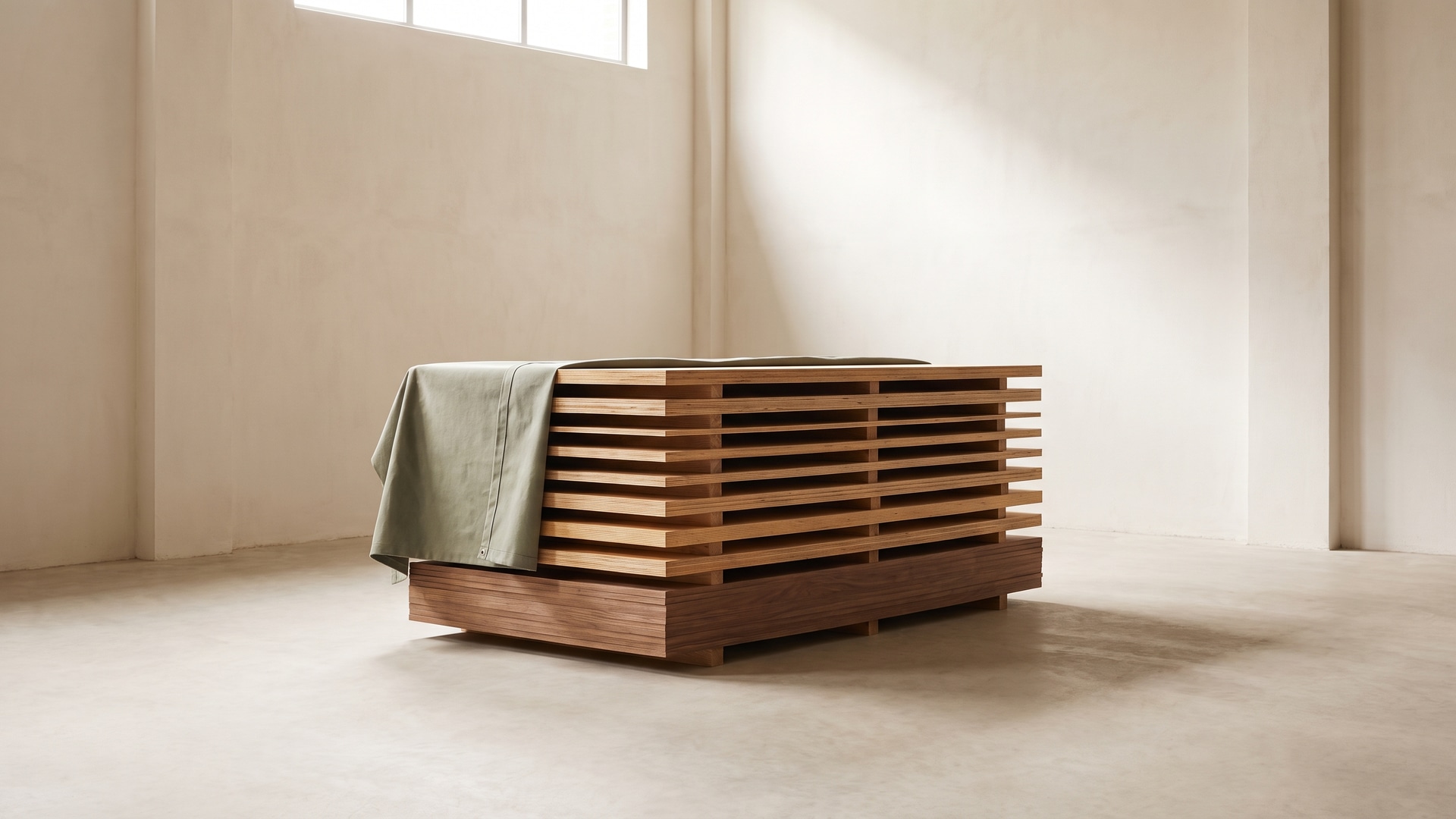
- Lay it flat, never on edge. A sheet stood on its long edge or leaned against a wall is supported along a thin line only, carrying its own weight as a bending load for days until it takes a bow that no later persuasion fully removes. Stack sheets flat, one on another.
- Support the whole sheet. Rest the stack on a flat, level surface, or on timber bearers spaced closely enough that the boards cannot sag between them — battens at roughly half-metre intervals are ideal. A stack propped on two end supports, or on an uneven floor, is slowly pressed into the shape beneath it.
- Keep it off a damp floor. A new or ground-floor slab, especially through the monsoon, gives off moisture steadily. Raise the bottom sheet on bearers or a pallet so air can move underneath and the lowest board is not drinking damp out of the concrete.
- Stay out of direct sun. Sun striking one face of a stack dries that surface faster than the shaded side, and the exposed top sheet can bow in a single afternoon. Store under cover, away from windows that throw a hard beam across the pile.
- Protect the top of the stack. The topmost sheet, with nothing above it, is the freest to move; a plain cover board or a little even weight keeps it honest. Leave factory bundles banded until you need them.
Give it time to acclimatise
Perhaps the most under-rated step of all costs nothing but patience. Plywood leaves the factory at a settled, low moisture content, then travels through whatever the weather and the warehouse hand it. The room where it will finally live has its own moisture level, set by the season, the ventilation and the wet trades still under way. Cut and fix a board straight off the truck and it comes to terms with that room after it is installed — moving while fixed, which is precisely when movement turns into a bow, a gap or a sprung joint.
The remedy is to let the boards sit in, or close to, the space where they will be used for a day or two before you cut them, stacked flat and loosely separated so air reaches every sheet. They quietly gain or shed the small amount of moisture needed to reach equilibrium with the room, and are then far more stable to work and far less inclined to move afterwards. This matters more in India than in most places, because our humidity does not sit still.
A board that has come from an air-conditioned godown into a freshly plastered, still-damp room is being asked to cross a wide humidity gap — a dry Delhi winter and a Mumbai monsoon are different worlds for a piece of wood. Let it make that crossing in the days before it is cut and fixed, not the weeks after. Across the swings between peak-summer dryness and monsoon damp, that couple of days of settling in is the cheapest insurance against movement you will ever buy.
Seal and balance both faces
If storage is where panels bow before fitting, unbalanced sealing is where they bow after. The principle is the same symmetry that keeps the board flat: whatever you do to one face, do to the other. A panel finished on the show face and left raw on the back is the classic recipe for a slow, stubborn cupping — the bare back breathes moisture freely while the sealed front cannot, so the two faces settle at different tensions and the sheet cups.
- Seal every edge. A cut edge is open end-grain, and end-grain draws moisture many times faster than a face. Unsealed edges are the quickest route to a swollen, wavy border and a panel that has taken on damp unevenly. Edge-band or seal every cut edge, the concealed ones included.
- Finish both faces, not only the one on show. Where a decorative laminate goes on the front, put a backing laminate or balancing sheet on the back; where the front is polished or lacquered, at least seal the back with a plain coat. The back need not be beautiful, but it must be closed to roughly the same degree as the front.
- Never leave one face open to a wet wall. Panelling fixed flat against masonry should be sealed on its hidden face and, ideally, held a few millimetres off the wall so air can move behind it. A raw back pressed against fresh plaster is a standing invitation to cup.
This balancing is structural, not a finishing luxury — a backing laminate costs a fraction of the show face it keeps flat.
Fix at the right centres
Even a perfectly stored, sealed and acclimatised panel will disappoint if it is asked to span too far with too little behind it. Plywood is stiff, but not infinitely stiff, and a large unsupported area will sag under its own weight over time or flex the moment it is leaned on. The answer is a sound framework and sensible fixing centres.
Back large panels with battens or a sub-frame so no expanse of board is left to keep itself flat over a long distance, and fix at regular, close centres rather than only at the corners — even fixings pull the panel to the straight line of the frame. For shelves, which carry load as well as their own weight, keep spans short or add a mid-support, and step up a thickness where the run is long; a sagging shelf is almost always one asked to span too far for its board. The heavier the load and the longer the run, the closer the support and the thicker the panel.
Handle it well while the room is still wet
Boards are at their most vulnerable in the hours they are being moved and worked — before they are fixed, and while the room around them is still wet from other trades. A little care here prevents both physical damage and the uneven moisture pick-up that leads straight to warping.
- Move large sheets on edge, with two people, and set them down flat. Do not drag a sheet from the bottom of a stack; it scuffs the face and can crack a corner.
- Keep nothing loaded on top of a flat stack. A toolbox, a paint tin or a bundle of offcuts left overnight presses a dent or a permanent set into the sheet beneath.
- Stand the plywood clear of the wet trades. Plastering, screeding and the first coats of paint push a great deal of water into a room; let that work dry before you bring panels in, and never fix joinery tight against green, still-curing masonry.
- Do not seal a panel over damp. A cabinet back or wall panel fixed across a wall that has not finished drying traps that moisture against itself — and a trapped, one-sided damp is exactly what makes a good board cup.
A pre-installation checklist
None of this is complicated or expensive. Before the first cut, a quick run through these points will catch almost every avoidable warp:
- Stored flat, on a level surface or close-spaced bearers — never leaning on edge.
- Raised off the floor, with air moving underneath, and kept out of direct sun.
- Acclimatised in or near the room for a day or two before cutting.
- Both faces balanced — laminate or finish on the back to match the front, never one side left raw.
- Every cut edge sealed or banded, concealed edges included.
- A proper frame behind large panels, with fixings at close, even centres.
- Wet trades finished and the room reasonably dry before boards are fitted.
- Right thickness for the span, with a mid-support on any long shelf.
A flat panel is a supported panel
It is worth ending where we began, because the whole of this comes down to one reframing. A warped panel is very rarely a bad board. It is almost always a good board that was stored on its edge, cut the day it arrived, sealed on one face and left raw on the other, or fixed across too long a span. Each is a small decision, made or missed in a moment on a busy site — and each is entirely within your control.
Get them right and the plywood does exactly what it was built to do. Store it flat and fully supported, keep it dry and out of the sun, give it a day or two to settle into the room, seal its edges and balance both faces, fix it to a sound frame at proper centres, and handle it with care while the room finishes drying. Do that and even a large sheet stays flat — season after season, through the sharpest swing from monsoon damp to peak-summer heat. A flat panel is not luck; it is a panel that was supported, sealed and given time. Look after the balance the board was made with, and it will hold that balance for you.