Turn a sheet of plywood over and look at the back. Somewhere on that face — usually ink-stamped straight onto the board, sometimes on a small pasted label — is a cluster of letters and numbers most buyers glance past as branding. It is nothing of the sort. That stamp is the board's specification: a compact, testable statement of what the sheet is, who made it, to which Indian Standard it was built, and whether an outside authority has certified the claim. The face veneer is chosen for the eye. The stamp is written for the record.
This matters because plywood is the one building material where the important qualities are invisible once the laminate goes on. You cannot see the resin, the core, or the bond from across a showroom, and a confident sales pitch fills that gap with adjectives — waterproof, marine, premium, gold. The stamp is where the adjectives have to become a number you can hold to account. Learning to read those few square centimetres is the single most useful skill a plywood buyer can have. This article decodes the stamp field by field, so you know exactly what you are buying before it leaves the counter.
The stamp is a specification, not decoration
Think of the stamp as the board's passport rather than its logo. A genuine one carries, in some order, the manufacturer's name, the grade of the board, the Indian Standard it conforms to, the ISI mark with a licence number, the nominal thickness, and a batch or production code. Read together, these tell you what job the sheet is fit for and let you trace it back to the exact run it came from.
None of this is on the face, and that is the point. The stamp on the back is the only place the board commits itself to a claim that can be checked — against a standard, against a laboratory test, and against the Bureau of Indian Standards itself. Before you judge a sheet by its face, flip it and read what it has been made to promise.
The two numbers that matter most
Almost everything else on the stamp is context for one detail: the IS number. For plywood, two numbers carry most of the weight, and knowing them is most of the battle.
IS:710 is the standard for boiling-waterproof (BWP) marine-grade plywood. It is bonded with phenolic resin and must survive prolonged immersion in boiling water without the plies letting go, along with tests for fungal resistance and preservative treatment. This is the board for kitchens, bathrooms, utility areas, exteriors and anything structural — wherever water genuinely lives.
IS:303 is the standard for general-purpose plywood, the grade you will meet most often as moisture-resistant (MR). It is verified against humidity and cold water rather than boiling, and it belongs in dry interiors: wardrobes, TV units, bookshelves, partitions and the like. It is an honest, economical product used in the right place, and a false economy used in the wrong one.
Fix these two in mind and the stamp speaks plainly. The rest of the label — the ISI mark, the licence, the batch code — exists to prove the IS number printed there is real.
When the claim and the number disagree, trust the number
Here is where a stamp earns its keep. The words a board is sold with and the standard it is built to are two different things, and they do not always agree. Terms such as marine, waterproof, platinum and club grade are marketing language with no fixed legal meaning. The IS number is the specification. When they conflict, the number wins, every time.
So if a sheet is talked up as marine but the stamp reads IS:303, you are holding a moisture-resistant board whatever the sticker says — it has been tested as MR and will behave as MR the first time it meets standing water. Conversely, a board stamped IS:710 yet offered at a suspiciously low price should make you question the certification, not congratulate yourself on a bargain. Genuine BWP has a real cost floor: phenolic resin, better core veneers and preservative treatment all cost more. The adjective flatters; the number commits. Read the number, match it to the room, and let the salesmanship wash over you.
The ISI mark and the licence number
An IS number on its own is only a claim — anyone can print “IS:710” on a board. What turns a claim into a certification is the ISI mark: the registered monogram issued by the Bureau of Indian Standards (BIS) to manufacturers licensed to make a product to a given standard. Crucially, a genuine ISI mark never travels alone. It always appears with two companions: the IS number it certifies, and a licence number.
That licence number is the heart of the whole system. It is usually written in a format such as CM/L followed by a string of digits, and it identifies the specific factory that BIS has authorised to stamp that specific standard. The letters “ISI” with no IS number and no licence number beside them are decorative at best and dishonest at worst.
The buyer's real power is that this can be checked independently. BIS publishes licence details, and you can cross-check a number yourself:
- Use the BIS Care app or the BIS website (bis.gov.in) and enter the licence number from the stamp.
- Confirm the firm and product that come up match the board in your hands — the manufacturer, the product, and the standard should all line up.
- Check the licence is live and covers the grade being sold, not lapsed or issued for a different product.
If the number does not resolve, or resolves to a different firm or product, the mark is not what it pretends to be. A two-minute check against an outside authority tells you more than any assurance across the counter.
The rest of the stamp worth reading
With the standard and certification settled, the remaining fields fill in the detail and give the board an identity you can refer back to:
- Manufacturer or brand name — a genuine sheet is proud to name its maker on the board itself, not only on a swing tag that can be swapped.
- Grade — MR, BWR or BWP spelled out, and any core description such as full hardwood core. This should agree with the IS number, not contradict it.
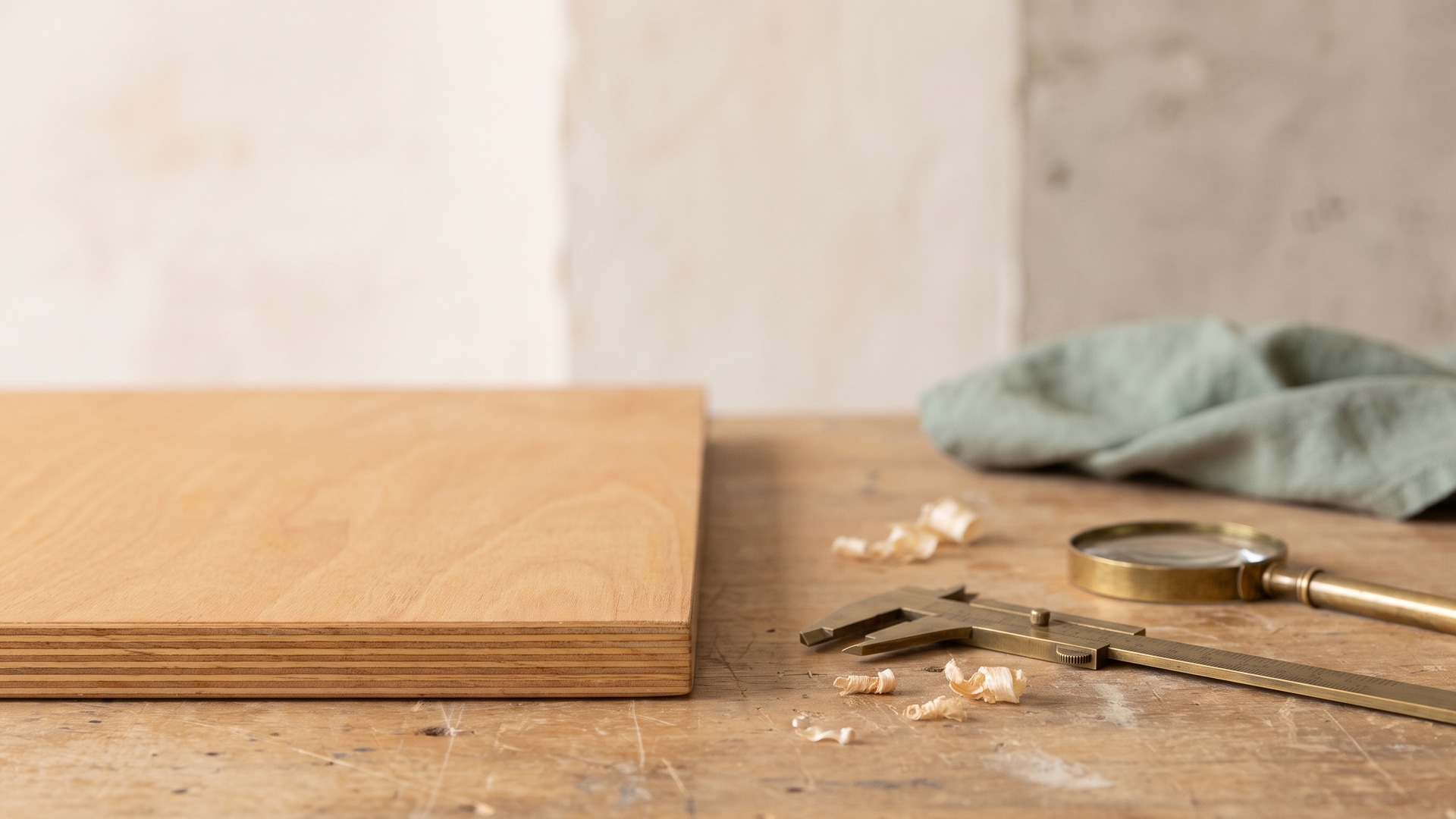
- Thickness — the nominal figure, such as 6, 12 or 19 mm. Worth confirming with a caliper at the corners, since a calibrated board holds its stated thickness across the whole sheet.
- Batch or production code — often with a date or shift marking. This is the board's fingerprint: it ties the sheet to the exact run it came off, and it is the field that makes a warranty claim traceable.
- Treatment and dimensions — many boards note borer and termite treatment and the sheet size, confirming the preservative claim is part of the specification, not a verbal add-on.
How counterfeit and misleading marks give themselves away
Fakes and half-truths tend to fail in the same recognisable ways. Once you know the tells, most of them are caught in seconds:
- ISI letters with nothing to back them — the monogram or the word, but no IS number and no licence number anywhere near it.
- A licence number that will not verify — it returns no result on the BIS app or website, or points to a different company or a different product entirely.
- Marketing everywhere, standard nowhere — “100% waterproof” and “marine” splashed across the sheet, but no IS number stamped on the board.
- A claim that fights the number — premium, marine language sitting above an IS:303 stamp.
- Sloppy or removable marking — smudged, off-centre or inconsistent printing, or a stamp that wipes or peels off. Genuine marks are printed cleanly and durably onto the board.
- Only a paper tag, no stamp on the board — a stapled label is easy to move from a good sheet to a bad one; insist the mark is on the board itself.
- A “deal” that undercuts reality — a steep discount on a supposed marine sheet. With One India · One Price, a genuine board costs the same in Kochi or Kanpur, so a wild bargain usually means the grade, the certification or the invoice is not what it seems.
The invoice is the other half of the label
The stamp identifies the board; the invoice ties that board to you, this purchase and this batch — and you need both. A warranty against delamination, borer or termite is only worth something if you can later prove precisely what you bought and when. That proof is the batch or production code recorded on the invoice, sitting alongside the grade and the standard.
So do one small thing at the counter that pays off for years: ask for the batch or production code from the stamp to be written onto the invoice, and keep the two together with any warranty document. If a problem surfaces in year three of a monsoon-and-heat cycle, that paired record is the backbone of the claim. Without it, even a genuine board can leave you with a promise no one can trace.
This is also the plainest argument for buying from an authorised dealer. Authorised stock is traceable to the manufacturer, the invoice is genuine, the price is the published One India · One Price rather than a mystery discount, and the warranty is honoured because the chain from factory to buyer is unbroken. A grey-market bargain with a vague or missing invoice has no warranty behind it, however impressive the stamp may look.
A 30-second label-reading checklist
Take this to the counter and run it on every sheet before you commit:
- Flip the board and find the stamp printed on the sheet itself, not only on a hanging tag.
- Read the IS number — 710 for BWP marine, 303 for MR — and match it to the room the board is going into.
- Find the ISI monogram and a licence number together; treat the mark as meaningless without both.
- Verify the licence number on the BIS Care app or bis.gov.in, and confirm the firm, product and standard match.
- Check the claim against the number — no “marine” talk sitting over an IS:303 stamp.
- Note the batch or production code and confirm the thickness at the corners.
- Get the batch code onto the invoice and keep the invoice and warranty together.
- Buy from an authorised dealer at the listed price, not a grey-market discount.
The stamp tells you more than any sales pitch
A showroom is full of talk, and most of it is sincere enough — but talk describes a board, it does not certify one. The stamp on the back is quiet and specific where the pitch is warm and general, and it is the only part of the whole transaction that can be measured against an authority outside the shop. A salesman tells you what the board is like; the IS number and the ISI licence tell you what it has been tested and certified to be; the batch code and the invoice make sure that promise still has your name on it years from now.
None of this asks for expertise, only the habit of turning the sheet over and reading a few lines before you read the price. Do that, and you stop buying plywood on persuasion and start buying it on evidence. In a market where the most important qualities hide beneath the surface, the small print on the back is the most honest thing in the room — and no sales pitch can tell you anything the stamp has not already told you first.