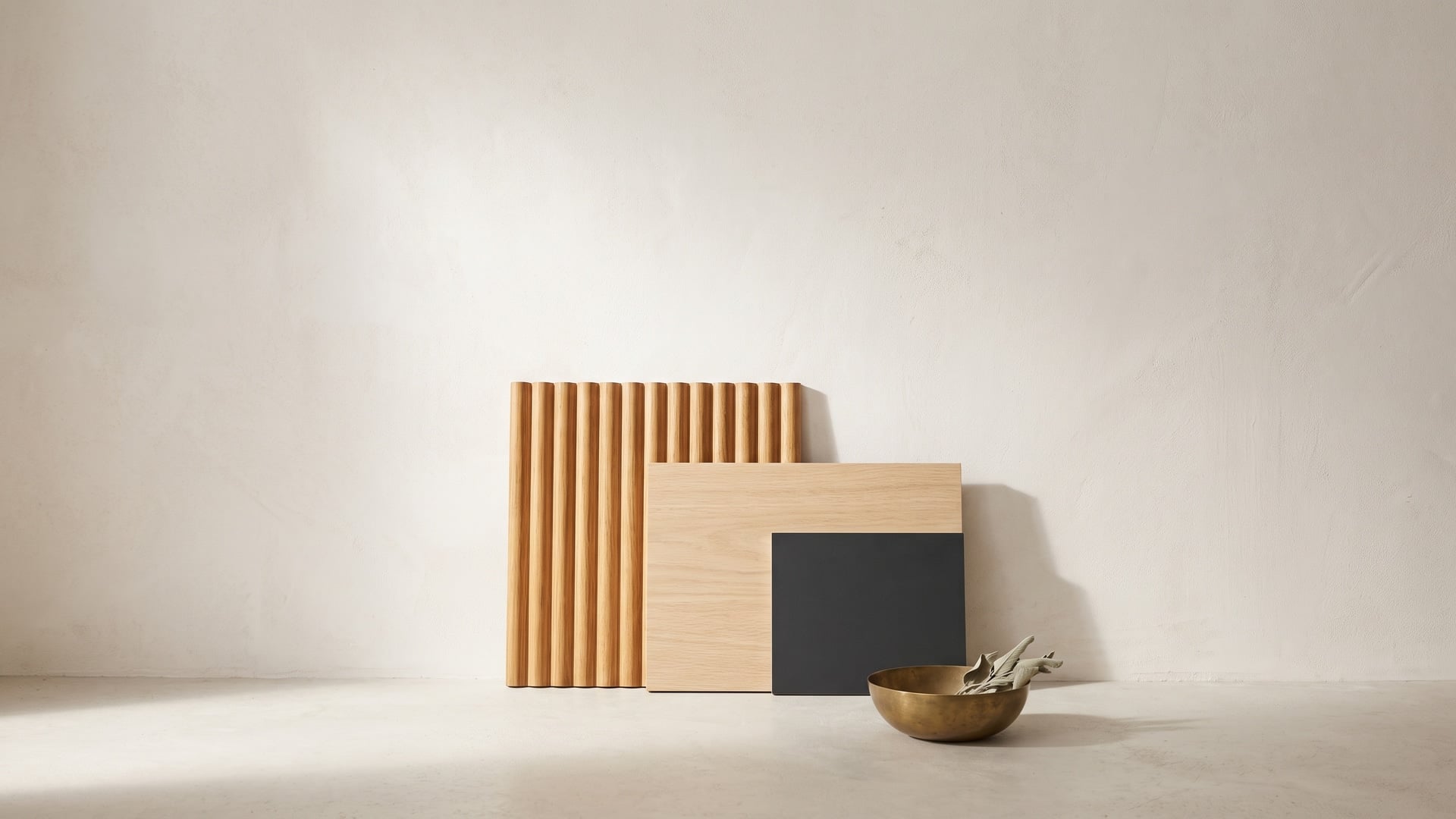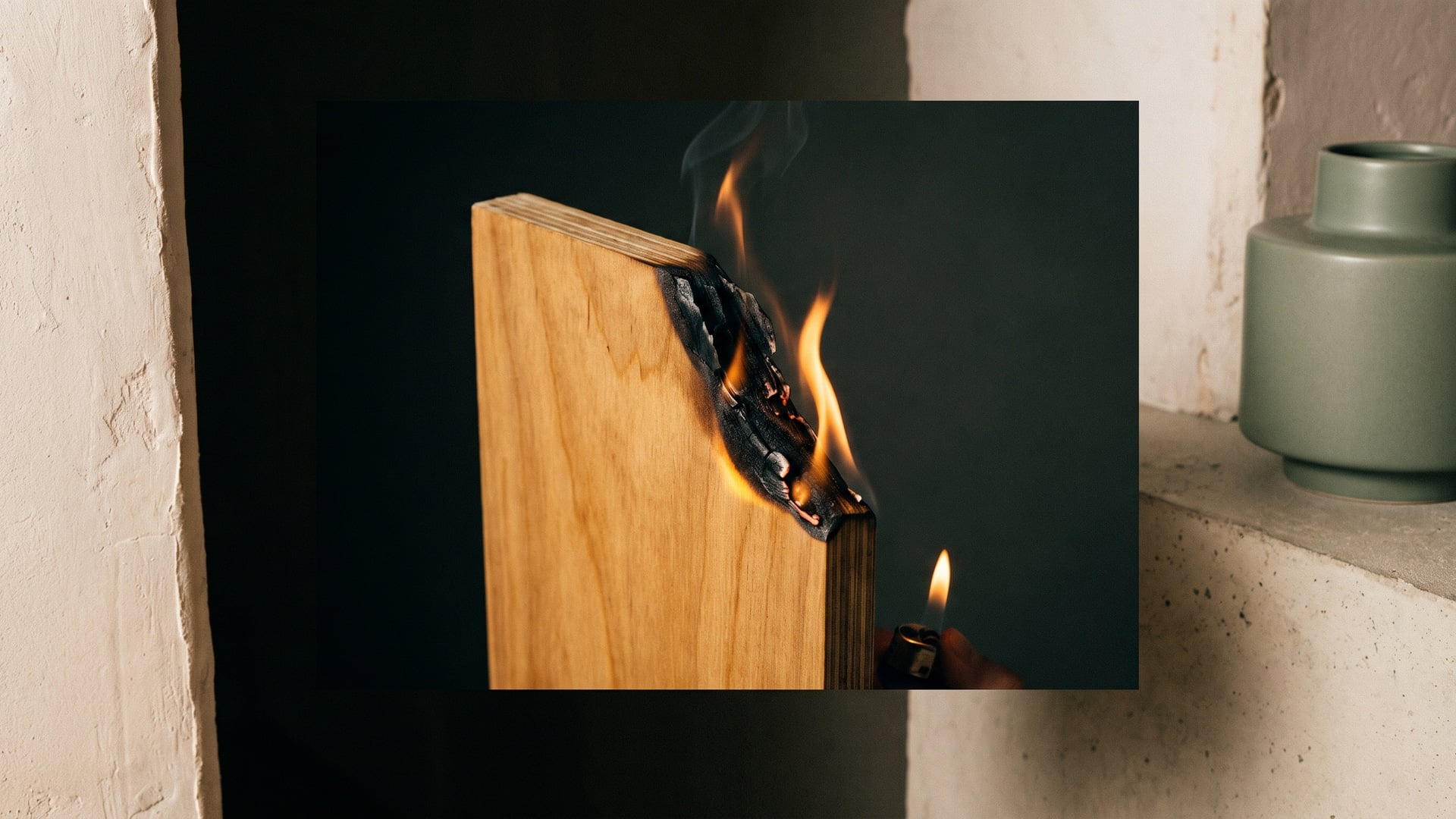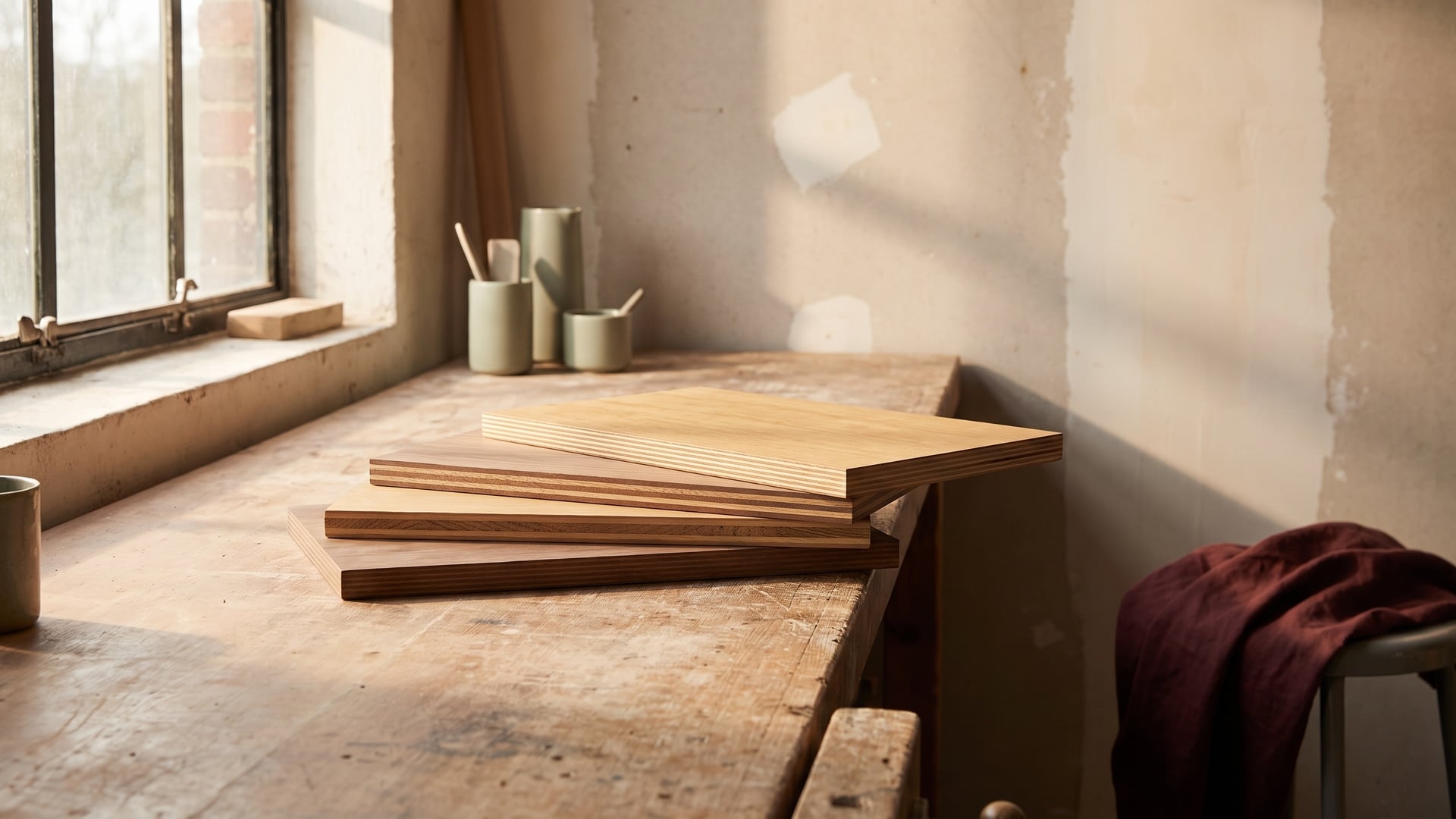
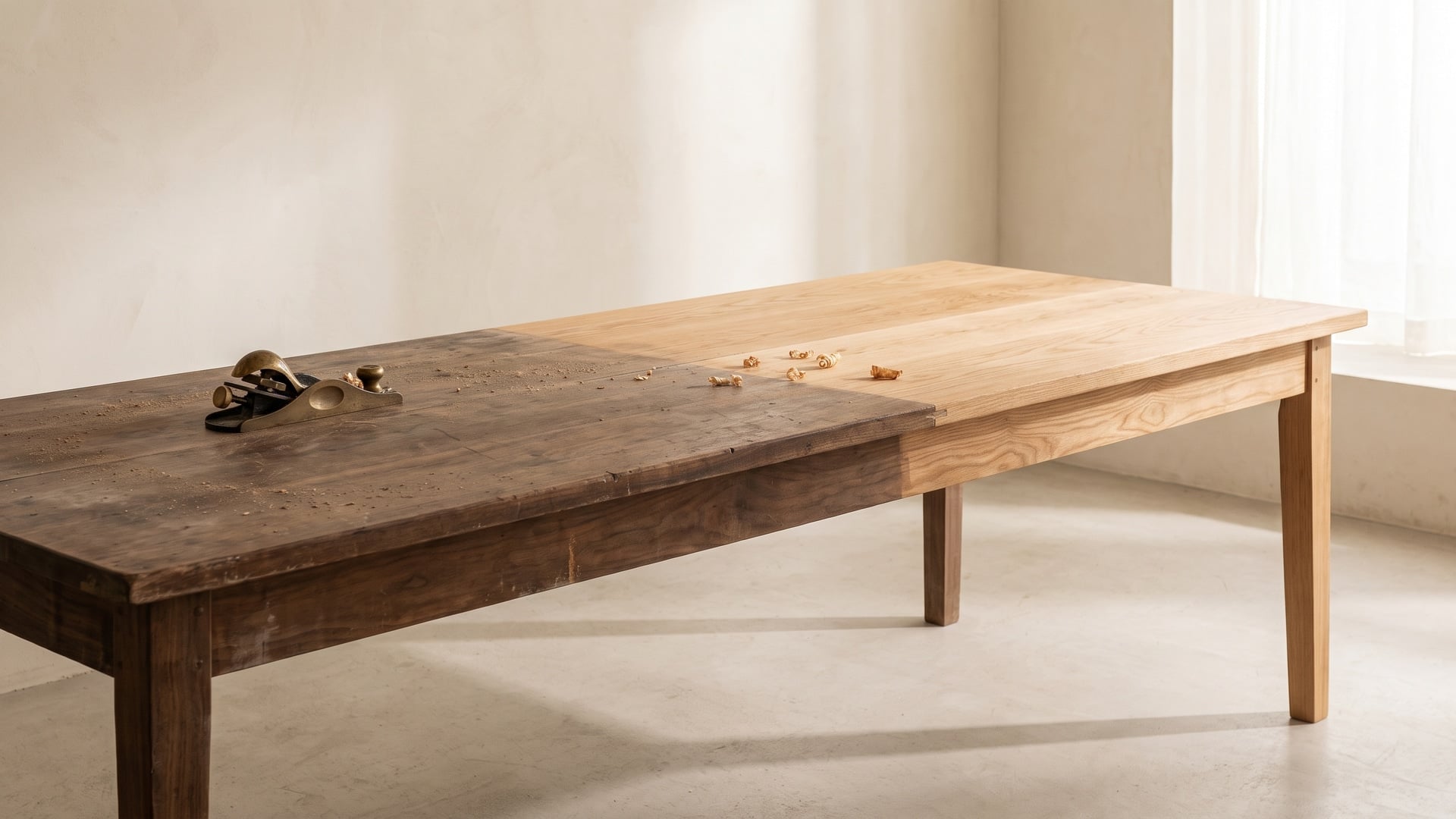
There is a moment in the life of almost every wooden surface when it begins to look tired — a worktop gone dull and cloudy, a door with a pale ring where a glass once sat, a wardrobe front scuffed at the handle and scratched along its lower edge. The instinct, more often than not, is to tear it out and start again. It is a costly instinct, and frequently a mistaken one. A surface that has lost its lustre has not necessarily lost its life; very often the timber beneath is perfectly sound and only the thin skin of finish on top has worn. Telling those two apart — a surface that needs reviving from one that genuinely needs replacing — is among the most useful skills a homeowner, builder or architect can carry.
That difference is worth real money, and more than money. Replacing a built-in panel means new material, the labour to strip out the old and fit the new, a room turned briefly into a worksite, and the quiet waste of a piece that might have been saved. Refinishing, where it is the right call, avoids nearly all of that — while refinishing the wrong surface only postpones the inevitable and wastes the effort besides. This article sets out how to assess an ageing surface honestly, when to revive it, when to let it go, and how choices made at the very outset decide which of those futures a surface will have.
A worn surface is not a lost surface
Begin with what a finish is actually for. The lacquer, polish, oil or wax on a wooden surface is a sacrificial layer — it exists precisely so that daily life wears the coating rather than the wood. Every scuff a shutter takes at the handle, every faint scratch a worktop gathers, every slow dulling under years of wiping is the finish doing its job and taking the punishment on the timber's behalf. So when a surface starts to look weary, the honest first question is not “is the wood finished?” but “is the finish finished?” — and the answer, surprisingly often, is that only the top skin has aged while the material beneath is entirely sound. A tired surface and a failed one can look identical from across a room yet call for opposite responses, and much avoidable expense comes from confusing the two.
When reviving is the right call
Real-wood veneer and solid-timber surfaces can very frequently be revived, and the trouble that responds best is exactly the kind that looks worst day to day: cosmetic wear that lives in the finish rather than the wood. If the damage sits on top — in the coating, not the fibre — it is almost always a candidate for reviving. The common cases:
- General dullness and loss of sheen. Years of wiping and dust leave a surface flat and lifeless; a thorough clean and fresh wax or a light re-coat bring the depth straight back.
- Light surface scratches. Fine lines that catch the light but do not snag a fingernail sit in the finish alone, and lift with careful cleaning, buffing and re-waxing — often disappearing entirely.
- Smudges, hazing and minor marks. Everyday grime, cloudiness and dull patches are a cleaning-and-refresh problem, not a replacement one.
- Water rings and light stains on sealed wood. A white ring from a wet glass usually sits in the wax or lacquer rather than the timber, and can often be lifted with gentle heat, fresh wax or a careful local re-coat.
- Dryness and greying on oiled or waxed timber. These finishes are meant to be topped up; a thirsty, faded panel simply needs feeding, and a fresh coat of oil or wax restores both colour and protection.
The methods are modest and honest — work a good carpenter or french-polisher can do in place: clean back the grime, lift what marks will lift, feed an oiled surface, or lay fresh polish over a lightly keyed one. India has a long, living tradition of re-polishing rather than discarding — the instinct that keeps a grandmother's teak almirah cared-for across generations. It applies as much to a modern veneered panel as to an heirloom.
How to read the damage honestly
Every sensible decision rests on one diagnostic question: is the damage in the finish, or in the material? Damage in the finish is a surface problem with a surface cure. Damage in the material — the wood, the veneer or the board beneath — is structural, and no amount of polishing will truly mend it. Telling them apart takes a few minutes and a little honesty.
Run a fingernail lightly across the mark: if it glides over and catches nothing, the damage is shallow and almost certainly cosmetic; if it drops into a groove or snags a lifted edge, the trouble has reached the wood. Look at whether colour has genuinely changed in the timber or only the sheen has dulled — a darkened or blackened patch soaked into the fibre is a different matter from a cloudy film sitting on top of it. Press the surface: sound wood is firm, while anything soft, spongy or crumbling has taken in moisture and begun to fail. And test any cleaner, wax or solvent in an inconspicuous corner first, so a rescue attempt never becomes fresh damage of its own. Be truthful at this stage; calling a deep problem “just a scratch” is exactly what leads to money spent twice.
When it is genuinely time to replace
Honesty cuts both ways, and part of a manufacturer's job is to say plainly when a surface is beyond reviving. Some damage is structural, and refinishing over it is not a repair but a cosmetic delay. The clearest signs that a panel has reached the end of its serviceable life, rather than merely the end of its finish, are these:
- Delamination or bubbling. When a laminate or veneer lifts, blisters or bubbles away from the board, the bond has failed — not the coating. Re-coating the top does nothing for a glue line that has let go.
- Swelling, warping or a spongy board. Water that has reached the core makes it swell, buckle or go soft, and no surface work restores flatness and firmness. In our monsoon climate this is the commonest structural failure of all — a leak under a sink or a persistently damp wall quietly destroying the panel from within.
- Veneer worn or sanded through to the substrate. Real-wood veneer is a thin layer of genuine timber, often well under a millimetre, and there is only so much to work with. Once it wears through — or is sanded through in over-enthusiastic refinishing — the board beneath shows, and no re-coating disguises it.
- Burn-through, deep gouges and cracks in a wear layer. A laminate's decorative surface is a finished skin; a cigarette burn or a chip that reaches the kraft below cannot be polished out, because there is no depth of material to polish into.
- Rot, active infestation or penetrating black stains. Softness, frass or dark staining that has entered the fibre points to decay or pest damage a finish cannot address and should never seal over.
The unifying principle is simple: if the substrate or the bond has failed, replace; if only the surface has worn, revive. Refinishing buys nothing on a board that has already lost its integrity.
Why the material you chose decides the ending
Here is the part that belongs at the start of a project rather than the end of a surface's life, because it is where the question is really settled: whether a tired surface can be revived at all is largely decided the day it is specified. Real wood — solid timber and genuine veneer — is inherently repairable. It can be cleaned, re-oiled, re-waxed, lightly sanded, re-coated, patched and blended across its life; a scratched, dulled or ringed veneer door is often a morning's work away from looking new. It forgives, and it can be brought back — a quiet, practical argument for real wood that rarely reaches the brochure.
Laminate is a different proposition, and it is fairer to both materials to be candid. A decorative laminate is a hard, sealed, factory-cured wear-surface — superb precisely because it shrugs off punishment that would mark natural wood in a season, and the right choice on a worktop, a vanity or a run of hard-used shutters. But that same finished perfection is why a failed laminate generally cannot be locally refinished: when it chips, burns through or delaminates, you replace the panel rather than revive the surface. Neither fact is a criticism — it is the trade each material makes. So design for repairability where it counts: put real wood on the feature surfaces you will want to keep and refresh for years, and reserve laminate for the hard-working faces where its toughness earns its keep and local repair is unlikely to be needed.
The quieter cost: waste avoided
There is a further reason to revive rather than replace, and it has nothing to do with the invoice. Every new panel carries an environmental cost the tired one has already paid — the timber and resources to make it, the energy pressed into it, the transport to bring it, and, at the far end, the old surface sent to landfill for no better reason than a worn coat of finish. Refinishing sidesteps almost all of that: a tin of wax, a fresh coat of lacquer and an afternoon's care extend the working life of something that already exists, which is very nearly always the lower-impact choice.
This dovetails with buying well in the first place. A properly made, ISI-marked board of the right grade for its exposure — boiling-waterproof (BWP, to IS:710) where water and humidity reach, moisture-resistant (MR, to IS:303) in the dry interior — is a surface built to be worth reviving, one whose core is still sound when its finish has aged. Cheap boards fail in the substrate, where no refinishing can help; good boards fail, if at all, only in the finish, where a refresh sets them right. Longevity and repairability are two halves of the same idea, and both begin at specification.
A refinish-or-replace decision guide
Standing in front of a tired surface and weighing what to do, work through this checklist in order — it moves from the cheapest, most reversible test to the final call:
- Clean it first. A genuine deep clean removes grime, haze and old polish, and often reveals that far less is wrong than it appeared. Never judge a surface until it is clean.
- Do the fingernail test. If your nail glides over the marks and catches nothing, the damage is in the finish — lean towards reviving.
- Press for firmness. If the board is soft, spongy, swollen or warped anywhere, moisture has reached the core — replace that panel.
- Check the bond. Any lifting, bubbling or delamination of laminate or veneer means the glue line has failed — replace, do not re-coat.
- Look for the substrate. If veneer has worn through to the board beneath, or a laminate has burned or chipped through its decor layer, there is nothing left to refinish.
- Ask what the material allows. Real wood and veneer can be re-oiled, re-waxed or re-coated in place; a failed laminate surface generally cannot.
- Test any treatment in a hidden spot before committing to the whole surface.
- Cosmetic, revive; structural, replace. In genuine doubt, try the reversible reviving step first — you can always replace later, but you cannot un-replace a panel torn out too soon.
Before you rip it out, ask
The habit worth building is a small pause before a large decision. A surface that looks past saving from the doorway has, more often than not, simply spent its finish and kept its substance — and the gap between those two states is the difference between an afternoon with a tin of wax and a fortnight of demolition, cost and dust. Refinishing is not a lesser, make-do option; on a sound board it is the intelligent one, kinder to your budget, to the room and to the world outside it.
So before you call the carpenter to strip out the wardrobe, the door or the worktop, ask the honest question first: does this surface need replacing, or does it just need reviving? Read the damage truthfully — finish or fibre, surface or structure — and let that reading, not the first flush of dismay, make the decision. Replace what has genuinely failed, without hesitation and without pouring good effort after a lost cause. But revive what has merely grown tired, because a great deal of what looks finished is only waiting to be brought back. Very often, a worn surface is not asking to be let go — only to be cared for, and, given that care, it will go on serving for years to come.