You do not need a laboratory to judge a sheet of plywood. That is worth saying plainly, because the talk around plywood — resins, cross-linking, boiling-water cycles, micron tolerances — can make quality feel like a mystery only a chemist could settle. It is not. The very qualities that decide whether a board lasts a decade or swells apart in a single monsoon leave visible, audible, physical traces, and almost every one can be read at the dealer's counter with nothing more than your eyes, your hands, a few minutes and, if you want to be thorough, a cheap caliper.
This matters because plywood hides its faults better than almost any material in the house. Once a sheet is laminated, edge-banded and screwed into a wardrobe or a kitchen carcass, the core is sealed away for good — the voids, the gaps, the under-thickness and the weak bond all vanish behind a handsome face veneer, and you meet them again only years later when a shutter sags or an edge lifts. So the counter is the one place you can still catch a weak board: before it becomes furniture, before your money is committed, while you can still put it down and ask for better. What follows is five quick field tests, a handful of bonus checks, the red flags that should end a sale, and a printable checklist to carry with you.
Test one: read the cut edge
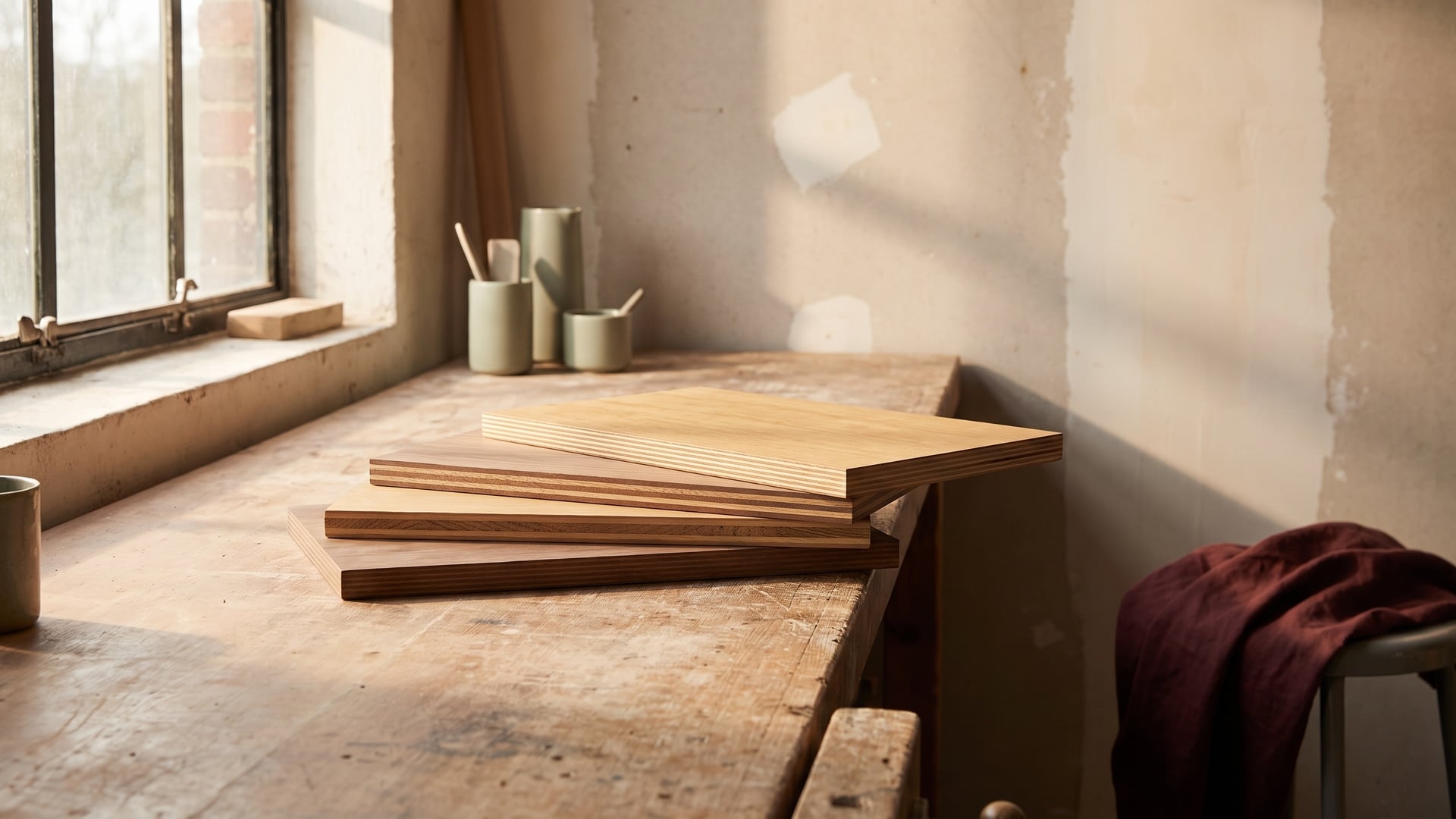
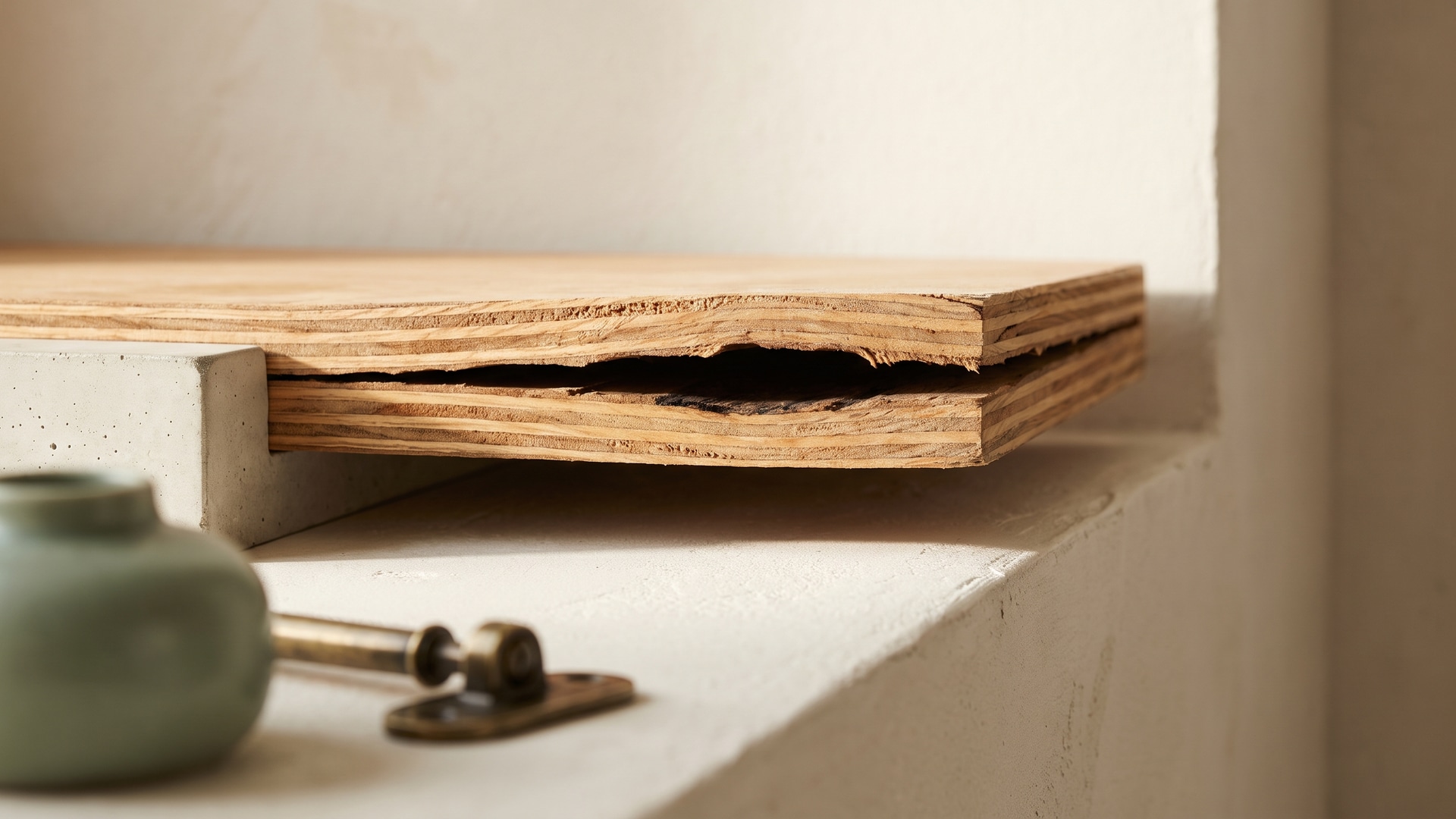
The face of a board is chosen to impress you; the edge is where it tells the truth. Ask the dealer for a freshly cut edge, or examine the factory-cut edge of the sheet, and look at it as a cross-section — a clean slice through everything the laminate will later hide. A good board shows tight, even, parallel plies of fairly uniform thickness, with continuous glue lines and a core packed solid from edge to edge. There is no daylight in it.
A weak board gives itself away here, and once you know the tells they are hard to miss:
- Gaps and voids — dark hollows or empty pockets between the plies where the core veneers do not meet. These trap moisture, refuse to hold a screw, and eventually telegraph as dips through the surface.
- Overlaps and core gaps — places where core strips ride up over one another in a lump, or leave a space because a strip is simply missing. Both mean an uneven core that will never sit flat under load.
- Wavy or mismatched plies — veneers that wander in thickness, or a core built from odd offcuts and soft filler species rather than clean, consistent hardwood.
- A soft or powdery core — run a fingernail or a key along the edge. Good core resists it; a poor one crumbles or powders, a sure sign of low-density filler wood.
Two quick habits sharpen the read. Count the plies — they should be an odd, consistent number, and a board padded out with a few thick, cheap veneers is rarely as sound as one built from more and better layers. And note the colour of the glue lines: the phenolic bond in genuine BWP runs darker, a reddish-brown to near-black, while the urea bond in MR is paler. A dark line alone proves nothing, but a suspiciously pale line on a board sold as marine is worth a second look.
Test two: tap it, lift it, feel the weight
Your ears and your arms are better instruments than you think. The tap test is the oldest in the trade: rap your knuckles firmly across the board, from corner to centre. A well-made board answers with a solid, dense, uniform note wherever you strike it — the sound of continuous core with nothing missing inside. A poor board betrays its voids with a change in tone: a hollow, drum-like or rattling sound over the empty pockets where the plies never properly bonded. If the note wanders as you cross the sheet, so does the quality.
Then lift it. A full hardwood-core board of a given size and thickness has a reassuring, consistent heft — a density you can feel. A sheet that seems oddly light is often hiding a low-density filler core, internal gaps, or plain under-thickness. Weight is not the whole story, but paired with the tap test it is telling. Best of all, set two sheets of the same nominal size side by side and lift each: the weaker one usually announces itself in your hands. Flex a corner too — a quality board is stiff and springs back, where a tired one feels soft and floppy.
Test three: check it flat and true
Plywood is meant to be dead flat, and a board that will not lie flat in the shop will not lie flat in your furniture either. Stand the sheet on one long edge and sight down the surface as you would look down a snooker cue or a rifle barrel. Distortion that is invisible face-on jumps out along a sight-line. You are hunting three faults:
- Bow — a curve running along the length of the sheet.
- Cup — a curve across the width, so the sheet dishes or crowns.
- Twist — the worst of the three, where the four corners no longer sit in one plane and the sheet winds like a propeller.
Lay the sheet flat on a level floor and see whether it rocks or a corner lifts, then run a straight edge or spirit level across the face and both diagonals to confirm. A mild bow can often be pulled flat when the board is fixed down, but twist is very hard to correct and should be treated as a defect you walk away from. Warp of any kind points to unbalanced construction, uneven drying or moisture — a well-built sheet with balanced veneers either side of the core stays flat through the humidity swings of an Indian year, while a badly built one only worsens once it is in the house.
Test four: read the stamp on the back
Everything so far tests the body of the board; this tests its paperwork. Flip the sheet over and find the specification stamped onto the board itself — not merely printed on a swing tag that can be moved from a good sheet to a bad one. A genuine stamp carries, in some order, the manufacturer's name, the grade, the Indian Standard the board is built to, the ISI mark with a licence number, the thickness, and a batch or production code.
Two numbers do most of the work. IS:710 is boiling-waterproof (BWP) marine grade, for kitchens, bathrooms, exteriors and anything that genuinely meets water; IS:303 is the moisture-resistant (MR) grade for dry interiors. Match the number to the room, and remember that marketing language is not a grade — marine, platinum and 100% waterproof mean nothing without an IS number to back them. The ISI mark, too, is only real when it travels with a licence number (commonly in a CM/L format), which you can check in under a minute on the BIS Care app or at bis.gov.in. If the licence will not resolve, or points to a different firm or product, the mark is decoration, not certification.
Test five: insist on a written warranty
The last test is a question you ask out loud: will you give me this in writing? A manufacturer confident in its board stands behind it with a written warranty against delamination, borer and termite — on paper, with a stated duration and clear terms, not a warm verbal assurance across the counter. If the warranty lives only as spoken confidence, treat it as though it does not exist.
A warranty is only as strong as your ability to prove what you bought, so tie the paperwork together before you leave. Ask for the batch or production code from the stamp to be written onto the invoice, and keep the invoice and the warranty document together. If a shutter delaminates in year three of the monsoon-and-heat cycle, that paired record is the backbone of the claim. And here is the quiet reason the warranty matters beyond its own words: it is honoured only through an unbroken chain from factory to buyer. A genuine invoice from an authorised dealer keeps that chain intact; a grey-market bargain with a vague or missing bill has no one standing behind it, whatever the stamp promises.
A few bonus checks when you can
When the purchase is large or the grade is critical — a full kitchen, an exterior job — a few extra checks earn the minutes they cost, especially if the dealer will spare you a small offcut:
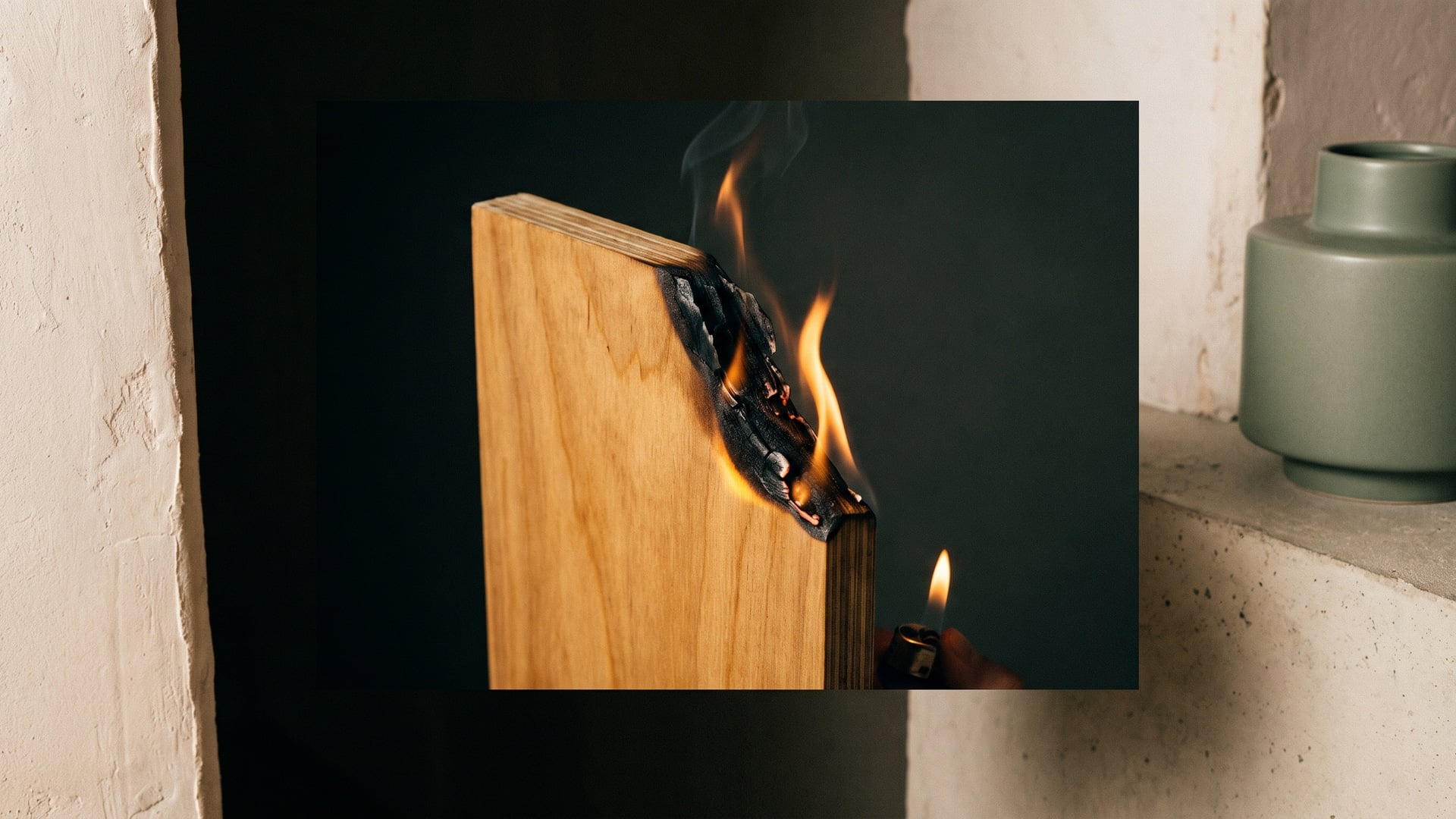
- The soak or boil test. Take a small offcut home, soak it overnight in water, or boil it for a couple of hours. Genuine BWP comes through with its plies intact; an MR board or a fake sold as waterproof will swell, blister and begin to separate. Nothing exposes a false grade more plainly.
- The smell of the resin. Properly cured resin gives off only a mild, clean odour. A sharp, harsh, eye-watering chemical reek suggests poor curing or excess free formaldehyde — a marker of cheap resin and a board that will keep off-gassing indoors.
- The caliper check. Measure the thickness at several points and at each corner. A calibrated board holds its nominal figure — 6, 12 or 19 mm — uniformly across the whole sheet. Thickness that falls short of the stamp, or varies from corner to corner, points to poor calibration or defects sanded away.
Red flags that should make you walk away
Any one of these is reason enough to put the board down and ask for better, or to try another dealer altogether:
- No stamp on the board — only a paper tag, or only marketing words, with no IS number printed on the sheet itself.
- An ISI mark with nothing behind it — the letters but no licence number, or a licence that will not verify or resolves to another company or product.
- Visible voids, overlaps or gaps at the edge, wavy or mismatched plies, or a core that crumbles under a fingernail.
- A hollow, drummy or rattling tap, or a sheet suspiciously light for its size.
- Obvious bow, cup or twist you can see by sighting down the sheet.
- Under-thickness or uneven thickness when you run a caliper over it.
- A harsh, lingering chemical smell that does not settle.
- Refusal to provide a written warranty, a proper invoice, or a small offcut to test.
- A price that looks too good to be true — with One India · One Price, a genuine board costs the same in Kochi or Kanpur, so a steep discount usually means the grade, the certification or the invoice is not what it claims to be.
Your two-minute counter checklist
Photograph this or keep it in your pocket, and run it on every sheet before you commit:
- Read a freshly cut edge for tight, even plies and a solid, void-free core.
- Tap across the board for a solid, uniform note; lift it for consistent weight and stiffness.
- Sight down the length and width for bow, cup and twist, and confirm with a straight edge.
- Flip it and read the stamp — correct IS number for the grade, ISI mark with a licence number, brand, thickness and batch code.
- Verify the licence on the BIS Care app, and match the grade to the room it is going into.
- Caliper the thickness at several points, and note the smell of the board.
- Soak or boil an offcut when the grade really matters.
- Insist on a written warranty and a proper invoice with the batch code on it.
- Buy from an authorised dealer at the listed price — treat a bargain that undercuts it as a warning, not a win.
Two minutes of checks beats ten years of regret
None of this asks for expertise or equipment — only the habit of slowing down for a couple of minutes before you glance at the price tag. A board cannot hide a void from a tap, a warp from a sight-line, a thin bond from a boiling offcut, or a false grade from its own stamp. The evidence is all there at the counter, waiting for anyone willing to look; you are simply choosing to read it before the sheet becomes furniture rather than after.
And that is the whole case for doing it now. Once the board is laminated, edge-banded and built into a wardrobe or a kitchen, its faults are sealed out of sight and surface only years on — a sagging shutter, a lifting edge, a swollen base — at precisely the moment they are most expensive to put right. Two minutes of looking, tapping, sighting and reading at the dealer's counter is the cheapest insurance in the whole project. In a climate of long monsoons, hard heat and patient termites, that small habit is what stands between a board you chose on evidence and one you regret for a decade. Spend the two minutes; your furniture will keep the promise for years.