The sustainability conversation around building materials has quietly become a conversation about ingredients. We read labels for recycled content, ask about formaldehyde emissions, look for forest certification, and weigh the carbon in a sheet of plywood against the carbon in a slab of stone. All of that matters. But it skips the single largest lever any of us actually controls: not what a surface is made of, but how long it stays in service. A material's footprint is not paid once; it is paid in full every time the material is made. And so the greenest board is very often not the one wearing the most impressive eco-label. It is simply the one you fit once and never have to replace.
This is an awkward thing for a company that sells sheets to say, and we will say it anyway: durability is an environmental strategy, and arguably the most powerful one available to an ordinary home. A wardrobe that serves faithfully for twenty years does the work of three or four wardrobes that each give up in five, having been manufactured, transported and installed only once. Everything that follows is an argument for buying once and buying well — for treating longevity not as a pleasant bonus but as the number that quietly decides a material's real cost, to the planet and to your own household. In a country where most good joinery is built in and cannot be removed without dismantling the room around it, that number matters more here than almost anywhere.
The greenest board is the one you never replace
Almost every environmental accounting of a material stops at the factory gate. But a surface has a life after that, and the honest unit of measurement is not the board at all. It is the board multiplied by how many times you are forced to buy it. Think in impact per year of service rather than impact per sheet, and the whole picture rearranges itself.
A modestly greener sheet that fails in five years can carry a heavier true footprint than a plainer, tougher sheet that lasts twenty, because the first is purchased, made and freighted four times while the second is made once. Longevity is the multiplier that eco-labels leave off the page: unglamorous, easy to ignore, and the most important sustainability decision in the room.
The arithmetic of replacement
When a surface fails and is torn out, you do not pay some small fraction of its cost a second time. You pay the entire cost again from the very beginning, because a replacement is a brand-new board with a brand-new footprint. Every failure restarts the same full cycle:
- Raw material. Fresh timber, resin and laminate — grown, harvested and processed all over again for a board that only stands in for one you already owned.
- Manufacturing energy. The heat and pressure that press and cure a panel, spent a second time, and a third, and a fourth.
- Transport. The sheet hauled from mill to depot to town to site, burning diesel on every leg — and across India's long freight distances, that is no small line item.
- Fabrication and fitting. A carpenter's days, the offcuts, the edge-banding, the hinges and handles, all consumed again.
- Disposal. The failed board becomes waste, and most laminated plywood cannot be meaningfully recycled, so it is burned or sent to landfill.
The conclusion is stark. A board that lasts twenty years instead of five does not save you a quarter of the impact; it removes three entire additional cycles — three complete rounds of raw material, energy, freight and disposal that now simply never happen. That dwarfs the difference between a slightly greener and a slightly less green sheet. Durability does not add up; it compounds.
What actually makes a surface last
Longevity is not luck, and it is not a marketing adjective. It is engineered, and four things decide whether a surface reaches old age or fails young:
- The right grade for its exposure. A board usually fails prematurely because it was asked to do a job its chemistry was never rated for — a moisture-resistant panel under a kitchen sink, swelling and delaminating in the first serious monsoon. Boiling-waterproof where water genuinely lives, moisture-resistant where it does not: matching grade to exposure is the first, cheapest and most decisive durability choice you make.
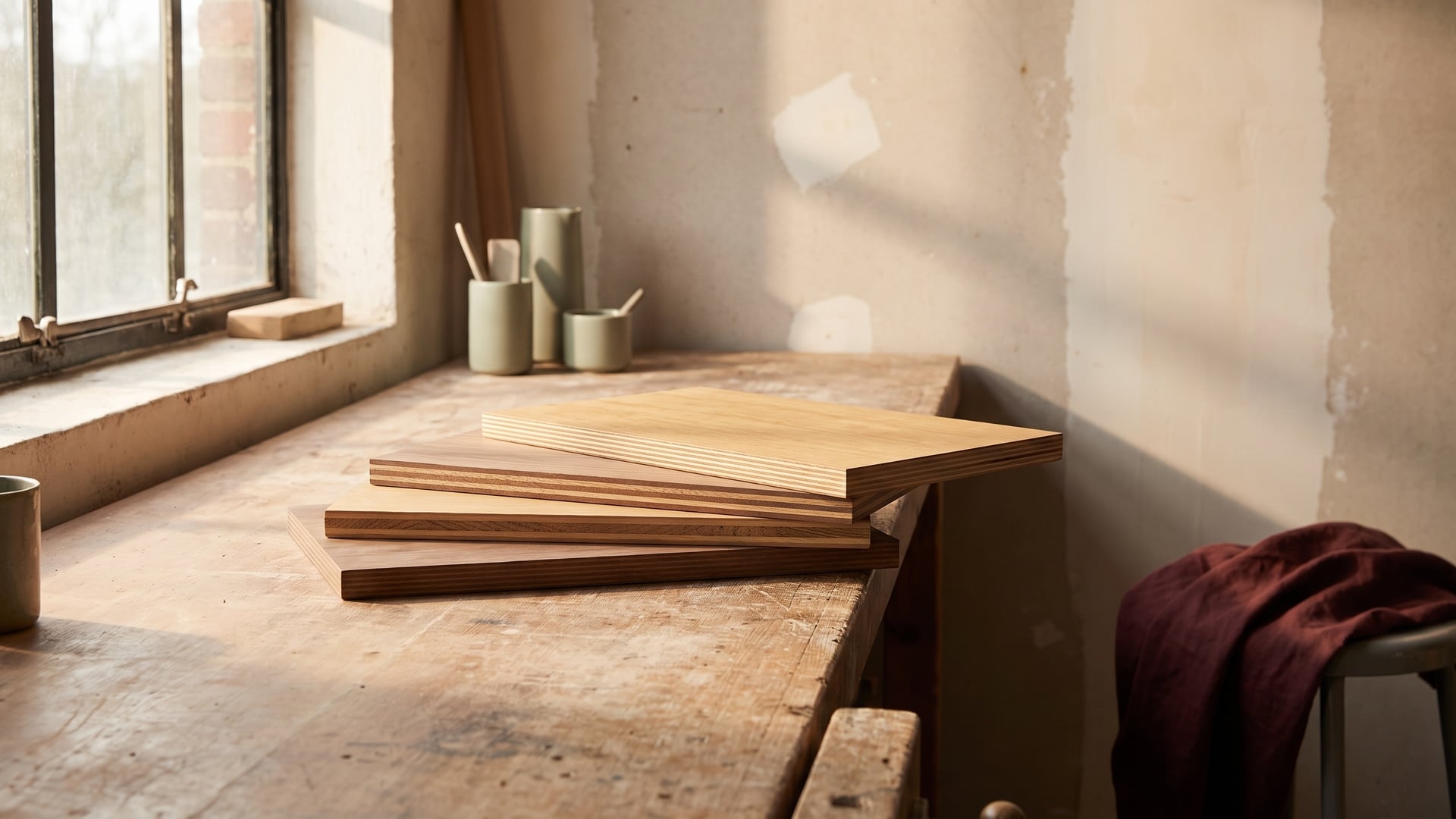
- A robust core and an honest adhesive. A full hardwood core with few gaps or overlaps, bonded with a quality resin that resists delamination through India's relentless wet-and-dry cycles, is what carries the screws and holds the shape for decades. The core you cannot see is doing most of the work.
- A finish that survives daily life. Scratches, stains, heat marks and ultraviolet fade age a surface cosmetically long before it fails structurally. A hard-wearing laminate or a well-chosen finish keeps a panel looking new long enough that nobody is tempted to rip it out.
- Repairability. The most durable surfaces are the ones that can be brought back rather than binned when they finally show their years.
That last point is where natural materials quietly win. A real-wood veneer or a solid timber edge can be sanded, re-oiled or re-polished, and a decade of scuffs disappears for the cost of a little labour and finish. A tired panel becomes a fresh one without a single new board being made or an old one sent to landfill. A material you can repair has several lives folded into one, and each life you unlock is a replacement cycle that never has to happen.
The two ways a surface dies
A surface can reach the end of its life in two quite different ways, and durable construction only answers one of them. The first is physical failure: it swells, delaminates, sags on its hinges, or the finish wears through to the substrate. The second, and in practice the more common cause of a perfectly sound wardrobe ending up on the pavement, is aesthetic fatigue — the joinery still works flawlessly, but the colour, the gloss or the pattern now feels dated, and it is torn out for looking old rather than for being old. Both send a board to landfill; both restart the full cycle.
Sturdy construction defeats the first; restraint defeats the second. A surface bought in whatever finish shouts loudest this season has a short life in the mind whatever its physical strength, while quieter, timeless choices — natural wood tones, calm neutrals, honest materials — stay wearable across decades and shifting tastes. The most sustainable specification is frequently the least fashionable one: the finish you will not be quietly embarrassed by in fifteen years. Pair a long-lived material with a long-lived look and you have closed both exits to the skip at once.
The false economy of the cheapest board
There is always a cheaper sheet. It looks near enough identical on the rack, shaves a comforting amount off the estimate, and asks you to believe the difference is only a brand premium. Sometimes it is. Often it is the core, the adhesive or the grade — precisely the things that decide how many years the board will give you. The saving is real at the counter and largely imaginary over the life of the room.
This is where the Indian reality bites hardest. Because so much of our best joinery is built in — the modular kitchen carcass, the full-height wardrobe, the panelled wall bolted to the structure — the cost of a premature failure is never merely the price of a replacement board. It is the demolition of the old unit, a room turned into a worksite, the carpenter and the hardware paid for a second time, and the days a kitchen or bedroom spends out of use. A board chosen to save a little at purchase, if it gives up early, is repaid many times over — and every one of those repayments is also an environmental cycle you did not have to run. Cheap-and-often is the most expensive way to furnish a home and the least sustainable; buy-once-well is, over a decade, both greener and cheaper. Here the two goals are not in tension. They are the same decision.
Durability and responsible sourcing pull the same way
None of this argues against green credentials; it argues for putting them in the right order. Longevity and responsible manufacture are not rivals — they compound. A board responsibly sourced from well-managed plantation timber, pressed with low-emission adhesives so the indoor air stays healthy, and then lasting twenty years is the best of both worlds: the fibre was grown with care, your family breathes easier, and that whole conscientious footprint is spread thin across decades instead of years.
The worst outcome, by contrast, is the virtuous-looking board that fails early, because you pay the full cost of replacing it however green the label was. So the right sequence is: build it to last first, then make certain that long-lived thing is also responsibly made and healthy to live with. Sourcing and emissions decide how clean each cycle is; durability decides how many cycles you run — you want both, few cycles and each of them clean. A traceable manufacturer willing to state the grade, back it with a written warranty and stand behind it years later is part of what turns durability from a promise into something you can rely on.
A durability checklist
Before you commit a surface to a decade or two of service, a short set of checks will tell you whether you are buying longevity or merely hoping for it:
- Match the grade to the exposure — boiling-waterproof for wet zones, moisture-resistant for dry ones — so nothing is set up to fail early.
- Confirm a full hardwood core and a quality adhesive; read the edge for a dense core and darker, well-bonded glue lines.
- Choose a finish rated for its duty — scratch, stain, heat and UV resistance wherever the surface will be handled hard or sits in sunlight.
- Prefer materials you can repair — real-wood veneers and solid edges that can be sanded and refinished rather than thrown away.
- Favour timeless colours and finishes you will still happily accept in fifteen years, not this season's statement pattern.
- Insist on the ISI mark and the correct IS number for the grade, plus a written warranty from a maker you can trace.
- Detail it to last: sealed edges, waterproof joints in wet areas, and treated stock even in the hidden backs and bottoms.
- Then keep it — maintain and repair as the default, replace only as the last resort, and judge every surface by the years it serves.
Buy once, buy well, keep it for a decade
Sustainability in a home is usually sold to us as a series of small subtractions — a little less carbon here, a slightly cleaner adhesive there. Those subtractions are worth making. But the largest single thing you can do for the environment with a sheet of plywood is dull: choose it well enough that you never think about it again. A surface fitted once and kept for a decade or two has quietly avoided every raw material, every unit of factory energy, every truck and every landfill run that its replacements would have demanded. That is not a slogan you take on faith; it is subtraction you can count, cycle by avoided cycle.
So buy once, buy well, and keep it for a decade and then some. Match the grade to the room, insist on the core and finish that will go the distance, choose a look you will not tire of, and repair rather than replace when the years finally show. The most sustainable surface really is the one you never replace — and the second most sustainable is the one you refinish instead of tearing out. Nearly everything else, however green the label, is a cycle you are about to pay for all over again.