Few words in the plywood aisle carry as much quiet authority as marine. It calls up boats and salt spray, monsoons shrugged off, a panel built to outlast the building around it. That reputation is largely deserved — genuine marine-grade plywood is a superb material. But reputation is exactly why it is so often bought for the wrong job: fitted behind a dry wardrobe, under a study table, or into a living-room television unit that will never meet a drop of standing water. The most impressive word on the label quietly becomes the default choice, and the budget absorbs the difference without ever being asked whether the water was going to arrive.
Our advice, as a manufacturer rather than a showroom, is simple: buy for the exposure the panel will actually face. Marine grade is not a luxury upgrade to be sprinkled across a whole house; it is a precise answer to one problem — sustained wetting. Knowing what makes a board marine-grade, and where a certified boiling-water-resistant board does the same job for less, is the difference between a specification that is genuinely robust and one that is merely expensive. This guide sets out where marine earns its keep, where it does not, how the grades really relate to one another, and how to be sure that whatever you buy is the real thing.
What actually makes a plywood marine-grade
Marine plywood is defined less by any single feature than by the discipline applied at every stage of its making. In India it is governed by IS:710, the standard for marine plywood, and a board that genuinely meets it differs from ordinary ply in ways you can often see at the edge and always feel in the hand.
- Superior face and core veneers — denser, better-graded timber laid with minimal gaps, overlaps or voids in the inner plies, so there are few hollow channels for water to travel along.
- The highest-performance waterproof adhesive — a boiling-water-proof (BWP) phenol-formaldehyde resin that holds the plies together through prolonged heat and moisture, rather than the moisture-resistant glue used in interior boards.
- The boiling-water test — the signature of IS:710. Samples are boiled continuously for a prolonged, standard-specified period (commonly cited as around 72 hours) and must emerge without the plies letting go: a far harsher trial than the gentle cold-water and humidity checks applied to interior grades.
- Resistance to micro-organisms — a mycological test and preservative treatment against the fungi, borer and termite that thrive in warm, damp conditions, so the board resists rot as well as delamination.
- Built for immersion, not merely humidity — the whole specification assumes the panel may sit genuinely wet for long stretches and still hold together.
Put plainly, marine grade is engineered to survive prolonged water exposure, high humidity and even sustained immersion. That is a real achievement — and also the clue to where it belongs, and where it is wasted.
The grade ladder, and the decision that actually matters
It helps to see the whole ladder rather than only its top rung. Much of the confusion in the market comes from treating the grades as a single spectrum on which “more waterproof” is always the safer buy. They are better read as different tools for different exposures.
- MR — moisture resistant (IS:303). A urea-formaldehyde-bonded interior board for dry, indoor use: wardrobes, bookshelves, television units and other furniture that meets only the humidity in the air, never liquid water.
- BWR — boiling water resistant (IS:303). A phenolic-bonded board that withstands a boiling-water cycle and everyday damp. This is the workhorse for most kitchen and wet-area cabinetry — genuinely waterproof-bonded, at a friendlier price than marine.
- BWP and marine (IS:710). The top grade. Here “marine”, “boiling water proof” and “710” all name the same thing — they are not three separate products. This is the board for sustained wetting, immersion and full exterior exposure.
The practical point is that the real decision for a wet room is rarely “marine or nothing”. It is almost always marine (IS:710) versus a certified BWR board (IS:303), and knowing which of the two a given job needs is precisely where money is saved or wasted.
Where marine plywood genuinely earns its cost
There are places where nothing else will do, and specifying marine there is not indulgence but sound engineering. Reach for IS:710 wherever a panel will be wetted repeatedly, stay wet for long periods, or face the open weather.
- Boat building and outdoor structures — the material's original purpose, where immersion and constant spray are the everyday condition, not the exception.
- Bathroom vanities and shower-adjacent joinery — cabinetry that lives in splash, steam and standing humidity day after day.
- Kitchen base units exposed to constant moisture — the sink cabinet above all, where drips, leaks and washing keep the carcass perpetually damp.
- Exterior doors and their frames — surfaces that meet driven rain on one face and dry air on the other, a punishing gradient that warps a lesser board.
- Pergolas, garden furniture and other outdoor woodwork — anything that must live outside through a full Indian summer and a full monsoon.
In each of these the panel meets water as a routine, not an accident. On the coast, where salt-laden air and months of high humidity work at joinery from every side, the case for marine in these specific locations is stronger still.
Where a certified BWR board is enough
Now the part that saves money. A great deal of what gets called “wet-area” cabinetry is not, in honest truth, wet — it is merely damp, briefly and occasionally. For most of it, a certified BWR board to IS:303 performs excellently and costs meaningfully less than marine.
- Most kitchen carcasses — the runs of base and wall units away from the sink, which meet cooking humidity and the occasional spill rather than standing water.
- Everyday wet-area cabinetry — utility storage, dry-balcony units and similar joinery that lives in damp air but never in immersion.
- Wardrobes and storage in humid or coastal homes — where the real concern is relentless ambient moisture, and a boiling-water-resistant bond is ample insurance.
This is not a compromise; it is correct specification. A well-made BWR board carries a proper phenolic bond and will serve for decades in these roles. Reserving true marine grade for genuine sustained-immersion and exterior work, and letting a certified BWR board handle the everyday cabinetry, is simply how a sensible budget is built — you spend the premium where water actually collects, not where it merely passes through the air.
Why certification matters more than the label
Here is the harder truth, and the reason a grade name alone should never decide a purchase: marine and BWR are each only as good as their certification. An uncertified sheet stamped “710” or “waterproof” may hide a cheaper adhesive, thin or gappy core veneers and no preservative treatment at all — while carrying a marine price. A genuine BWR board will outperform a counterfeit marine board every single time, because it is the bond, not the branding, that meets the water.
This is where a manufacturer's integrity does its quiet work. The resin, the veneers and the treatment all disappear from view the moment a panel is polished and fitted, so the certification and the maker behind it become your only real guarantees. It is one reason our One India · One Price commitment matters to us: the same specification, honestly graded, at the same price wherever in the country you buy it — so your decision rests on what the panel must endure, not on who is standing across the counter.
How to verify the grade
Whether you settle on marine or BWR, insist on evidence rather than assurances. A few checks separate a certified board from an optimistic sticker.
- Look for the ISI mark with the correct standard — IS:710 for marine, IS:303 for MR and BWR — printed with a licence number, not merely the letters “ISI” or a bare grade word.
- Read the board's own branding stamped on face and edge: a genuine sheet carries maker, grade, standard and batch details.
- Ask for the test certificate and warranty. A maker confident in the grade provides both without fuss; vague verbal claims are a warning in themselves.
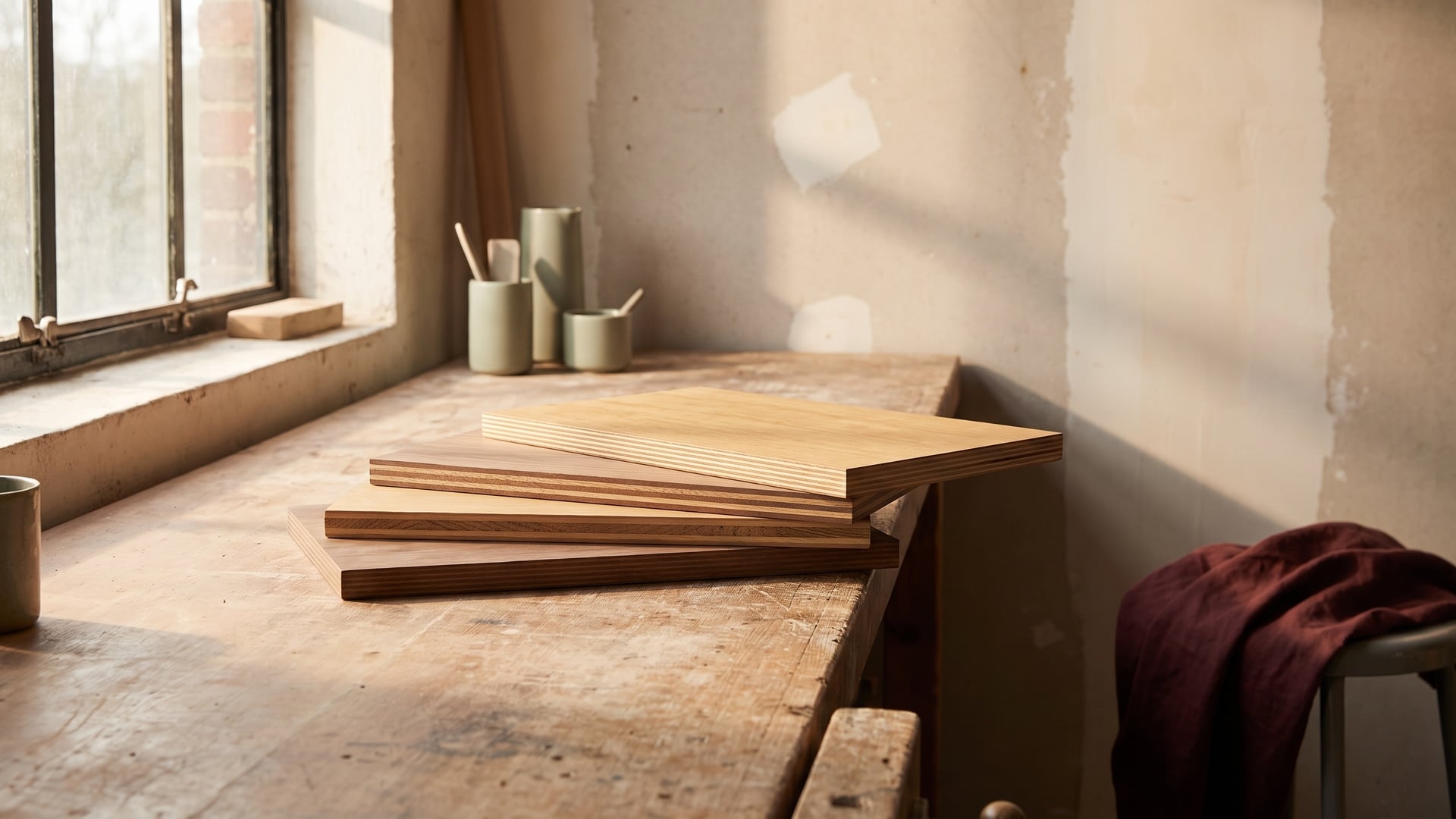
- Inspect the edge and core. Darker, reddish-brown to near-black glue lines point to phenolic resin; look too for a dense core with few internal gaps or voids, whatever the label promises.
- Feel the weight, then test an offcut. Well-made waterproof boards are noticeably heavy for their size; and a small piece boiled for a few hours should not delaminate, blister or open at the glue lines. A genuine board simply holds.
A decision guide: marine or BWR?
When the samples are in front of you and the quotation is due, this is the sequence we would use. Work down it and stop at the first line that fits the piece in hand.
- Will it ever be immersed, or stay wet for long stretches? Boats, the cabinet directly under a sink, permanently damp joinery — choose marine (IS:710).
- Is it outdoors or directly weather-exposed? Exterior doors, pergolas, garden furniture — choose marine (IS:710).
- Is it a bathroom vanity or shower-adjacent? Constant splash, steam and standing humidity — choose marine (IS:710).
- Is it kitchen or wet-area cabinetry that only gets damp, away from standing water? Most carcasses and everyday units — a certified BWR board (IS:303) is enough.
- Is it dry indoor furniture — wardrobes, shelving, television units? An MR board (IS:303) is the honest, economical choice; marine here buys reputation, not performance.
If two lines seem to apply, specify for the wetter one — but resist the reflex to push everything to marine “just to be safe”. In specification, safety means matching the board to the exposure, not overpaying across the board and calling it caution.
Buy for the exposure, not the label
Marine plywood deserves its reputation. Where a panel will be immersed, weathered or kept genuinely wet — a boat, an exterior door, a bathroom vanity, the cabinet beneath a busy sink — IS:710 is exactly the right tool, and worth every rupee it costs. The mistake is to read that reputation as a reason to fit marine everywhere, when most of a home's joinery will never meet more than warm, humid air and the occasional spill.
So read the exposure first, and let it choose the grade. Reserve true marine for sustained immersion and exterior work; let a certified BWR board carry the everyday wet-area cabinetry; keep dry interior furniture on a sound MR board; and insist that whatever you choose is genuinely certified, because a real BWR board beats a counterfeit marine one every time. Do that, and your specification will be robust where it must be, economical where it can be, and honest all the way through — which, in a monsoon climate, is exactly what good plywood should be.